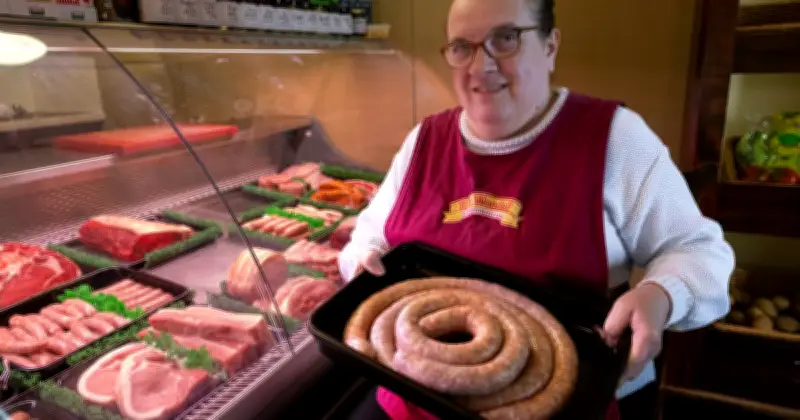
RB Woodall, the family-run butchers in Waberthwaite, Cumbria, that supplied sausages to Buckingham Palace for decades, could close within a year as rising costs threaten its future. The shop, founded by Hannah Woodall in 1838, has produced traditional Cumberland sausages for almost 200 years, and now seventh-generation descendant Joyce Hadwin and her husband Alistair are weighing up whether to shut up shop if the outlook does not improve.
A Royal Connection
The business holds Protected Geographical Indication (PGI) status for its products, which still follow the original recipe: coarsely chopped pork, seasoned with a top-secret spice mix and shaped in the region's signature continuous curl. The style is said to owe much to spices arriving through the nearby port of Whitehaven in the 18th century.
Since Hannah first started curing pork to support her family, the products have supplied early Mount Everest summit expeditions, featured on the Titanic's menu in 1912 and been served at Buckingham Palace. The royal connection was official for decades, with the firm holding a royal warrant from 1990 until Queen Elizabeth II's death in 2022.
Joyce said it began at the Lowther horse driving trials, where the business had a tent. "The Duke of Edinburgh used to come down, and he walked past once," she said. "He just had a bit of a browse then carried on, and we thought, 'He's obviously not interested'. But then he sent someone back to buy some sausage. And we provided the Palace with various things over the years afterwards: sausages, ham, pancetta."
"The Queen came down another year, and she had a look at our stall and said, 'Oh, these are the ones we get, aren't they?'" she added. "It was lovely to hear." Prince Philip's fondness for the products was such that the shop kept traditionally cured bacon with an 'R' label on hand at all times, in case a call came for more.
Rising Costs and a Smaller Operation
But even royal custom could not shield the business from rising costs. Around 2010, citing rising pork, haulage and feed prices, the family sold the original Richard Woodall trade name and traditional bacon recipes to the firm Cranswick Foods. A herd of pigs was also sold off, and the firm was relaunched under its current name as a much smaller operation, cutting the team from 35 to six people and focusing on the local area.
The staff include Joyce and Alistair's son Stephen, 33, and daughter-in-law Natalie, 31, while grandchildren Toby, 10, and Eve, 8, dart around the shop floor playing games after school. Joyce, who has worked in the shop since she was 16, has watched the trade change. The business, which also functions as a Post Office and adjoins an in-house butchery, was once a lifeline for the surrounding area.
"I've seen a lot of change," she said. "We used to go out in a van, delivering groceries to lots of people. There was a real reliance on us to feed them. At our peak, we were going as far as Newcastle. But now, our main trade is supplying hotels, guesthouses and retailers in Cumbria."
An Uncertain Future
Tourists remain a reliable source of income. In the peak summer season, Alistair produces around 400 kilograms of sausage and 400 kilograms of bacon a week. But Joyce says many locals now opt for cheaper supermarket meat, which is often sourced from abroad, and wholesalers selling similar products add to the competition. RB Woodall's traditional Cumberland sausage is priced at around £11.35 per kilogram, compared to an average of as little as £2.49 on UK supermarket shelves.
The Hadwins say they have run out of ways to cut costs. "We've done all that we can," Joyce said. "We made lots of changes, including upgrading our equipment and investing in a computerised sausage machine. We also started supplying Tebay Services on the M6 around the lockdown period. Doing that saved us from a real existential crisis, but costs just keep going up, and the situation is looking worse and worse."
Like many small business owners, they have slashed their own wages, but don't relish passing that burden on to the next generation. "We just take enough to cover our basic expenses, bills and such," Joyce said. "The other staff get a good wage, but you have to make sacrifices if you want it to keep going. It's a lot to take on. I think how we do next January, February and March, which is usually our quiet period, will tell us whether it's worthwhile to continue or not."
The shop is now one of only a handful of butchers in the UK making traditional Cumberland sausages. Joyce believes the quality is what customers are paying for, and that they may not realise what they stand to lose. "You want to save money where you can, but we do pay extra for the quality that we buy," she said. "It's the pure satisfaction of providing high-quality food. It's a struggle, because I do believe that if more people knew the difference between good, local meat and cheap cuts from abroad, they would think it's worth the price gap."
For now, the Hadwins are taking stock. "It's great to think back on all the years we've had, all the things our family has achieved," Joyce said. "It isn't an easy world to be in at the moment, as any kind of business owner. But we've accomplished a lot. And we'll carry on for as long as we're able to."