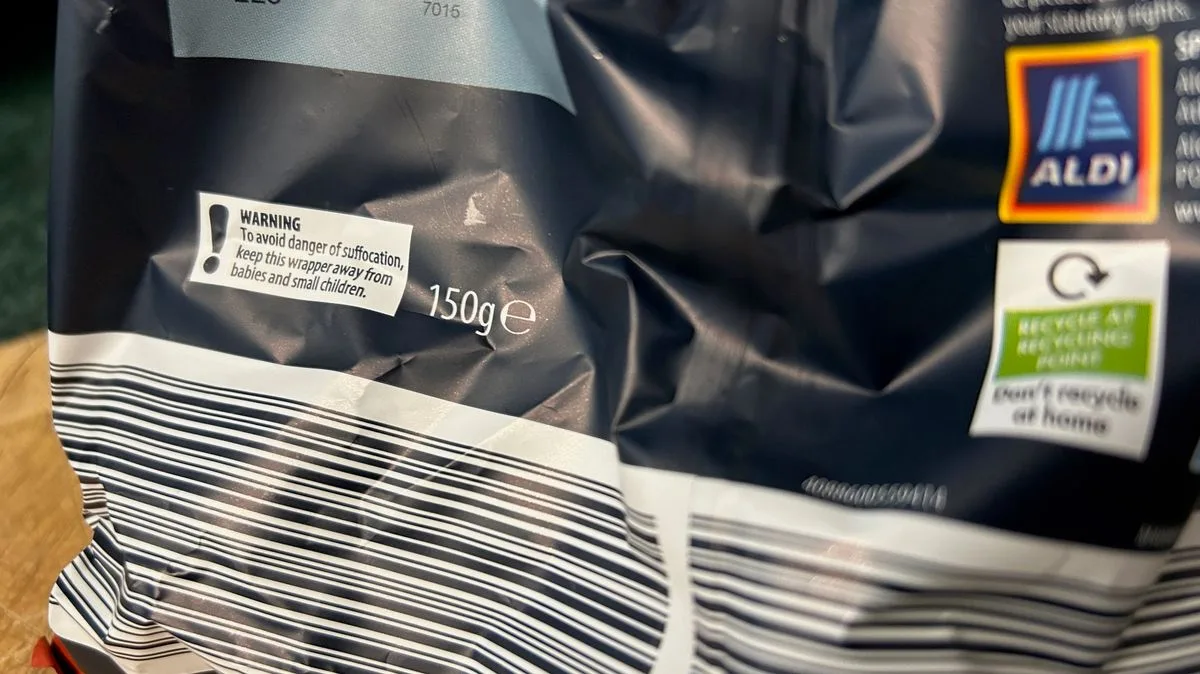
Sharp-eyed shoppers in Australia have expressed dismay after discovering the true meaning of the 'e' symbol on food packaging, which indicates that the stated weight or volume is only an average. The revelation came when a Canberra mother weighed a 230g bag of crisps from Aldi and found it contained just 139g of crisps, with the rest being air.
The shopper shared her findings on Facebook, sparking a wave of complaints. She detailed her experiment: placing the whole bag on scales showed 157g, but the crisps alone weighed 139g, far short of the advertised 230g. Many commenters were shocked, with one noting that even though the 'e' mark allows for minor variations, a discrepancy of nearly 100g was "massive."
The 'e' mark signifies compliance with the Average Quantity System (AQS), an internationally agreed method ensuring pre-packed goods have a constant nominal content but allow for slight variations. According to the Department of Industry, Science and Resources, no pre-packaged article can have a shortfall greater than 5% of the stated quantity. However, in this case, the shortfall was approximately 40%, far exceeding that limit.
EU regulations also require the 'e' mark on products to show compliance with relevant European laws. While the system aims to protect consumers, many shoppers feel misled. One Australian user wrote: "Not getting what you pay for is a joke and being so far off the 'e' weight is just ridiculous."
The incident has renewed calls for clearer labelling, as consumers struggle to decipher symbols that can allow for significant discrepancies between stated and actual contents.