

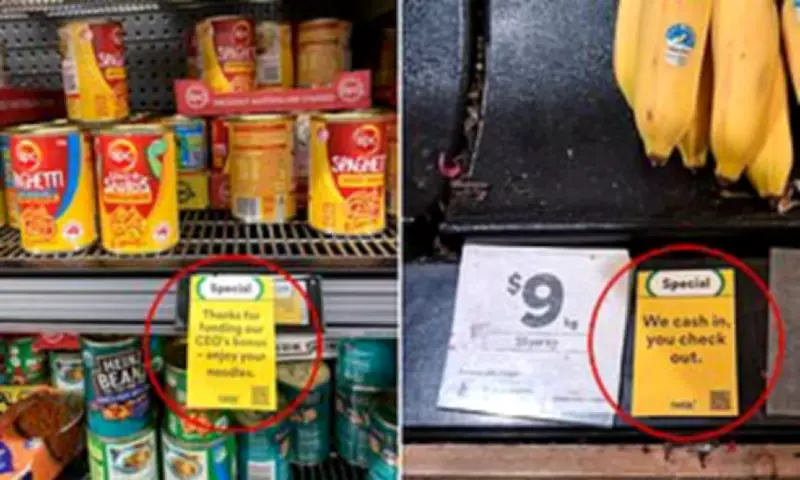
Shoppers across Australia have launched a grassroots protest against supermarket giants Coles and Woolworths, amid escalating claims of price gouging that are turning everyday grocery staples into luxury items for many households. The Australian Competition and Consumer Commission (ACCC) is pursuing significant penalties for alleged breaches of promotional campaigns, including Woolworths' 'prices dropped' and Coles' 'Down Down' initiatives, spanning a contentious 15-month period from late 2021 to early 2023.
Creative Consumer Backlash
In a bold and ironic response to the alleged price-gouging, frustrated customers have taken to placing tongue-in-cheek replicas of the supermarkets' own promotional flyers directly on store shelves. These protest stickers carry biting messages that highlight corporate profits and consumer struggles. One sticker, positioned above packs of instant noodles, reads: 'Thanks for funding our CEO's bonus - enjoy your noodles.' Another starkly declares: 'Over $1billion in profit - thanks to record-high prices,' while a third quips: 'We cash in, you check out.'
Voices of Financial Strain
After images of these protest flyers circulated on Reddit, Australians flooded the comments with personal accounts of hardship, detailing their difficulties in affording basic necessities. One individual lamented, 'I am eating the absolute cheapest things I can find. Cereal, beans, pasta. Even fruit feels like a luxury now. Bread and butter, an extravagant treat.' Another reminisced, 'Can anyone remember the days when we used a trolley and filled it with food? Nowadays, I buy what I can carry and fill one bag, tops.'

A third shopper expressed frustration over rising costs, stating, 'I look at my trolley and there's only about five or six items and it still costs me $80 for everything each week!' Further illustrating the financial pinch, another person noted they typically spend $300 weekly for two people, covering weekday needs but requiring additional weekend trips for ingredients. They added, 'I'm now earning more money than I ever have, yet for the first time I have to quite religiously stick to a budget to have the same lifestyle I did five to 10 years ago on considerably less money.' The struggle extends to families, with one parent sharing, 'I have a one-year-old who has just discovered she likes berries. Pray for me.'
Organised Outcry and Corporate Response
Paul Ferris, chief executive of GetUp!, informed Daily Mail that thousands of shoppers have been submitting photos of their local protests at Coles or Woolworths stores. He asserted, 'Supermarket giants are making eye-watering profits while Aussies struggle to afford the basics. These corporations have been caught red-handed with sneaky tricks like "shrinkflation" and fake "discounts" that actually hike costs.' Ferris emphasised, 'The strong response to the campaign from our members shows the incredible and growing frustration.'
Daily Mail has reached out to both Coles and Woolworths for comment on these allegations. Meanwhile, a 12-month inquiry by the ACCC, concluded last year, revealed that Coles and Woolworths had increased their profit margins in recent years. The report highlighted average profit rises as high as 43 percent for potatoes, 38 percent for cucumbers, and 35 percent for bananas, with suppliers often left in a weak bargaining position.
Market Competition Concerns
The ACCC's report, released in March, identified far less competition in Australia compared to overseas markets, describing the supermarket sector as 'oligopolistic.' It stated, 'Coles and Woolworths have limited incentive to compete vigorously with each other on price. We have not observed Coles and Woolworths seeking to substantially discount prices below each other in aggregate.' However, the ACCC stopped short of labelling the situation a duopoly or deeming grocery prices 'excessive,' and did not attribute the broader cost-of-living crisis solely to the supermarket giants.

Legal Battles and Defences
Coles is currently embroiled in legal proceedings over claims that it misled customers by artificially inflating prices before reducing them and promoting the reductions as discounts. The supermarket has defended its 'down down' campaign, arguing that grocery shoppers understand these represent 'fair dinkum' price reductions. The case continues before Justice Michael O'Bryan, underscoring the ongoing scrutiny of supermarket practices in Australia.





