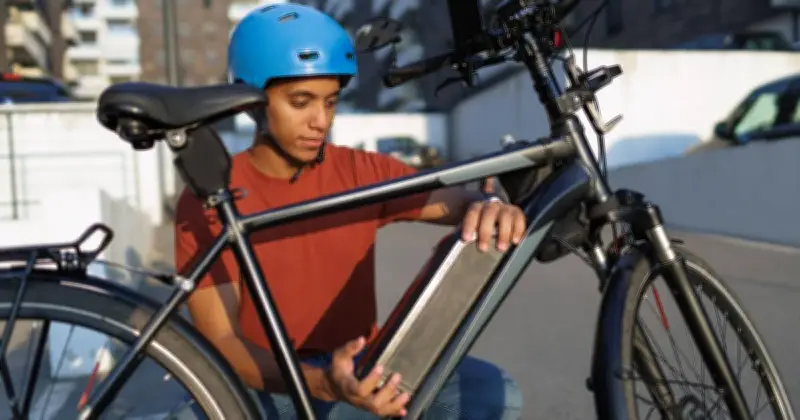
The Office for Product Safety and Standards (OPSS) has issued a safety alert to e-bike users over lithium-ion battery fire risks and illegal conversion kits, urging riders to inspect their batteries and comply with strict speed limits.
The updated guidance, released by the UK Government agency, is primarily directed at manufacturers and retailers, but officials have also cautioned the public about the dangers of fire and breaking the law on public roads. The agency warns that converted e-bikes carry a significantly higher fire risk than factory-built models.
Fire risk from incompatible parts
This hazard frequently arises when riders purchase components separately and combine batteries and chargers with mismatched voltage ratings. Mixing incompatible parts can cause lithium-ion batteries to overheat, explode, or ignite.
A statement on Gov.uk reads: "Converted e-bikes may pose a greater fire risk as they are formed following the installation of an e-bike conversion kit, or separately sourced parts combined to provide the same electrical assist function, to a pedal bike."
The statement adds: "Growing evidence from stakeholders, including fire and rescue services, and research commissioned by OPSS, points to incompatible products, such as batteries and chargers with mismatched voltage ratings, being more likely to fail when used together, and potentially lead to explosion or fire."
Safety advice for riders
To remain safe, riders are encouraged to adhere to the Government's Buy Safe, Be Safe guidance. Consumers should only purchase conversion kits from reputable retailers that offer clear instructions regarding which bike frames are suitable for conversion.
Riders are additionally cautioned never to leave e-bike batteries charging overnight or unsupervised. People should also store bikes away from hallways and fire exits in the home.
Legal requirements on UK roads
Alongside the fire hazards, the announcement reminds riders of the stringent legal requirements for riding e-bikes on UK roads. While the latest guidance does not introduce new legislation, it makes clear that existing restrictions will be rigorously enforced.
To ride an e-bike or converted bicycle on public roads and cycle paths without a licence, tax, or insurance, the motor must not exceed 250 watts of power. It must also cease providing electrical assistance once the bike hits 15.5 mph, and it must only offer support while the rider is pedalling.
Gov.uk states: "Once installed, kits that enable a continuous rated power output above 250 watts and/or speeds above 15.5mph create a motor vehicle which is illegal to use on the road and public land, unless it meets the normal motor vehicle laws that apply to electric motorcycles."
Conversion kits that permit a bicycle to travel in excess of 15.5 mph, or move without pedalling above walking pace, are prohibited on public roads unless the bike is registered as a moped or motorcycle. Riding an unlawfully converted bike on the road can result in prosecution, fines, and seizure of the bike by police.