
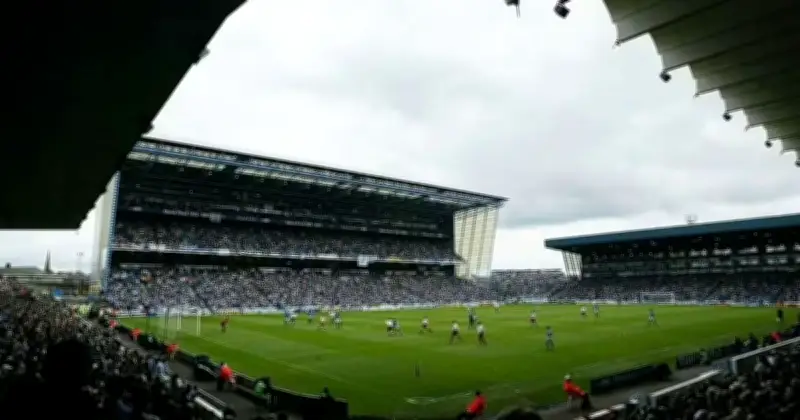
Maine Road, the stadium that was home to Manchester City for 80 years, was demolished and replaced with hundreds of new homes. The ground opened in 1923 and was torn down between 2003 and 2004.
History and construction
Plans for the stadium were first announced in 1922 after Manchester City decided to leave Hyde Road. The club felt their old ground could no longer be expanded, and a fire had badly damaged its main stand two years earlier. A site in Moss Side, Manchester, was chosen, and construction took around 300 days.
The first match at Maine Road was played on August 25, 1923, when Manchester City beat Sheffield United 2-1 in front of a crowd of more than 58,000. Over the following decades, the stadium became one of the most famous grounds in English football, hosting FA Cup semi-finals, England matches, the Charity Shield, and a League Cup final.
Record attendance
Maine Road holds a record that still stands today. In 1934, a crowd of 84,569 watched Manchester City take on Stoke City in the FA Cup. It remains the highest attendance recorded for a match at an English club ground. Even Manchester United used Maine Road between 1945 and 1949 after Old Trafford was damaged during the Manchester Blitz.
Redevelopment and closure
Over the years, the ground was redeveloped several times. New stands were added and old terraces were replaced as football moved towards all-seater stadiums following the Taylor Report. By the time it closed, Maine Road had a capacity of just over 35,000.
Manchester City played their final match at the stadium on May 11, 2003, against Southampton. The club had decided to move to the City of Manchester Stadium (now known as the Etihad Stadium), which had been built for the 2002 Commonwealth Games. Following City's departure, demolition work began later that year and took around 10 months to complete.
Housing development
There was some discussion about other sports teams using the stadium, but no plans went ahead. In 2005, permission was granted for a major housing development on the site. A total of 474 homes were built where the ground once stood. The development became known as Maine Place and includes a public art display marking the location of the old stadium. There is also a green space that marks the former centre spot of the pitch.




