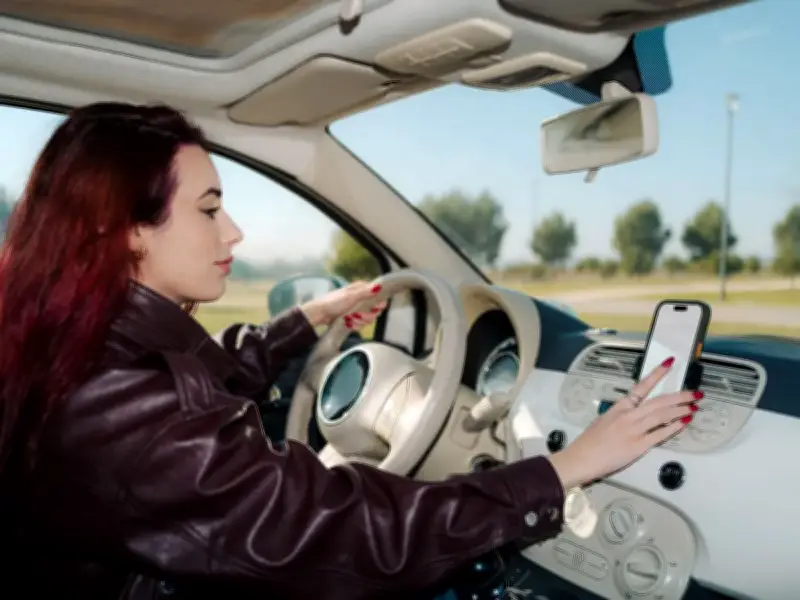
A barrister has clarified that it is technically legal to touch a phone while driving if it is securely mounted in a holder, but significant caveats apply. The explanation comes amid widespread confusion over the rules governing phone use behind the wheel.
Legal basis for phone use in holders
Barrister Daniel J. ShenSmith says the relevant legislation is the Road Vehicles (Construction and Use) Regulations 1986, specifically an amendment inserting regulation 110. The law is found in section F, "Avoidance of danger", where section F7 defines "using" a phone, covering actions such as illuminating the screen, unlocking it, and making calls.
Daniel said: "The short version is technically, yes, it is legal to touch your phone so long as it is securely mounted in a cradle and if you liken this to the screen on a Tesla, and you were to answer a call in a Tesla by pressing the button."

"You are not breaking the law for many reasons, but first of all, it is not handheld, and if you just press the button to answer the call, you're not likely to be distracted, but all of this comes with the big caveat."
Caveats to the legislation
In a video for his BlackBeltBarrister YouTube channel, Daniel explains that regardless of whether the regulation is breached, a driver could still be "held to be" driving without due care and attention. They could also be found to have driven carelessly or dangerously if phone use distracted them "sufficiently" to cause a collision involving serious injury or death.
Two caveats are noted in the legislation: contactless payment, which requires the vehicle to be stationary and the delivery to be immediate, and "genuine" emergencies.
Defining "use"
As for the term "use", it applies when the "thing is in your hand". Above F7, the regulation reads: "For the purposes of this regulation—a mobile telephone or other device is to be treated as hand-held if it is, or must be, held at some point [while being used]."
Daniel points out that the wording "treated as hand-held if it is, or must be, held at some point" remains unchanged, and it does not include holders. He said: "So, if it must be in your hand to do whatever it is you're doing, then it's caught by the regulations. It does not say that, you know, if it's in a cradle and you press a button."
"That's not what it says because if it's in a cradle and you can press a button to answer the call, or if it's a Tesla screen and you can press a button to answer the call, it is not, and it does not have to be in your hand to carry out that function, and that is not what the regulations say."
Highway Code and car screens
Rule 149 of the Highway Code, "Mobile phones and in-vehicle technology", states that motorists "MUST exercise proper control" of their vehicles at all times. It also says you "MUST NOT use a hand-held mobile phone, or similar device, capable of interactive communication (such as a tablet) for any purpose when driving or when supervising a learner driver".
The rule also prohibits picking up a phone while driving to dial a number before placing it in a holder, and picking up or using a phone while stationary in traffic.
Regarding modern car screens, Daniel says using a screen is "wiped out even if it is legal to use it" under the rule if the driver is not exercising proper control of the vehicle at all times. He points to the explanatory note: "So the keyword in there is 'held in the hand'. If it is in a cradle, it is not held in the hand."
"Now, if at some point this comes to court and the court says, 'Well, we're going to interpret it even more narrowly and say it's in the hand even if it's in a cradle - which I don't think it would - then that would change things, but that is not the meaning of the words."
Government guidance and advice
Guidance on the UK Government website states that drivers "can use devices" with hands-free access, provided they "do not hold them at any time during usage", including via voice command, dashboard holders, mats, and windscreen mounts.

Summing up, Daniel advises people to only use their phones as sat navs. If they do use it as a phone, they should only "press a button to answer it and press a button to end it". He added that it is best not to dial for calls, even if the phone is in a holder, as doing so would cross the threshold into not driving with due care and attention.