
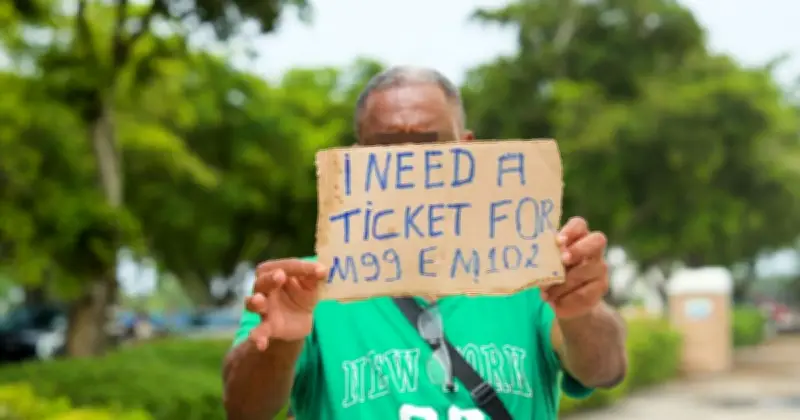
An Express investigation has exposed organised ticket touting gangs operating outside World Cup stadiums in the United States, with fans blaming FIFA for enabling a 'Wild West' secondary market that has seen ticket prices soar to up to £25,000 per seat. The final between Spain and Argentina on Sunday is expected to generate an estimated half-billion dollars for resellers, as touts exploit legal secondhand markets to extort thousands from ordinary fans.
Gangs Target Fans Outside Stadiums
Our reporting team observed groups posing as ticketless supporters working together to buy spare tickets from unsuspecting punters, then reselling them on the secondary market for vast profits. At the Miami Stadium before England's game against Norway, a gang of Brazilian touts attacked our team when we approached them to ask questions. The group's ringleader ran at our videographer with a clenched fist, attempted to grab the camera, and threatened to 'call the police' after his cronies were caught on camera asking fans to 'buy or sell tickets.'
Before the England versus Argentina semi-final, we found a man with a laminated 'I need tickets' poster working with another tout to buy tickets at a rate that would give him a $5,500 (around £4,000) profit. When approached, he fled and was labelled a 'fraud' by a passing Three Lions fan.
Ticket Prices Skyrocket
Ticket prices for the final at the New York/New Jersey Stadium ranged from $8,000 (around £5,950) to $30,000 (around £22,300) per seat on the secondary market, at least three times their face value. One older England fan who paid $24,000 (around £17,800) for him and his son to attend two games told the Express: 'There's already a level of touting going on through official channels and the prices are just on a level that I'd never seen before. I've been to Russia, France, Germany, all the World Cups, and these are like ten times what I've ever paid for tickets before. It cost me $6,000 to be behind the goal at the Azteca for England versus Mexico.'
An Argentine fan attempting to buy tickets outside the stadium for friends added: 'It sucks, man. I paid $2,000, and the face value was $305. You can make some profit, but 200-300%? Come on.'
Expert Blames Cultural Differences
Football finance expert Kieran Maguire of the University of Liverpool described the situation as 'the Wild West.' He suggested that European fans' revulsion is driven by contrasting approaches to major sporting events. 'I think culturally it's different,' he told the Express. 'Our views are inconsistent with the way it's done in the United States. Typically, if I've got a season ticket for an NBA team, I'd go and watch four or five matches myself, sell the others off and make a huge profit. Nobody has any resentment towards it because that's the American dream—it's all about the Benjamins. Are we the outliers in that we're not fitting in with American culture? FIFA has embraced it because it's financially beneficial.'
Maguire also pointed to the outsourcing of ticket harvesting to low-wage workers in countries like Vietnam and Cambodia, comparing it to practices in the computer game industry. 'It's part of an underworld that we choose not to engage until it affects us in a product as high-profile and as meaningful to us—as European football fans—as the World Cup.'
Fan Groups Condemn FIFA
Fan group Football Supporters Europe described the 'extortionate ticket prices' as a 'monumental betrayal of the tradition of the World Cup.' The group filed a lawsuit with the European Commission in March to force FIFA to lower prices. FIFA President Gianni Infantino has previously defended secondary-market prices, arguing that it is better for resale money to go to national associations rather than black market activities. 'If you sell it at a lower price point, in this particular market it would have gone—which is perfectly legal in the USA on secondary markets at much, much higher prices—and where would the money go then? Well, to those who organise secondary markets or black market activities and not to football,' he said at a press conference earlier this month. FIFA has been contacted for further comment.




