

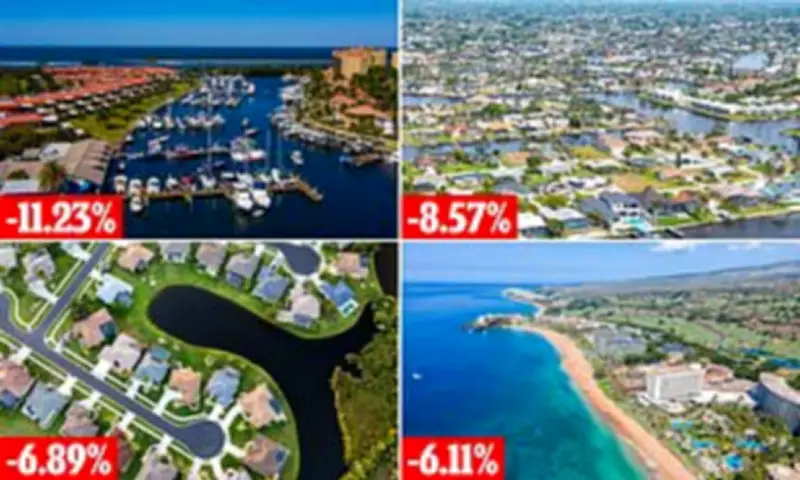
Home prices are currently declining in approximately one-third of major US housing markets, according to fresh analysis, indicating that the prolonged property boom may be losing momentum. Based on an examination of the Zillow Home Value Index, national house price growth has decelerated significantly over the past year.
Sharp Slowdown in National Growth
Between January 2025 and January 2026, prices increased by a mere 0.4 percent, a stark drop from the 2.1 percent growth recorded during the previous year. Although the market experienced a brief dip into negative territory in mid-2025, it has since stabilised, suggesting the most severe phase of the slowdown could be over.
Expanding Local Declines
Simultaneously, a growing proportion of local housing markets has entered a downturn. In early 2025, only about 10 percent of the 300 largest metropolitan areas were witnessing year-on-year falls. This figure rose rapidly through the first half of the year, reaching a peak of 36 percent by June and July 2025, before levelling off.

By early 2026, around 99 markets—roughly one-third—continued to see prices drop, indicating that while the downturn has spread, it is no longer accelerating.
Weakest-Performing Regions
The locations suffering the steepest declines follow a distinct pattern, concentrated in pandemic boom areas such as Florida, Texas, and parts of the Mountain West. Topping the list is Punta Gorda, Florida, where prices fell by 11.23 percent between February 2025 and February 2026.
Now, prices have further decreased by 12.4 percent, with the average house price there standing at $332,468. Cape Coral, with an 8.57 percent decline, and North Port, down 6.89 percent, also rank among the most significant drops, alongside Kahului-Wailuku-Lahaina in Hawaii, which saw a 6.11 percent fall.
These regions experienced rapid price growth during the pandemic and are now correcting as demand cools and inventory rises.
Moderate Declines and Gradual Rebalancing
A second tier of markets, including Asheville, North Carolina, Stockton, California, and Tampa, Florida, has encountered more moderate declines of around 4 percent, reflecting a more gradual rebalancing between buyers and sellers. Increased housing supply and persistently high mortgage rates are compelling sellers in these areas to reduce prices to secure transactions.
Smaller Declines and Resilient Markets
Further down the rankings, markets such as Daytona Beach and Homosassa Springs in Florida, as well as Denver, Colorado, are posting smaller declines of approximately 3 percent. The markets experiencing the smallest year-over-year price reductions are scattered across the country, with decreases barely noticeable in some locales.
At the low end, Eugene-Springfield, Oregon saw virtually no change at −0.01 percent, followed by Pensacola-Ferry Pass-Brent, Florida at −0.07 percent and Urban Honolulu, Hawaii at −0.10 percent.
Other resilient markets include Tallahassee, Florida (−0.19 percent), Memphis, Tennessee-Mississippi-Arkansas (−0.18 percent), and Flagstaff, Arizona (−0.29 percent). In California, Bakersfield witnessed a modest drop of −0.48 percent, while Reno, Nevada and Shreveport-Bossier City, Louisiana each fell just under half a percent.
Pockets of Stability Amid Cooling Trend
Overall, these smaller declines highlight pockets of stability amid the broader cooling trend across the US housing market. The data demonstrates that many cities in the Northeast and Midwest also remain relatively resilient, largely due to tighter housing supply, which continues to support prices despite weaker demand.
A 'Split' Housing Market Emerges
The overall picture is of a 'split' housing market. National price growth has slowed to near flat, but local conditions vary widely. For buyers and investors, the key takeaway is that the US is no longer a single, unified housing market, but a patchwork of regional trends shaped by supply, demand, and the scale of pandemic-era price surges.






