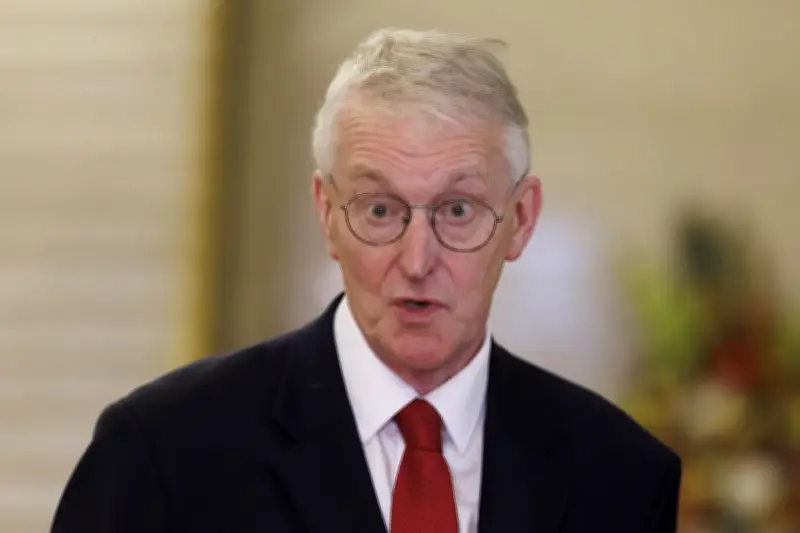
Northern Ireland Secretary Hilary Benn has announced the start of a political process aimed at placing the region's finances on a "long-term sustainable" footing, following talks with leaders of the powersharing Executive at Hillsborough Castle on Thursday. Benn, joined by Chief Secretary to the Treasury Lucy Rigby, met with representatives from Sinn Féin, the DUP, the Alliance Party, and the Ulster Unionists to address Stormont's ongoing budget crisis.
Budget crisis deepens as departments operate without approved spending plan
Devolved ministers have failed to agree a budget for the current financial year, leaving departments to operate on contingency budgets since April. The Executive exceeded its budget in the previous financial year, prompting the UK Government to allocate £400 million from reserves to cover overspend pressures in health and education. This sum must be repaid over the next three years. The Treasury has already conducted an "open-book exercise" examining the Executive's budget.
Speaking after the talks, Benn described the day as "productive" and outlined a programme of work beginning Friday. "We have agreed a programme of work that will start tomorrow, which will involve officials from the Treasury, the Northern Ireland Office and the Northern Ireland Civil Service, that will look first of all at the pressures that the Executive’s finances are facing," he said. "We need to fully understand what those are, and that detailed work can now begin with full disclosure."

Long-term plan needed to avoid one-off fixes
Benn emphasised that the process would also examine the Executive's plan for fiscal sustainability, efficiencies, and public services transformation. "We can’t deal with this by finding another one-off fix. We need a long-term sustainable plan for the future of Northern Ireland’s finances, and this is the start of a political process with that objective in mind," he added.
Rigby echoed the need for sustainability, stating: "The objective here is to try and ensure that the Executive’s finances can move on to a sustainable footing for the long term. There will be further work that’s going to continue tomorrow, and then hopefully over the summer as well, importantly, sharing information about the current status of budget pressures, the drivers behind those pressures and, as well, emphasis on the plans for fiscal reform."
DUP leader calls for earlier engagement
DUP leader Gavin Robinson, who attended the talks, said he had been requesting a process around Stormont's budgetary challenges since last October. "It would have been better to our mind if there had been engagement in a detailed and a sincere way since that period of time, because it is unconscionable that we’re in a position we are today, which is three months into a financial cycle and no budget," he said. Robinson added that the process was about "trying to get the best advice necessary for the Prime Minister" and that he had agreed to provide departmental financial information within minutes of the meeting. "I hope that allows the Chief Secretary to the Treasury, the Secretary of State and the Government more generally to understand and appreciate some of the real financial challenges that are going to need to be grappled for the people of Northern Ireland."
Sinn Féin highlights funding deficit compared to Scotland and Wales
Sinn Féin leader Mary Lou McDonald, speaking before the meeting, argued there was a "very, very significant deficit" in how Northern Ireland is funded compared with Scotland or Wales. "We are on common ground with all of the parties of the Executive, and we are here to make the case for proper funding," she said. "The failure of the British Government and the British state to fund this place correctly isn’t a phase. It’s not just a moment in time. This is a permanent fixture." Michelle O'Neill, Sinn Féin vice president, noted that this was her seventh British prime minister in 10 years, describing it as "the chaos of Westminster" and adding that the budget discussion was "very much scene-setting for Andy Burnham, the incoming prime minister."

Alliance and Ulster Unionists call for fair funding and reform
Alliance Party leader Naomi Long described the talks as an "important day" for Northern Ireland's finances. "We’ve been very clear now for a long time that we still believe, despite recent changes to the funding formula in Northern Ireland, we remain funded below need," she said. "That is a real challenge. It’s not just an opinion, it is something that has been raised now by a number of independent assessments that recognise that Scotland and Wales are both funded above need and Northern Ireland below need."
Ulster Unionist leader Jon Burrows stressed that calls for more funding must be accompanied by better governance at Stormont. "We need to be credible and responsible, negotiate hard for more money, spend it more wisely, cut waste," he said. "We’ll also be making the case to help Northern Ireland grow by getting things like cuts in corporation tax, in VAT and hospitality and tourism that allows us to compete better with the Irish Republic."