
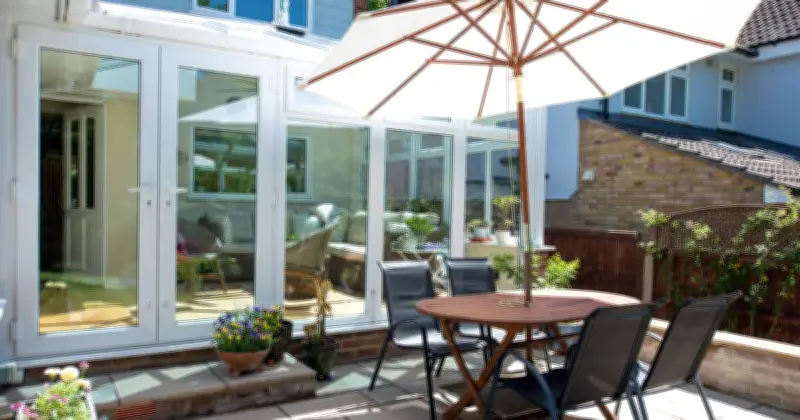
New data reveals the home improvement projects Brits are most likely to search for on Google before submitting a planning application. Conservatories, sheds and garages top the list, with homeowners potentially spending as much as £3,500 on architectural drawings to support their application.
The data comes as the national Planning Portal, a joint venture between TerraQuest Solutions Limited and the Ministry of Housing, Communities & Local Government, launches a free tool based on real data to help people understand what they can do with their property.
Top Searched Projects
In the first seven months of 2026, Planning Portal data shows that 7,271 applications were made in England for large home extensions, 39% of which were in London. The homeowners making these applications could lose thousands if their applications are refused.
Up to now, Brits have been putting their home improvement planning questions to Google, with overall queries jumping 10% in a year, according to Google Trends data compiled by the national Planning Portal. The data reveals the top 10 projects householders have been asking about from January to August 2026, led by more budget-friendly projects including conservatories, sheds and garages, with air conditioning search interest rising fourfold amid this summer’s heatwaves.
Free Tool to Reduce Risk
Planning Portal is sharing the data as it launches its own free Householder Insights Tool that lets homebuyers and homeowners find out whether they need planning permission for popular home upgrades, and their chances of approval if they do need to apply. The service offers users three free property reports a month, showing recent planning activity in their area, and combining local rules, permitted development rights and past decision data in the immediate area to indicate the chances of a project being approved on a scale from “unlikely” to “very likely”.
Technology has transformed how homeowners approach these projects, with TikTok and Instagram now often the first port of call for inspiration and home reno influencers racking up millions of views offering everything from extension ideas to DIY planning advice. But while this content is great for style inspiration, it rarely reflects the planning reality of a specific property - leaving a gap between what looks good on a "For You" page and what's actually achievable on a homeowner's own street.
Expert Comment
Geoff Keal, CEO at TerraQuest – operators of Planning Portal, said: “We all want to make the most of our properties, which is why so many of us consider bespoke upgrades that tailor our homes to meet our families’ individual needs. Yet planning rules can be confusing because they vary by area to allow for local accountability and to protect the distinctive character of different neighbourhoods. A project can be allowed in one place, but not in another. That means it’s easy to be overwhelmed by advice that might seem like it contradicts itself.
"So, when it comes to upgrading our properties to become our dream homes, it can be difficult to know whether we should spend thousands on professional consultants. The search data shows the biggest interest in the most budget-friendly projects, suggesting people can ill afford to risk thousands on dead-end projects.
“Householder Insights clears up confusion and reduces the risk of putting money behind a project before you know if you’re likely to get planning permission. We see it becoming the first point of call on any home upgrade project.”
Data from Checkatrade shows that simple architectural drawings to accompany a planning application for an extension typically cost between £1,000 and £3,500.




