
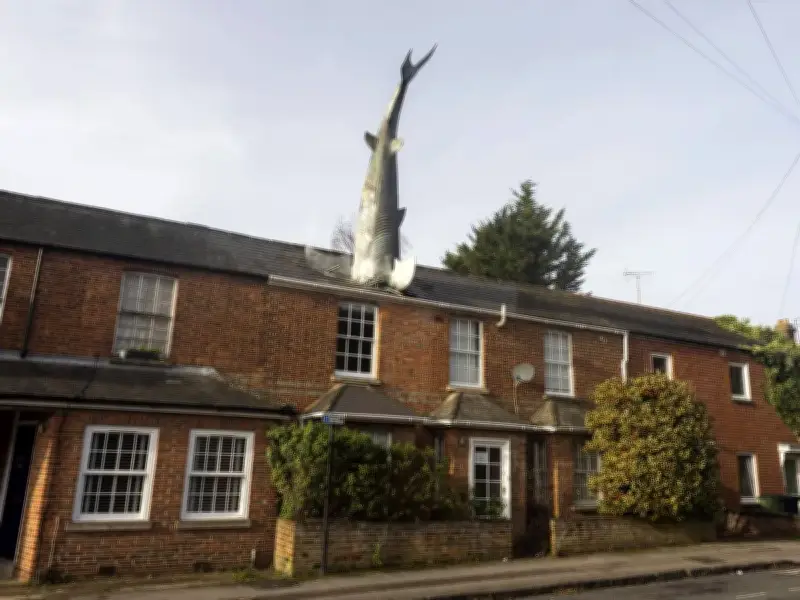
The owner of the 'Shark House' in Oxford has urged the local council to lift its ban on short-term lettings, arguing the property should be treated as public art. Dr Magnus Hanson-Heine marked the 40th anniversary of the distinctive dwelling by calling for planners to grant it special status and find a loophole allowing tourists to experience it.
Five years of Airbnb lettings
The four-bedroom, four-bathroom residence in Headington ran for five years as an Airbnb before Oxford City Council banned it from short-term rentals. Forty years ago this week, Magnus's late father Bill Heine built the 25-foot structure, which appeared overnight on the roof of his terraced property without formal planning consent.
The American-born journalist and broadcaster had arrived in Oxford in the 1960s to study at Oxford University. The shark was constructed over three months, and its location remained unknown until it was transported to New High Street on a tractor-trailer, where a crane positioned it into the roof. A six-year planning dispute followed.
Council opposition and safety approval
Oxford City Council objected to the installation, claiming it posed a danger to the public, but engineers and inspectors declared it structurally sound. To safeguard the shark, Magnus purchased the property in 2016, and it became a popular attraction on Airbnb. In March 2025, he was told he could no longer use the house as a short-term rental, a decision he says would damage Oxford's wider tourism sector.
Marking the 40th anniversary, Magnus expressed hope about finding a solution that would allow the public to experience it. He said: "The previous planning inspector accepted that the Shark House was an appropriate location for the use and found no evidence that it had caused problems for neighbours or highway safety.
"The main obstacle was Oxford's general policy against the loss of a residential dwelling. With Oxford's new Local Plan going through independent examination, we've made representations asking for greater flexibility for genuinely exceptional properties such as the Shark House."
Public art and special status
Magnus argued the house should be treated differently from an ordinary rental property, noting it is "one of Oxford's best-known pieces of public art." He said: "When it was available on Airbnb, people could actually experience that extraordinary place from the inside and make it part of birthdays, reunions, visits to Oxford and other special occasions, rather than only ever seeing the Shark from the pavement."
After the ban, the property was listed for longer-term rental at £4,000 a month. Its listing describes it as "a dive into a piece of living art history," featuring the 25ft fiberglass and steel shark sculpture that "spectacularly 'crashes' through the roof." The listing adds: "The Shark House stands as a testament to creativity, freedom, and the voice against conformity. Erected by my late father, Bill Heine, and sculptor John Buckley, it sparked a national debate on public art and personal expression."
Screenplay and future plans
Magnus also revealed a screenplay adaptation has been written of his father's book The Hunting of the Shark, based on the true story of the shark's creation and the six-year battle that followed. He said: "It's really a very British story about art, war, freedom, authority and the right to dissent, all with an American out-of-water at the centre of it."
He added: "Forty years later, the object they fought over has become part of Oxford's cultural heritage without losing any of the provocation that made it matter in the first place. If there are filmmakers, producers or actors out there who know the Shark and see the potential in that story, I'd genuinely love to hear from them."
Looking to the future, Magnus said he is beginning to think seriously about the Shark's next 40 years, including professional conservation advice, longer-term care of the structure, and investigating grant funding. He noted that fundraising or crowdfunding might eventually form part of that effort.
Council defends ban
The council has stood firmly behind its decision, stating that the trend of renting out entire properties has led to the "loss of valuable homes in the UK's most unaffordable city." It also highlighted that nearly 3,500 households are on the waiting list for social housing in Oxford.
One councillor previously remarked: "Where properties have changed from being residential homes to becoming short let businesses without planning approval, we do take enforcement action. We live in one the least affordable places for housing in the UK. There are nearly 800 properties let out entirely as short lets in Oxford and we need those for people to live in and not as holiday accommodation."




