
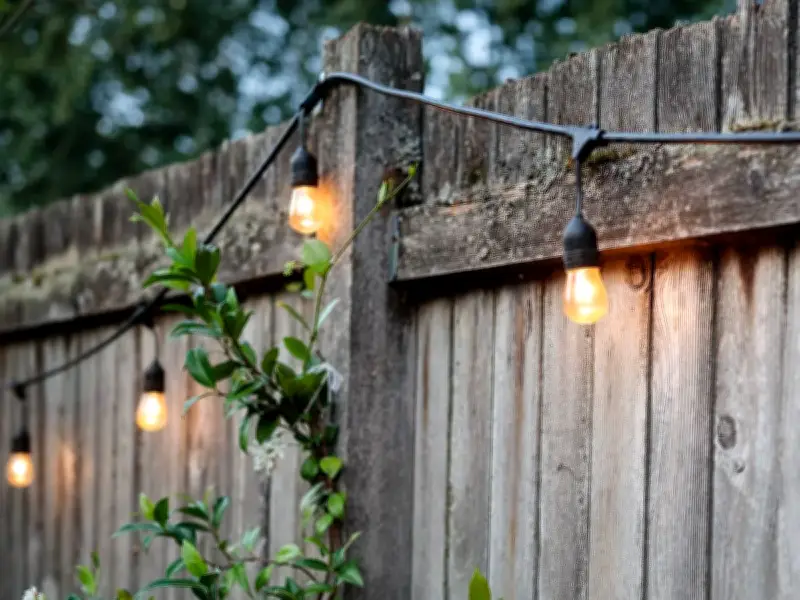
As summer evenings draw in, many Brits are stringing up fairy lights to keep their gardens glowing after dark. But a little-known UK property rule means you could end up footing the bill for damage if you hang them in the wrong place.
Who owns your fence?
In the UK, garden fences are not automatically owned by the person whose garden they border. Ownership is determined by your property deeds, and in many cases, the boundary between two gardens is the legal responsibility of just one of the neighbouring properties.
Your deeds may include a 'T' mark on a boundary plan. Whichever side of the boundary the 'T' sits on indicates which property is responsible for maintaining that boundary – and responsibility for maintenance generally indicates ownership. If the mark appears on your neighbour's side, that fence legally belongs to them.
If your deeds don't make things clear, you can find guidance on boundary disputes through GOV.UK, or consult a solicitor who specialises in property law. It's worth resolving any uncertainty before you make any changes at all.
Why hanging lights on a fence can be a problem
It might feel harmless to loop a string of fairy lights over a fence panel, but if that fence belongs to your neighbour, you are technically altering their property without consent. Experts from lighting specialists LightingLegends.com warn that this can quickly become a source of serious neighbourly tension.
Jon Saeed, managing director of LightingLegends.com, said: "Decorating your garden and creating an inviting space for yourself and your guests to enjoy is one of the great benefits of having an outdoor area, and hanging lights or other decorations from a fence can be a simple yet effective way to enhance the space.
"It's just important to remember that if the fence doesn't belong to you, it's important to speak with the neighbour who owns it before attaching anything. Having that conversation first can help prevent misunderstandings and avoid disputes that could result in you having to pay for any damage caused."
The key risk is physical damage. Drilling holes to fix hooks or screws, applying adhesive fixings, or simply adding weight to aging fence panels can all cause damage – and if the fence belongs to your neighbour, they may be entitled to claim the cost of any repairs from you.
Even if no drilling is involved, placing decorations on a fence without asking could still cause friction and, in the worst cases, escalate into a formal boundary dispute – a process that can be both lengthy and expensive.
How to avoid trouble
The simplest way to avoid all of this is also the most obvious: ask your neighbour. A friendly conversation before you put anything up costs nothing and could save a great deal of stress down the line. Most neighbours are perfectly happy to agree to fairy lights, especially when approached with courtesy and good communication.
If permission is granted, it's still worth being careful about how you attach the lights. Avoid drilling into fence panels where possible, and opt for lightweight string lights that won't place undue strain on the structure. Remove them at the end of the season to prevent long-term wear.
If a dispute arises despite your best efforts, UK law expects both parties to attempt to resolve the matter through discussion before pursuing legal action. Mediation services are also available as an alternative to the courts.
What to do if your neighbour says no
A refusal isn't the end of the road. There are plenty of creative alternatives that don't involve the fence at all, and in many cases they can look just as effective – or even better.
Jon Saeed added: "If your neighbour isn't comfortable with you hanging lights from their fence, it doesn't mean you have to miss out. There are plenty of alternative solutions like hanging lights on trellises and trees to brighten up your outdoor space without causing any tension."
Free-standing garden poles and shepherd's crook stakes are a popular option, allowing you to position lights exactly where you want them without touching any shared or neighbouring structure. Pergolas and gazebos make excellent anchoring points for string lights, creating a canopy effect that can look striking on summer evenings. Wrapping lights around tree trunks or threading them through hedging you own are other straightforward solutions.
Trellises fixed to your own wall or a fence that you own are another versatile option, doubling as both a garden feature and a structure from which to hang lights.




