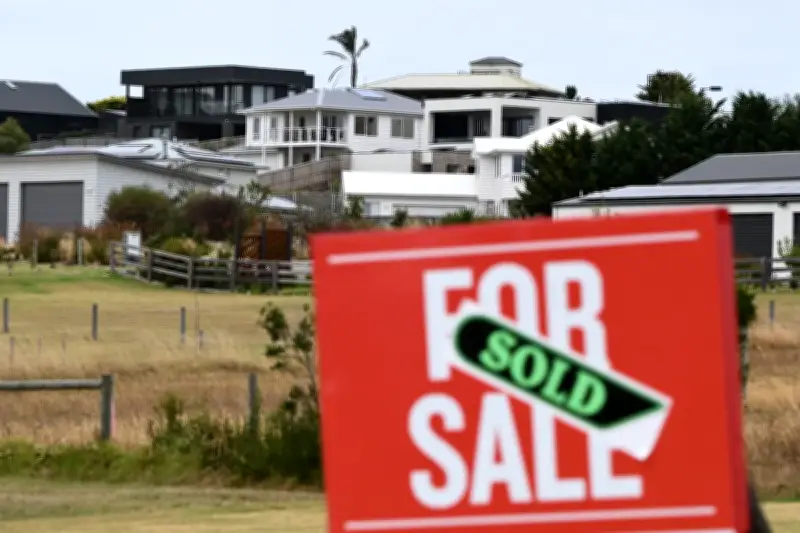
First home buyers are the only cohort applying for more home loans than they were in June, even as investors step back from Australia's property market, according to new data from Loan Market, the mortgage broking company.
Home buying had slowed after interest rates rose three times and Labor abolished negative gearing for most investment purchases. Prime Minister Anthony Albanese has said the reform was meant to “level the playing field” for first home buyers.
Loan applications trend upward
Loan Market reported first-timer applications dropped 3% in July, then rose 10% into the first half of August on a weekly average basis. Applications from other owner-occupiers and investors were roughly steady in August compared to June.

Home loan demand had been falling across the board by June, down 5.4% compared to the prior quarter, according to the Australian Bureau of Statistics (ABS). While the number of investor loans fell by 8.6%, the number of first-time buyer mortgages fell only 2.9% on a seasonally adjusted basis, the ABS reported.
First home purchases were still higher in New South Wales and the Australian Capital Territory than the same time the year before. They rose to hit their highest level since 2021 in South Australia and Tasmania.
Sentiment shifts in favour of new entrants
Peter Esho, the chief executive of property finance firm 13x, said new entrants to the market had become more visible in recent months.
“First home buyers, I think, now feel like the sentiment has swung in their favour, and investors feel like the sentiment swung against them,” Esho said.
“There’s been a lot of buyers on the sideline for a long time … so that pent-up demand is going to keep it for the next few years and policy is obviously a big driver.”
Esho said demand was concentrating on properties with prices close to the eligibility caps set by the government’s 5% deposit scheme. The program allows first-time buyers to borrow up to 95% of a property’s value and have the government guarantee the loan, waiving costly lenders’ mortgage insurance (LMI).
Prices have fallen across Australia, but properties eligible for the guarantee have seen slower price falls than homes outside the scheme, according to data company Cotality.
Scheme expansion and impact
Homes are eligible if they are below $1.5m in New South Wales cities, $1m for south-east Queensland, $950,000 for Melbourne and Geelong, $850,000 for Perth, $900,000 for Adelaide and $700,000 for Hobart. Labor expanded the scheme and scrapped income caps for applicants in October 2025.
Housing Australia, which administers the scheme, found applicants typically saved more than $15,000 in LMI for the median deposit paid on the median home purchased under the 5% deposit scheme. More than 320,000 people have become homeowners under the scheme since it was established in 2020.
The housing minister, Clare O’Neil, told Guardian Australia that scheme participants had collectively saved more than $2.5bn in LMI by the end of July. “We know that for too long the housing market has been stacked against young people and without this scheme many wouldn’t be able to enter the market at all,” O’Neil said.
More than 5,000 new guarantees had been issued each month since February. Housing Australia said that slipped just below 5,000 in July, which was still more than had been issued in any month before Labor expanded the scheme.
Australia’s leading LMI company, Helia, has estimated the scheme’s expansion cost it nearly $9m worth of first home buyer business in the first half of 2026. Its remaining customers were typically people buying above the price caps or from non-participating banks, a spokesperson said.
ANZ, which began offering the 5% scheme in March, was the only big four bank to maintain a steady value of mortgage applications in the June quarter. The influx of first home buyers offset a drop in lending to other groups, and scheme participants now account for one in every 20 new loan applications at ANZ.