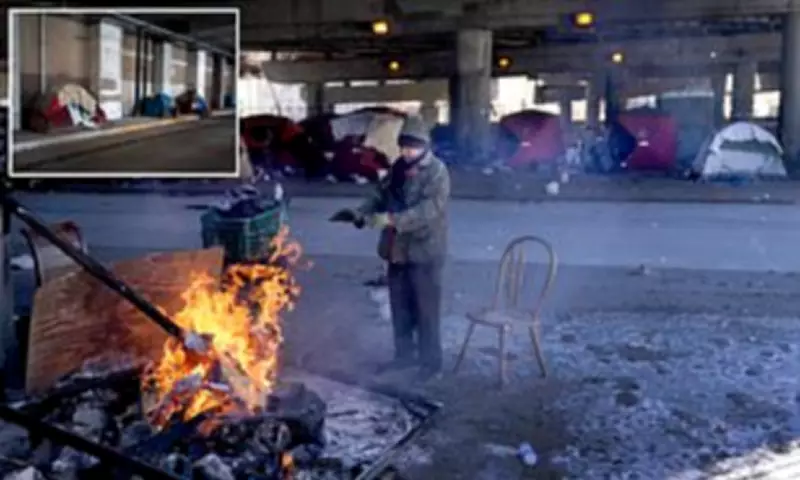
Chicago's 'Whack-a-Mole' Homeless Crisis: Tent City Torn Down in Freezing Temperatures
This week, Chicago authorities dismantled a tent city in Legion Park, forcibly removing homeless residents into below-freezing temperatures as the city's homelessness crisis intensifies. Police cleared the encampment, displacing approximately 20 individuals, while protesters gathered nearby to voice their opposition.
A Never-Ending Game of Displacement
Advocates have sharply criticized the city's approach, describing it as a futile game of 'whack-a-mole.' Ryan Spangler, Street Outreach Supervisor at Heartland Alliance Health, told Block Club Chicago that this action merely pushes the problem elsewhere without addressing systemic failures. 'They close one and then folks just move to a different place,' Spangler said. 'It's just pushing the problem elsewhere, instead of dealing with the root causes of what an encampment is, which is a failure of our systems, not of people experiencing homelessness.'
According to the city's annual count released last July, Chicago is home to 7,452 unhoused people, marking the second-highest number in over a decade. The Department of Family and Support Services has connected 16 of the displaced Legion Park residents with long-term affordable housing, with two more working with providers. However, residents may face a month-long wait before moving in.

Systemic Failures and Trauma
Forced relocations are not only disruptive but also traumatic, advocates argue. Spangler highlighted the consequences: 'We lose track of folks. Folks lose their belongings, lose their documents. They're put through displacement and trauma, which causes them to further disengage from the process and lose trust in our systems.' He added, 'So it's the exact opposite of what we should be doing.'
The city's shelter system has been offered as an interim solution, but many homeless individuals do not feel safe there, according to a representative from Parks for All. Data from Housing Action Illinois reveals a severe shortage of over 126,000 affordable rentals for low-income residents, with many available units concentrated on Chicago's South and West sides. All Chicago, a social services organization, reported that potential residents wait an average of four years for long-term housing.
Community Support and Counter-Proposals
Despite the turmoil, some neighbors near Legion Park supported the closure, citing safety concerns after fires in November and February linked to open flames at the campsite. The Hollywood-North Park Community Association stated, 'The conditions that make this encampment dangerous are specific to this location and do not apply to all parks. Closing the encampment in Legion Park acknowledges these risks without criminalizing homelessness elsewhere in the City. This is not a precedent; it is an exception.'
In response, Parks for All developed a counter-proposal requiring tents to be set up at least 50 feet away from nearby business and residential property lines. Mary Tarullo, Director of Public Policy at the Chicago Coalition to End Homelessness, emphasized the necessity of public spaces for survival: 'Until there are accessible housing options for everyone experiencing homelessness across the whole city, people need public spaces in order to survive.'
Petition and Political Undertones
Parks for All also launched a petition advocating for homeless Chicagoans to camp in Legion Park, stating, 'Do not do Trump's work for him by destroying encampments. There are other ways to maintain our parks and protect unhoused people than to forcibly displace them.' This highlights the political dimensions of the crisis, as advocates push for more compassionate and effective solutions.
The dismantling of the Legion Park tent city underscores the deepening homelessness crisis in Chicago, where systemic issues, affordable housing shortages, and traumatic displacement continue to plague the city's most vulnerable residents.