
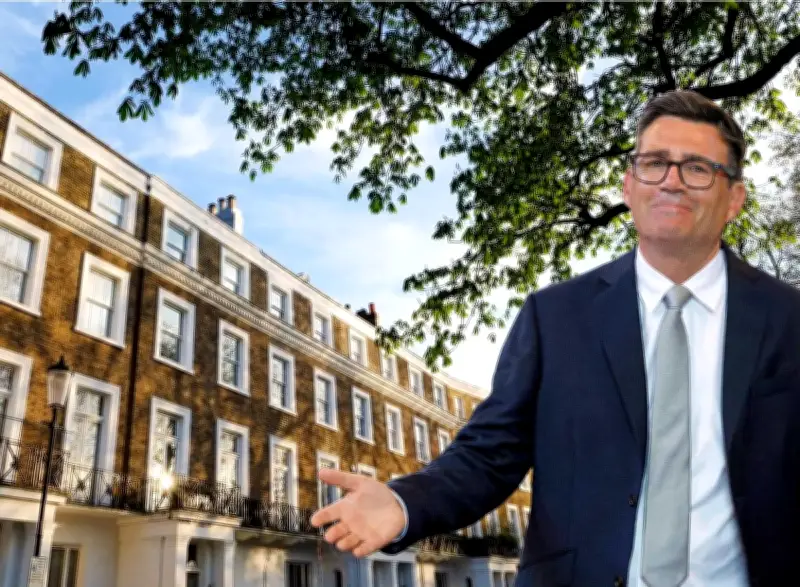
Above all else, what any housing market needs is stability. The very whisper of change or uncertainty can stall sales. Over the past five years political jolts, at home and abroad, have come fast and frequently, putting the London property market on pause each time and halting any serious momentum. This week another prime minister has entered No 10 Downing Street — the seventh in a decade — against a jarring discord of noise from the property industry. On the one hand, experts are calling for calm, certainty of policy direction and no sudden moves. And yet many voices also want urgent radical reform to fix London’s broken housing market. Which reality will take us into the next general election? And is Andy Burnham, the former mayor of Manchester and loudly heralded saviour of the North, going to help or hinder London?
Taxing Times
The London sales rate is crawling along. The number of transactions in the capital has fallen in seven of the past 10 years according to real estate firm JLL, nudging up just one per cent last year despite three interest rate cuts. The revolving door of prime ministers and housing ministers has added to a sense of chaos, highlighted this week by the remarkable comeback of Housing Secretary Angela Rayner who resigned last year after she admitted to not paying enough stamp duty tax on a property in Hove. Indeed it is the burden of property tax — specifically stamp duty — that is often charged with the breakdown of London’s housing market. “People are moving much less often, especially in really expensive places such as London,” says Marcus Dixon, head of residential research for JLL. “The change in leaders has largely been irrelevant [apart from the Liz Truss cameo] to the housing market. It is the cost of moving that has slowed sales.”
Think tanks from both sides of the political divide want to ditch stamp duty and modernise council tax. Stamp duty stops people from moving to meet their needs — meaning, for example, that empty-nesters occupy family-sized homes for too long. Council tax is seen as unfair and outdated, being based on values from the 1990s. Burnham has been vocal about overhauling property tax, not only over the past month but throughout the 16 years since he first ran for the Labour leadership in 2010. He favours a land tax or a flat annual property levy based on the value of the home. While then chancellor Rachel Reeves announced a new annual council tax surcharge in November last year of £2,500 on homes worth more than £2 million, Burnham has suggested lowering that threshold or charging 0.48 per cent of the value. That’s a £7,200 annual levy on a £1.5 million home. For second homes, empty homes or homes with overseas owners, that could rise to 0.96 per cent.
Winners and Losers
This has divided property experts in London. They want a workable replacement for stamp duty, but worry a mansion or wealth tax will penalise retirees who have lived in a home that has accrued value dramatically over decades and quash an already sluggish central London market. As with all tax changes, there will be winners and losers, but a flat land or property tax would disproportionally hit London households, especially in areas such as Hackney, where the average cost of a semi-detached house has leapt from £570,470 in 2012 to £1,181,319 now. There are also fears that if a homeowner has recently moved and paid stamp duty, with the change of prime minister, they could be hit with an annual property tax too. “Being asset rich on paper does not mean you have the cash to pay another annual tax,” says Becky Fatemi, partner at UK Sotheby’s International Realty. “My biggest concern would be a rush to impose yet another tax on property without understanding who would end up paying it. Lowering the mansion tax threshold or introducing a land tax could drag ordinary family homes into the net. These are not mansions. They are often homes that people have scrimped and saved for or owned for decades while the value has risen around them. Being asset rich on paper does not mean you have the cash to pay another annual tax.” Ben Hopkinson, of the Centre for Policy Studies, calls it a “family homes tax, not a mansion tax,” and Fatemi issues a stark warning: “Another tax risks trapping people in their homes, freezing transactions and damaging confidence.”
The Return of Help to Buy
But there are signs the new Prime Minister could be listening to the housebuilding industry, which has been barracking for the reintroduction of Help to Buy for some time. The controversial state-backed shared equity scheme lent buyers up to 20 per cent of the property’s value — up to 40 per cent in London — of the value of a property, meaning they needed to raise only a five per cent deposit. It was credited with getting developers building again after the financial crisis but it was also blamed for boosting house prices and lining the pockets of developers. The scheme ended in 2023. A recent review commissioned by the Treasury found it did not materially drive up prices. Burnham is reported to be reviewing it now, to bring back a version of the scheme to help boost first-time buyer demand and kick start the construction pipeline. Help to Buy made the biggest difference in London and the South-East, where the average price of a first-time buyer property has risen by more than a fifth from £395,612 a decade ago to £478,533 today.
Social Housing Boost — But How?
Underpinning the capital’s housing affordability crisis is the long-term lack of housebuilding. “The number of new starts is now at its lowest ebb since the Second World War,” says Hopkinson. Burnham has pledged the biggest council house building programme since the post-war period, but funding is the major stumbling block. Land in the 1950s was cheap and the post-war imperative to rebuild was widely understood to be urgent. Now a big proportion of the cost of building a house in London goes on the land, explains Professor Paul Cheshire of the London School of Economics. Then there are high construction costs and a lack of construction workers. “There is the big question of how to pay for new council homes when local authorities are cash-strapped and so is central government,” says Cheshire. The other barrier to constructing new communities in the capital has been the councils themselves. “In just three months we have seen a scheme to redevelop an old shopping centre in Peckham and build 867 new homes rejected by Southwark and thrown out on appeal. Enfield’s new Conservative leadership has announced its withdrawal from the proposed new town development at Crew Hill,” he says.
Manchester as a Blueprint
For Anya Martin, of the YIMBY Alliance, what Burnham has done in Manchester could be rolled out in London. “His record in Greater Manchester shows what is possible: building communities at scale, backing development corporations and capturing the uplift in land values that new infrastructure creates,” says Martin. “The task now is to roll out that model nationwide. In Manchester he has shown a real focus on brownfield regeneration and building homes for younger workers and families.” However, his record was not that impressive. Some 3.8 new homes per 1,000 people were built in Greater Manchester between 2018 and 2025 (his tenure as mayor lasted from 2017 to 2026), a slower rate than in Cambridgeshire and Peterborough, the East Midlands, the West and Greater London. Talk of devolution casts doubt on whether he intends to prioritise housebuilding in London, where the supply problem is at its most acute. “Urgent action is needed but there does not seem to be anything in Burnham’s public statements showing that he grasps these issues or will introduce the much-needed reforms to get London building again in a financially viable and sustainable way,” Hopkinson says. There are opportunities to “develop along the Bakerloo line extension and between the City and Canary Wharf. This would have a transformative effect on London’s economic growth. Sadly, it is all up in the air,” he adds.
‘Don’t Make Us a Cash Machine’
Burnham is tasked with a balancing act. The industry is calling for simple yet radical tax reform. On top of this he intends to drive devolution but must not cut London adrift. “Many of the tax models being discussed suggest a flat rate proportional property tax collected nationally and returned to the Treasury,” says Antonia Jennings, chief executive of the Centre for London. “You can’t level up the North by levelling down London,” Fatemi puts it more strongly: “If you damage the capital, the whole country feels it. Don’t make London the country’s cash machine.” Experts are calling for intention and direction to be set out on property taxation but without causing panic in the financial markets. “We have already lost the spring market due to political uncertainty at home and abroad,” says Dixon. “Burnham needs to set out his priorities now but if he announces that he will axe stamp duty in April 2027 (for example) then no one will move until then and we will lose the autumn market as well.” When it comes to property, Burnham is in a precarious position. He may have been Manchester’s rock, but London is a hard place to get housebuilding back on track and the market moving.




