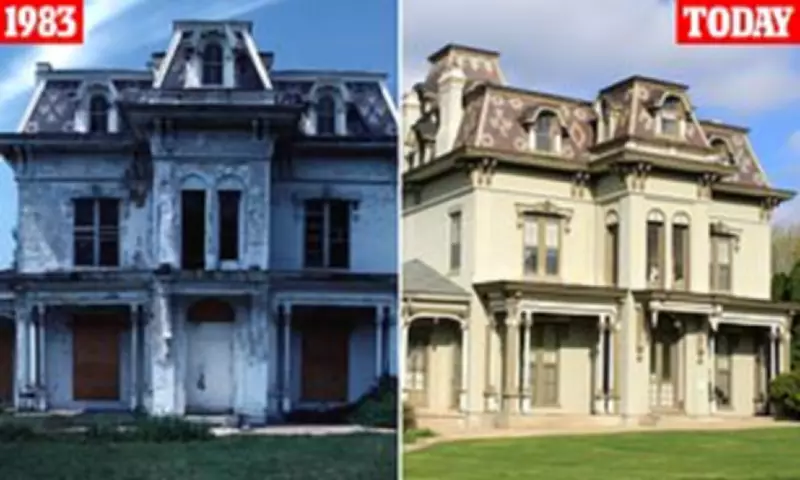
Brothers Rescue Historic Mansion Purchased for One Dollar
Two brothers have completed an extraordinary restoration of a crumbling Michigan mansion they acquired for just one dollar, with the historic property now listed for sale at $1.13 million. Christopher and Steve White dedicated over a year to saving the 19th-century Gilbert Mansion in Ypsilanti, transforming it into luxury apartments while preserving its architectural heritage.
A Building in Severe Disrepair
The Whites first encountered the property in 1986, when it stood in alarming condition. Broken and boarded windows, sagging and rotted eaves, falling ornate brackets, crumbling bricks, peeling paint, deteriorated window frames, and a missing original front door characterized the dilapidated structure. City officials had already spent seven years searching for a buyer for the decrepit mansion, built in 1861—the same year President Abraham Lincoln called for 75,000 volunteer troops during the Civil War.
"The city was taking proposals to find the best fit for the community," explained Christopher White, who has owned the property for four decades. "Someone proposed a bed-and-breakfast. Someone else proposed office space." The brothers submitted their own proposal to convert the Second Empire Mansard-style jewel into an apartment building.

Proven Track Record Secures Approval
The Whites possessed a significant advantage: they had already established a reputation in Ypsilanti for renovating historic properties. They had recently completed conversions of two nearby homes into five-unit and seven-unit apartment buildings. This proven expertise convinced city officials to approve their proposal, leading to the symbolic one-dollar purchase.
To authentically preserve the mansion's beauty, the brothers conducted exhaustive research on the Second Empire Mansard architectural style. This design approach originated during Napoleon III's transformation of Paris starting in 1852 and peaked in popularity between 1855 and 1885, particularly in the Northeastern and Midwestern United States.
The Gilbert Family Legacy
The mansion was constructed at the height of this architectural craze by John Gilbert Jr., after his father, John Gilbert Sr., bequeathed him a large parcel of land on North Grove Street. The elder Gilbert had amassed wealth through mills and real estate investments before losing control of the mills during an 1837 economic downturn. By 1840, the mansion's future lot was among his few remaining properties.
John Gilbert Jr. worked to restore the family fortune through various business and municipal projects, including investments in buildings that still stand in Ypsilanti's Depot Town. With the family's wealth secured by 1860, he built the house, which the Ypsilanti Daily Press later noted "had some claim to magnificence, due partly to Mrs. Gilbert's lovely roses and lilies." The property originally featured an artificial lake created by natural springs and a smaller pool near the house.
Decades of Changing Ownership and Decline
After John Gilbert Jr.'s death in 1864 and his wife Harriett's passing in 1910, the mansion passed through various hands. Their daughter Alice was the last Gilbert to reside there, moving out in 1920. The property then became owned by Daniel Smith, who made his fortune installing heaters in Detroit's streetcars.
The city acquired the mansion during the Great Depression after Smith failed to pay property taxes. It subsequently served as a social center during World War II, a teen canteen in the early 1950s, and later housed the Ypsilanti Boys' Club from 1961 to 1974, followed by the Girls' Club until 1981. By the 1970s, the building had already fallen into significant disrepair.
Fourteen Months of Intensive Renovation
Once the White brothers assumed control, they embarked on a 14-month renovation project to convert the mansion into seven luxury residential units ranging from 800 to 1,200 square feet each. The interior was completely gutted except for the original hardwood floors and a rare Pewabic tile fireplace—an artifact from the renowned Detroit-based company.

The brothers preserved the common halls in their historic configuration while adding new mechanical systems, drywall, and finishes throughout the 8,000-square-foot home. Remarkably, the patterned slate roof required minimal restoration, having withstood over a century of Michigan winters in nearly perfect condition.
"As far as the slate roof goes, it stood the test of time and is in great shape to this day," Christopher White noted.
Luxury Apartments with Historic Charm
The renovated apartment building now features high ceilings with large "daylit windows," a four-story tower on the backside overlooking the city, and apartments equipped with breakfast nooks and built-in bookshelves. Some units even include porches or private patios. The building is currently fully occupied with tenants, demonstrating the successful transformation of a once-crumbling historic landmark into desirable modern living spaces.