

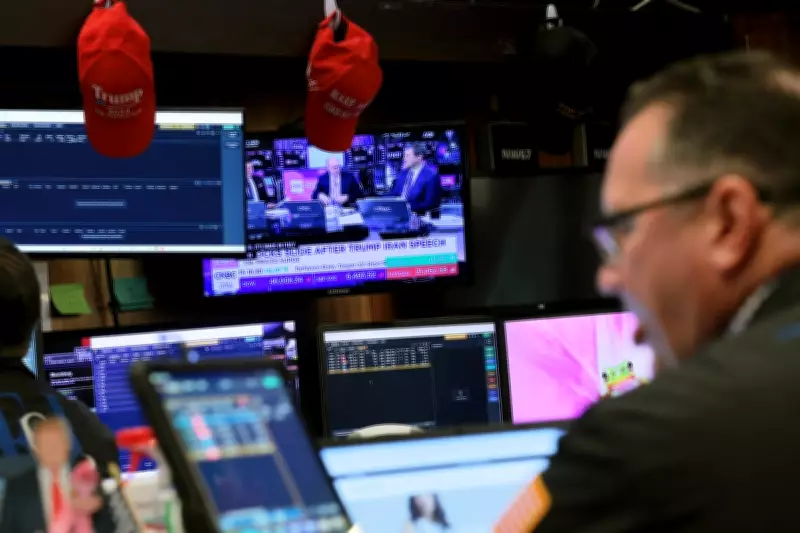
US stock markets displayed cautious gains on Monday as oil prices swung between gains and losses, with persistent uncertainty surrounding the ongoing conflict with Iran and an impending deadline set by former President Donald Trump concerning potential military action against Iranian power plants.
Market Movements Amid Geopolitical Tensions
The S&P 500 index edged up by 0.3 percent during midday trading, building on its first winning week in the past six. The Dow Jones Industrial Average climbed 100 points, representing a 0.2 percent increase by 12:30 p.m. Eastern time, while the Nasdaq composite registered a 0.4 percent gain.
Oil prices continued their volatile pattern, seesawing between positive and negative territory as market participants grappled with the uncertain trajectory of the Iran conflict and its potential disruption to global energy flows. Iran rejected the latest ceasefire proposal on Monday, instead calling for a permanent end to hostilities, though diplomatic channels reportedly remain open.

Trump's Deadline and Iranian Response
"We won't merely accept a ceasefire," stated Mojtaba Ferdousi Pour, head of the Iranian diplomatic mission in Cairo, in comments to The Associated Press. "We only accept an end of the war with guarantees that we won't be attacked again."
Military actions continued alongside diplomatic posturing, including an Israeli attack on an Iranian petrochemical facility. Meanwhile, the clock ticks toward a deadline where Trump has threatened to target Iran's infrastructure if it fails to open the Strait of Hormuz. Approximately one-fifth of global oil shipments typically pass through this strategic waterway during peacetime.
"Tuesday will be Power Plant Day, and Bridge Day, all wrapped up in one, in Iran," Trump declared on his social media platform over the weekend, warning Iranian leaders that "you'll be living in Hell - JUST WATCH!"
Economic Indicators and Market Reactions
Monday provided the first opportunity for US stock markets to respond to Friday's employment report, which revealed stronger-than-expected hiring figures for the previous month alongside an unexpected improvement in the unemployment rate. These signals offered encouragement for an economy grappling with significant gasoline price increases since the conflict's inception.
The national average price for a gallon of regular gasoline has climbed to nearly $4.12, according to AAA data, representing a substantial increase from the sub-$3 levels observed just before US and Israeli attacks initiated the conflict in late February.
Energy Market Dynamics
For nations with less domestic oil production than the United States, the economic impact has been more severe due to greater reliance on Middle Eastern oil supplies. The conflict has disrupted substantial crude production in the Persian Gulf region, with oil typically reaching global markets via the Strait of Hormuz.
The benchmark US crude price rose 0.3 percent to $111.88 per barrel after recovering from an earlier modest decline. Brent crude, the international standard, added 0.2 percent to $109.26 per barrel, maintaining a significant premium over its pre-war level of approximately $70.
Sector Performance and Corporate Insights
Wall Street experienced a mixed performance among influential Big Tech stocks that helped maintain market equilibrium. Apple shares advanced 1.2 percent, while Amazon gained 1.4 percent, though Microsoft declined 0.5 percent.
Banking stocks demonstrated particular strength, with JPMorgan Chase climbing 1.6 percent. In his annual shareholder letter released Monday, CEO Jamie Dimon noted the US economy's continued resilience and generally healthy business conditions, while acknowledging elevated asset prices that could make markets vulnerable to negative developments.
Bond Markets and Economic Indicators
Treasury yields remained relatively stable in bond markets, with the 10-year Treasury yield holding at 4.32 percent - substantially above its pre-war level of 3.97 percent. This increase has elevated borrowing costs for mortgages and business loans, contributing to economic deceleration.

A separate report indicated that US service sector businesses, including finance and transportation, expanded for a 21st consecutive month in March, though growth slightly trailed economist expectations. Notably, a price measure within this report accelerated at its fastest pace since 2022, presenting potential inflationary concerns.
Global Market Context
International markets presented a mixed picture, with Japan's Nikkei 225 adding 0.5 percent and South Korea's Kospi jumping 1.4 percent. Numerous European and Asian markets remained closed for holiday observances, limiting broader global trading activity.
The persistent uncertainty surrounding geopolitical developments, combined with evolving economic indicators, continues to create volatile conditions across financial markets as investors navigate complex risk factors in both the energy and equity sectors.





