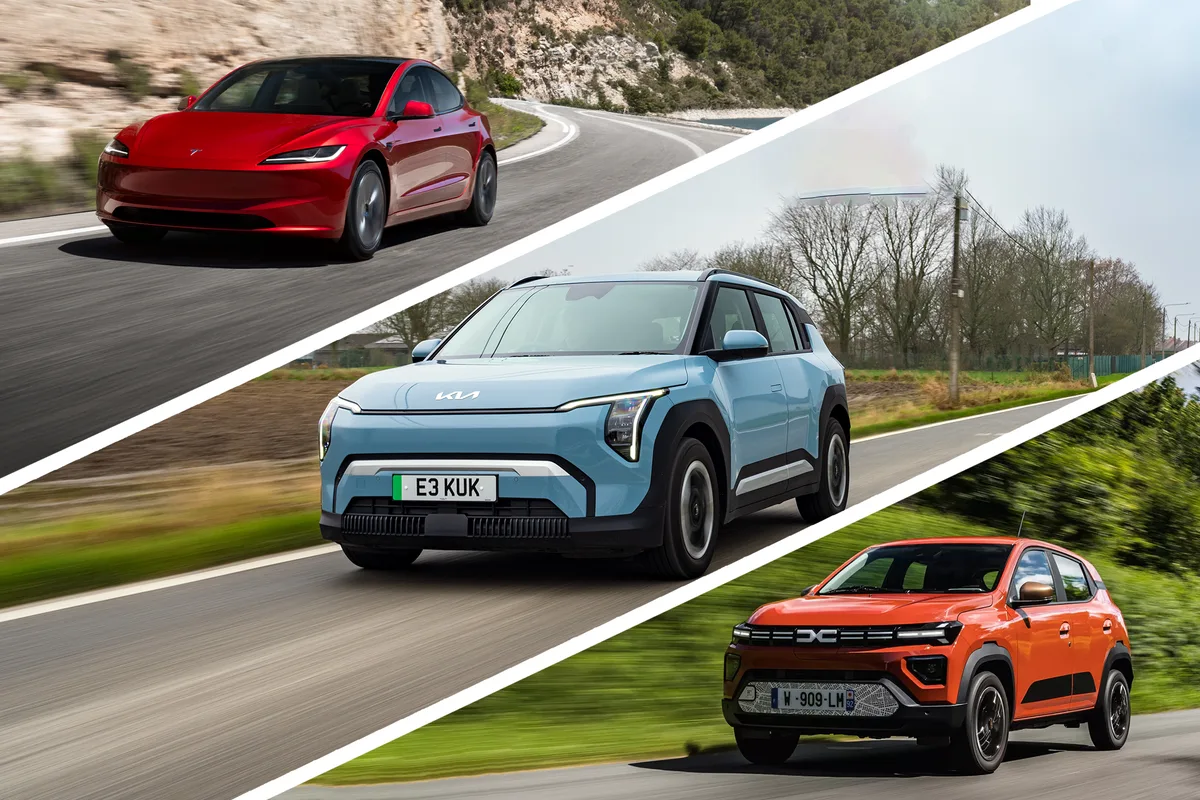
Electric car sales are off to a strong start in 2026, with March being the best-ever month for EV purchases in the UK. Sales of fully-electric vehicles were up 24 per cent compared to the same month a year ago, with almost 90,000 recorded. This impressive growth is thanks to there being more EV choices than ever before, and a welcome fall in prices too – as highlighted by the Independent EV Price Index.
The government’s Electric Car Grant continues to offer discounts of either £1,500 or £3,750 on eligible models – of which more are arriving all the time – bringing prices down even further. Meanwhile, car makers without eligible models have introduced their own discount schemes, and more great-value EVs are launching all the time. So, whether you want a small, city runabout, a family-friendly SUV or a sports car, there’s an EV for you. And while prices have dropped and choice has increased, improvements in battery and motor technology mean EVs can drive further – and charge faster – than ever before.
Some of today’s EVs have official driving ranges of up to 500 miles, while others can fill their battery to 80 per cent in under 20 minutes. Gone are the days of plugging in for an hour or more every 100 miles. As we head through 2026 and beyond, all of these attributes will only improve; EVs will go further, charge quicker and cost less.
You can now buy a new EV for well under £15,000, and our current favourite budget choice, the Leapmotor T03, costs just £15,995 – or £175 a month with an equally small deposit. Then there’s the upcoming Renault Twingo E-Tech, a joyful slice of retro design wrapped around the best car we’ve driven so far this year – and it’ll cost from under £20,000 when it lands in the UK in early 2027. Plenty of other brands are offering big discounts on their EVs, while even the likes of Tesla have low-rate finance offers to make monthly payments more affordable – and, in many cases, cheaper even than petrol or diesel models.
But which EV should you buy? We’ve come up with a list of 10 of the very best in 2026, covering every need and every budget, plus some advice on the EVs you should avoid.
How we tested
All our car testing starts with you in mind. We consider how you’re likely to use your electric car and what needs and priorities you might have. We test cars in real-world situations: parking them in car parks, filling them with shopping, fitting child seats, fiddling with the infotainment, turning the stereo up loud and driving them on a variety of roads in the UK and abroad. We won’t be driving a family-friendly SUV around a race track, but we’ll take it along B-roads, around the M25 and into city centres. Then we run the numbers to compare buying and running costs with rivals so we can make a recommendation you can really trust.
What should I look for when buying an EV?
Switching to an electric car may seem daunting, but knowing what to look for simplifies the process. On top of the usual considerations when buying any car – things like budget, size and practicality – look for an EV with a battery size and range that will comfortably accommodate your regular journeys. Many new models offer different battery sizes with varying range and power options, as well as the usual array of trim levels – just like petrol or diesel models do. Once you’ve narrowed the field, you can start to consider things like charging speeds – you might need to install a wall box charger at home – and charging accessibility, as well as conveniences like warranties and in-car tech and connectivity.
Why trust us
Our team of motoring experts have decades of experience driving, reviewing and reporting on the latest EV cars, and our verdicts are reached with every kind of driver in mind. We thoroughly test drive every car we recommend, so you can be sure our verdicts are honest, unbiased and authentic.
The best electric cars in 2026
1. Kia EV3: £33,005, Kia.com
Best: Overall EV
Independent rating: 10/10
Pros: Well priced; long range; comfy drive; lots of space
Cons: Some may not like the looks, but that’s about it
Kia’s newest EV is the best electric car the Korean manufacturer has yet made, taking everything we loved about the Kia EV9 and EV6 and rolling it into a super-affordable and family-friendly hatchback. For a starting price of £32,995, the entry-level Air model gets a 58kWh battery capable of hitting 270 miles on a single charge. Spend an extra £3,000 on the larger battery and that range heads up to a whopping 375 miles. That’s unbeatable value and an impressive mileage for this price. A stylish and modern-looking car inside and out, the Kia EV3 offers plenty of space for the family and a decent-sized boot. As well as being practical, it’s fun to drive too: comfortable without feeling floaty, with accurate and predictable steering and great visibility.
2. Tesla Model Y: From £41,990, Tesla.com
Best: Family EV
Independent rating: 10/10
Pros: Now rides better; super quiet; the best tech; efficient
Cons: Still a firm ride; others do quality better; no Apple CarPlay or Android Auto
The UK's best-selling EV has received the comprehensive update it desperately needed, while the new entry-level Standard model gives the range a cost-effective boost, too. However, it’s the Model Y Performance that’s the real star of the show and described in our review as the best car Tesla has ever made. The 2025 facelift addressed the key criticisms levelled at the original, transforming it into a far more complete and refined package. The ride quality has been softened thanks to redesigned suspension geometry borrowed from the latest Model 3, and the cabin is noticeably quieter due to new acoustic glass and improved sound deadening. Inside the quality is higher too, and new features like ventilated front seats and an 8in rear screen for passengers ensure even greater comfort when making the most of the longest range option of 387 miles.
3. Citroen e-C3 Aircross: From £21,105, Citroen.co.uk
Best: Budget family EV
Independent rating: 9/10
Pros: Superb ride comfort; spacious for a small SUV; new long-range option; excellent value for money
Cons: Slow acceleration; some cheap-feeling interior plastics; seven-seat option reserved for petrol/hybrid models
Citroën’s new e-C3 Aircross takes the family-friendly small SUV and places it squarely in the electric era without losing what made the C3 Aircross appealing in the first place. It’s still a compact, practical SUV with plenty of space for passengers and luggage, but now it’s zero-emission and even more comfortable than before. The electric version comes with a choice of battery sizes – the standard 44kWh unit with a claimed range that’s enough for most everyday use, and an extended 54kWh option that boosts range by about a quarter. That increase doesn’t make it a long-haul EV, but it gives peace of mind for longer trips while keeping prices competitive. Driving the e-C3 Aircross won’t thrill anyone chasing brisk acceleration, because the focus here is on a relaxed, easy nature rather than sporty performance. The real star is the ride quality, with Citroën’s advanced comfort suspension smoothing out rough roads in a way that rivals often struggle to match.
4. Renault Twingo E-Tech: From under £20,000 (tbc), Renault.com
Best: City EV
Independent rating: 10/10
Pros: Clever packaging; impressive tech for the class; strong efficiency; fun design; excellent urban usability
Cons: Some cheap-feeling materials; delayed UK arrival
Not satisfied with reviving the 5 and 4 to critical acclaim, Renault has now performed the same trick with the Twingo. An A-segment city car with the interior space of a class above, the new Twingo E-Tech is a joyous little thing, from the charismatic styling and clever packaging, to how it drives in a way that’s both entertaining and efficient. It may only have a tiny, 27.5kWh battery pack, but because it weighs just 1,200kg the Twingo manages over 160 miles between charges – and during a spirited lap of Ibiza we saw an impressive efficiency of five miles per kWh. We love how Renault has spent a tight budget in all the right places – including the standard-fit 10in touchscreen and 7in driver display, which run on Android and have native apps like Google Maps and Google Assistant (soon to be upgraded to Gemini for better AI voice control).
5. Kia EV2: From £24,245, Kia.com
Best: Small SUV EV
Independent rating: 9/10
Pros: Strong range for the class; easy drive; excellent visibility; quiet and refined; clever tech
Cons: Some cabin materials feel cheap; rear knee room is only average; unsupportive front seat base
Kia’s newest and smallest electric car yet fits in below the World Car-award-winning EV3, and shares a clear family resemblance with the EV4, EV5, EV6 and EV9. Prices for the EV2 start at £24,425, which gets you the larger 61kWh battery and 281-mile range in entry-level Air configuration. The EV2 scored very highly when we drove it in April, thanks to its easy drive, quiet, refined interior, clever tech and an impressive range for its class. The latter puts it nicely ahead of key rivals like the Skoda Epiq, Renault 4 and Volkswagen ID. Cross. Also impressive (for its size and price) is how the Kia EV2 charges at up to 118kW – topping the battery up from 10 to 80 per cent in 29 minutes. It’s also the first Kia to offer 22kW AC home charging, but you’ll need three-phase wiring and a suitable charger to make the most of that.
6. Leapmotor T03: From £14,495, Leapmotor.net
Best: Budget EV
Independent rating: 8/10
Pros: Loads of kit; easy drive; reasonable to drive
Cons: Poor infotainment; challenging looks
A new name to the UK but backed by automotive giant Stellantis, the Leapmotor T03 arrives with a single focus: value. At under £16,000, this budget-friendly EV undercuts almost everything else on the market, but still comes loaded with a decent amount of standard equipment that embarrasses cars costing twice as much. For not much money you get a sunroof, a 10in touchscreen and even adaptive cruise control. The 165-mile range is perfectly adequate for city driving, and its surprisingly spacious interior offers decent room for four. The budget price is evident in some areas. The infotainment system is fiddly and lacks Apple CarPlay or Android Auto integration. The ride can be a little choppy on poor road surfaces, and its exterior styling is certainly an acquired taste.
7. Hyundai Ioniq 9: From £64,995, Hyundai.co.uk
Best: Large family EV
Independent rating: 9/10
Pros: Spacious interior; exceptional ride comfort; strong real-world range
Cons: Expensive; charging speed not the fastest
Hyundai has taken the award-winning formula of its Ioniq 5 and 6 and scaled it up to create its new flagship, the Ioniq 9. The result is a capable large electric SUV that EV editor Steve Fowler called “one of the most complete electric cars I’ve ever driven.” The on-road experience is defined by exceptional ride quality that balances comfort and control. The six-seat version features swivelling second-row “captain’s chairs” that can turn to face the third row, creating a sociable lounge-like space when parked. This focus on thoughtful details, from the multiple vehicle-to-load sockets to the surprisingly effective N-Active Sound+ system, is what sets the Ioniq 9 apart. While the 361-mile range from its large 99.8kWh battery is strong, it's not a perfect package. The 240kW maximum charging speed is fast, but lags behind the 350kW offered by ultra-premium rivals in this price bracket.
8. Hyundai Ioniq 6 N: From £65,800, Hyundai.com
Best: Sports EV
Independent rating: 9/10
Pros: Huge fun to drive; incredible EV tech; clever fake engine noises; fast; still usable every day
Cons: Expensive; looks won’t be for everyone; rivals undercut it on price
Following the equally superb Ioniq 5 N, the 6 N from Hyundai proves EVs can be seriously fun drives that appeal to even the most fervent car enthusiasts. A more focused and better-rounded version of Hyundai’s vision for a performance EV, the 6 N takes everything we loved in the 5 N – including the N Shift Optimiser with its surprisingly engaging synthetic engine sound system and astonishing augmented gearbox – and wraps it up in a sleeker, more engaging and easier-to-use package. This car adds a layer of on-road finesse that was missing slightly from the 5 N. It’s more agile, yet also more usable and even slightly more comfortable too compared to its firmer, less compromising sibling. This makes the Ioniq 6 N a better daily driver, but one which retains the ability to be hilariously good fun on a B-road or even a track day.
9. Fiat Grande Panda: From £21,035, Fiat.com
Best: Urban EV
Independent rating: 9/10
Pros: Well priced; funky styling; great town drive
Cons: Rear space only adequate; 199-mile range
Fiat revived the spirit of its original 1980s icon with the new all-electric Grande Panda, delivering a well-priced, characterful and city-friendly EV. Applying a modern twist to its predecessor’s boxy shape, the Grande Panda is packed with delightful design details, from embossed Panda lettering to oval shapes inspired by Fiat’s famous rooftop Lingotto test track. There’s even some bamboo-based trim to honour the car’s namesake. While its name is Grande, it remains a compact car, at under four metres long, and feels at home on city roads. The 44kWh battery delivers a claimed 199-mile range, enough for urban jaunts, and it can be topped up quickly with 100kW DC fast charging delivering 20-80 per cent in 27 minutes. On our test drive we were pleased with the retractable 7kW charging cable integrated into the car's nose, eliminating the need to carry a separate cable for home charging.
10. BMW iX3: From £58,755, BMW.co.uk
Best: Long-range EV
Independent rating: 9/10
Pros: Exceptional range and charging performance; spacious and practical interior; impressive software and digital technology; strong performance and driving dynamics
Cons: Ride quality can feel fidgety; range on motorway not as good; some cabin materials feel mid-spec; steering wheel controls can be fiddly
The dawn of a new era of car from BMW, the iX3 is the first of its ‘Neue Klasse’ – a fresh-start approach from the German company that will see dozens of new cars arrive in the next few years. The new iX3 ticks a lot of electric car boxes, including an 800-volt system that unlocks 400kW ultra-rapid charging, a massive claimed range of 500 miles, an all-new computing architecture, and a radical new display that wraps across the entire width of the dashboard to great effect. Our EV editor covered over 1,000 miles in the iX3 over a couple of weeks, and praised its impressive charging performance, which can add up to 231 miles of range in just 10 minutes. He found the car’s efficiency to be equally impressive, with the iX3 returning a real-world range in the mid-400-mile region.
11. Polestar 3: From £69,900, Polestar.com
Best: Sustainable EV
Independent rating: 8/10
Pros: Fun to drive; spacious interior; lots of kit fitted as standard
Cons: Lack of physical controls can be annoying; no seven-seat option
The Polestar 3 is a full-size SUV with a big battery and, if you’re gentle on the accelerator, a real-world range closing in on 350 miles. It also benefits from fast charging, a roomy and stylish interior packed with kit as standard, and an on-road poise that will please keen drivers. It’s not a sports car by any stretch of the imagination – and you’re best off buying the least powerful model in return for maximum range – but the 3 goes well and feels composed, even nimble, for its size. Thankfully, it rides far better than the overly-stiff Polestar 2. It’s properly impressive, even on our broken British roads. Polestar’s interior tech is among the best, but some buyers might be frustrated by the lack of physical controls for key functions like the cabin temperature and mirror adjustment, while others will admire the clean and tidy Android interface.
12. Porsche Cayenne Electric: From £83,200
Best: Luxury EV
Independent rating: 9/10
Pros: Explosive Turbo performance; superb steering and body control; ultra-fast charging; strong practicality; excellent build quality
Cons: No one-pedal driving; thick A-pillars hinder visibility; fussy centre storage; noisy ventilated seats; only one wireless charger
Following on from Porsche’s all-electric Macan SUV, the Cayenne is also now available as an EV – but, unlike the electric-only Macan, the larger Cayenne will be sold as a plug-in hybrid soon too. We’ve driven the Cayenne Electric in its base and flagship Turbo configurations – the latter also being the more powerful production car Porsche has ever made. But away from the explosive straight-line performance – because a 0-60mph time of 2.4 seconds is truly outrageous for a full-size SUV like this – the Cayenne impresses with its steering and body control, ultra-fast charging and strong practicality. Porsche says the Cayenne can charge its sizeable battery from 10 to 80 per cent in as little as 16 minutes in ideal conditions, while the twin motors share their technology with Porsche’s Formula E race programme.
13. Renault 5: From £22,995, Renault.co.uk
Best: For affordable fun
Independent rating: 9/10
Pros: Comfortable drive; in-car tech; retro charm
Cons: Performance lacks the pizzazz of the exterior; wind noise; grabby brakes
The Renault 5 E-tech was, quite simply, one of the best cars of 2025 – and remains among the best in 2026 too. It is well priced and well equipped; it looks fantastic, with a lovely interior and great ride quality. It is also supremely comfortable for a car in this class, with loads of retro charm and a Google-powered infotainment system that works brilliantly. It isn’t especially quick – you can always go for the sportier, pricier and closely related Alpine A290 if that’s a concern – but the 5 is still a fun car to drive. It is particularly good around town, where we imagine most 5s will live, but it’s also fairly civilised on the motorway, too, although wind noise does ramp up (and efficiency falls) at higher cruising speeds. Although easy and enjoyable to drive, we wish the steering wheel wasn’t quite so cluttered by stalks, and we’d rather the car had a park gear, instead of asking for neutral, followed by a pull of the electric handbrake. It’s a small criticism though, for what is otherwise a fantastic car.
Electric car FAQs
When should I make the switch from petrol or diesel to electric?
Think about the journeys you do and whether you could live with an EV, as well as when and how you would charge it. Let’s put it this way: many people buy an EV as their second car and it quickly becomes their main vehicle.
How do EVs compare to petrol and diesel cars?
They’re cheaper to run, quieter and quicker, while the tech is often better. The biggest change is availability and time taken for fuelling. If you’ve got home charging, you can just charge overnight and it’ll be cheaper, but public charging still takes longer than pulling into a petrol station, and is significantly more expensive than filling the battery at home.
How do EVs compare to hybrid cars?
Full hybrid cars, also known as mild hybrids, can run on electric power for a very short period of time before a petrol engine kicks in. Plug-in hybrids, known as PHEVs, have larger batteries and combine these with smaller engines to offer dozens of electric-only miles and a long overall range. EVs run on electricity full time – they tend to be quicker and quieter, too.
How does home EV charging work?
It’s simple – you have a home charger installed and pay to charge as part of your household electricity bill. Pick a special energy tariff designed for electric cars and you can save money by charging on cheaper energy overnight. Home charging can be 10 times cheaper than using a public charger, although the latter are often much quicker.
How does public EV charging work?
You can just plug and pay with a tap of your credit/debit card these days, or you can have an account via an app. There are different speeds of chargers that will charge your car in different times; faster chargers, and those located at motorway service stations, tend to be more expensive to use. Some charge networks offer discounted rates as part of a subscription, which can be helpful if you frequently use the same charge station, or several operated by the same company.
What is the best electric car?
New EVs are coming thick and fast, with more choice available for every car buyer than ever before. We’re seeing improved range, faster charging, more connectivity and higher quality all the time. The cars are getting more comfortable, and prices are coming down, especially if you look at some of the lease deals available. Our pick of the best EVs of 2026 is the Kia EV3, a practical and fun family hatchback that combines impressive range with budget-friendly pricing. We also highly rate the Tesla Model Y. It’s so good it’s a real thorn in the side for other car makers. Not only is it a great EV that’s got a good range, is great to drive, has space for all the family and the best tech you can get, there’s also the benefit of Tesla’s bespoke Supercharger network – and for a price that makes other EV makers wince. That’s not to say there aren’t plenty of other outstanding EVs out there. We love the sheer affordability of the £15,995 (or £175 a month) Leapmotor T03 for starters, or for not a lot more money – especially when paying monthly – there’s the Citroen e-C3 Aircross and upcoming Renault Twingo – a joyous little car we gave a full score of 10/10. At the other end of the scale is the super-impressive Hyundai Ioniq 9 – a handsome car with a whiff of Range Rover about it, superb build quality, strong sustainability credentials and plenty of space for seven people. Another Korean car is the EV most likely to put a smile on your face: the Hyundai Ioniq 6 N. It’s a modern-day hot hatchback that blends fun (especially with the great sounds it makes) with a dose of practicality. It’ll carry five people and plenty of luggage, and is as happy at the shops as on a track day. There are cheap EVs, luxury EVs, EV family cars and EV vans – with new EVs being launched every month. It really is a great time to buy an electric car.






