

Supreme Court Tariff Decision Triggers Market Volatility
US stock futures experienced significant declines while Asian markets presented a mixed picture on Monday, following the Supreme Court's landmark decision to strike down the majority of former President Donald Trump's sweeping tariff policies. The ruling has injected fresh uncertainty into global financial markets, with investors grappling with the implications of this dramatic policy shift.
Cryptocurrency and Regional Market Reactions
Bitcoin tumbled dramatically, plunging as much as 5% in early Monday trading to drop below the $65,000 threshold. This substantial sell-off has been primarily driven by investors withdrawing from speculative assets amid growing concerns about future cryptocurrency regulation. The original digital currency, often marketed as "digital gold," has now lost nearly half its value since reaching its record peak of $126,210.50 on October 6th.
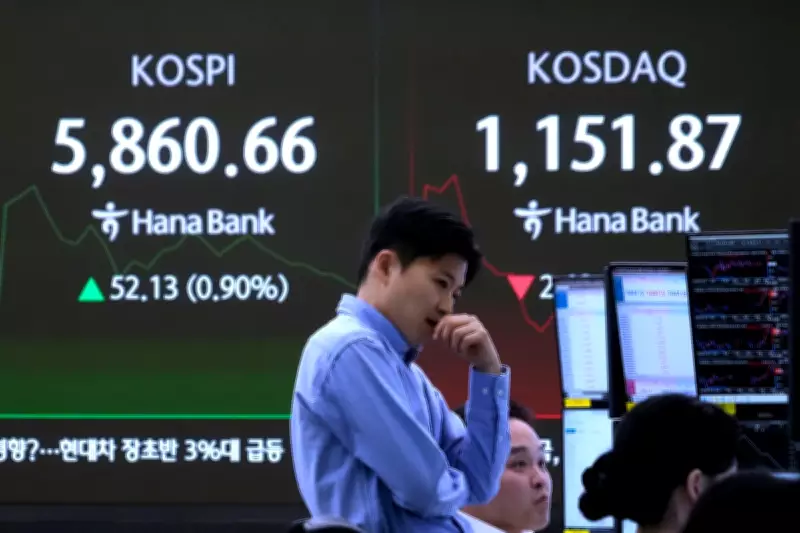
Regional markets displayed divergent responses to the tariff news. Hong Kong's Hang Seng index led regional gains with an impressive 2.2% surge to 26,980.22. Meanwhile, South Korea's Kospi gave back early advances, edging 0.1% lower to 5,809.53. Australia's S&P/ASX 200 shed 0.6% to settle at 9,024.40. Taiwan's Taiex added 0.5%, India's Sensex climbed 0.4%, and Bangkok's SET jumped 1.1%. Markets in Japan and mainland China remained closed for holidays.

Analyst Perspectives and Market Implications
Benjamin Picton of Rabobank observed in a commentary that these mixed reactions "highlight the winners-and-losers effect of shifts in tariff policy that has just delivered a boost to countries who previously had a comparatively bad deal." He further noted that "US tariff policy will continue to be a source of uncertainty for markets as traders attempt to price in the implications of what is still a movable feast."
US futures reflected this uncertainty with substantial declines: the S&P 500 future lost 0.8%, the Dow Jones Industrial Average future dropped 0.7%, and the Nasdaq composite index future was down 1%. This contrasted with Friday's relatively calm Wall Street response to the Supreme Court ruling, which had initially triggered panic in financial markets when the tariffs were announced last year.
Trump's Response and Ongoing Uncertainty
Despite the Supreme Court's decision, tariffs are not disappearing from the economic landscape. Trump declared on Friday that he would pursue alternative avenues to impose taxes on imports from other countries, calling the court's decision "terrible." He announced plans to sign an executive order imposing a 10% global tariff under legislation that could limit its duration to 150 days, later raising that figure to 15%.
The former president indicated he's exploring additional tariff mechanisms through other channels, some of which would require Commerce Department investigations. Market reactions have remained tentative given persistent uncertainties about what specific actions Trump might ultimately take.
Corporate and Economic Indicators
On Wall Street, Akamai Technologies suffered one of the market's sharpest losses, dropping 14.1%. Although the cybersecurity and cloud computing company reported stronger-than-expected results for the end of 2025, it provided a profit forecast for the upcoming year that fell short of analyst estimates. Akamai plans to allocate a larger percentage of its revenue toward equipment and other investments in the coming year, potentially indicating how shortages of computer memory created by the AI boom are affecting customers throughout the broader economy.
Discouraging economic reports showing slowing US growth and accelerating inflation drew a relatively muted response from markets. These reports highlight the Federal Reserve's ongoing dilemma regarding interest rates but did not substantially alter traders' expectations about the central bank's future actions. According to data from CME Group, traders continue to bet that the Fed will lower rates at least twice this year.
Lower interest rates could provide a boost to both the economy and investment prices, but they also carry the risk of worsening inflation. Federal Reserve officials emphasized at their last meeting that they want to see inflation decline further before supporting additional rate cuts.

Commodity and Currency Movements
In early Monday trading, US benchmark crude oil lost 77 cents to $65.71 per barrel, while Brent crude, the international standard, gave up 74 cents to $70.56 per barrel. Currency markets saw the US dollar slip to 154.40 Japanese yen from 154.94 yen, while the euro rose to $1.1820 from $1.1797. Precious metals showed strength with gold prices rising 1.9% and silver climbing 5.4%.
The Supreme Court's tariff ruling has created a complex landscape for global markets, with investors now navigating between the immediate relief of tariff reductions and the uncertainty surrounding potential alternative trade measures. This development comes amid broader concerns about economic growth, inflation pressures, and the Federal Reserve's policy trajectory, creating a challenging environment for market participants worldwide.





