
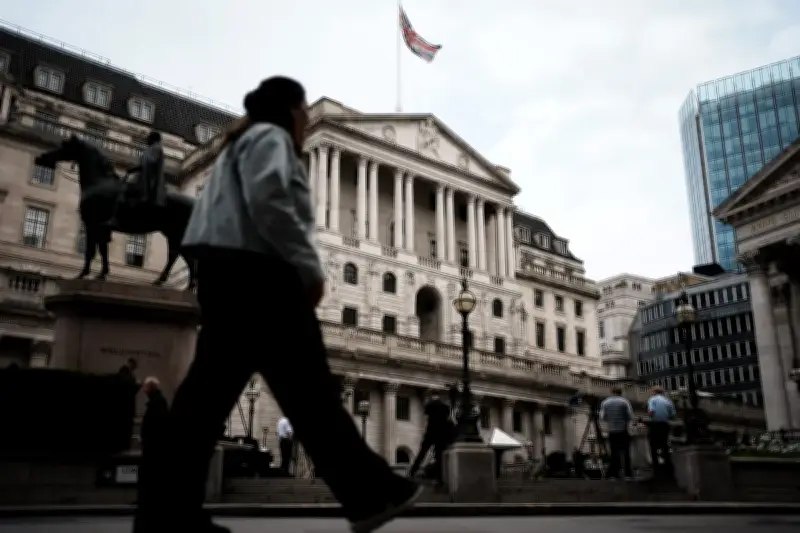
The FTSE 100 made further strong gains on Friday as Bank of England Governor Andrew Bailey played down inflation fears, although banks missed out amid fears of a tax hit.
In London, the FTSE 100 index ended up 41.55 points, 0.4%, at 10,881.90. The FTSE 250 climbed 109.13 points, 0.5%, to 24,533.90, and the AIM all-share rose 8.03 points, 1.1%, to 773.12.
For the week, the FTSE 100 rose 3.1%, the FTSE 250 was up 1.3%, and the AIM all-share was down 0.4%.
Bailey plays down inflation
Speaking at the International Monetary Fund’s annual meeting in Bangkok, Bank of England Governor Andrew Bailey said that evidence of second-round inflation effects was limited.
“To the extent we have seen evidence, it’s quite subdued”, Mr Bailey said, adding: “It’s too early”.
Mr Bailey also said that Bank of England policy was already restrictive and that ahead of the Middle East conflict, “the market was pricing a couple of cuts, and I thought that was probably pretty reasonable”.
He added that the UK economy was “more resilient than we expected it to be”.
Mr Bailey’s comments followed remarks by BoE chief economist Huw Pill earlier this week, who said that the four interest rate hikes priced into money markets look overdone.
Global markets mixed
Also speaking at the IMF meeting, Federal Reserve chairman Kevin Warsh was less forthcoming on his views ahead of the Federal Reserve meeting at the end of the month.
“I don’t prejudge meetings,” Mr Warsh said during a fireside chat with IMF managing director Kristalina Georgieva. “I don’t believe in saying now what I might do at the meetings that we have in the balance of the year.”
UBS notes Mr Warsh has been “loath” to offer explicit forward guidance, even refraining from offering his own forecasts for the summary of economic projections.
In European equity markets on Friday, the CAC 40 in Paris ended up 0.3%, while the DAX 40 in Frankfurt added 1.0%.
In New York, markets were mixed. The Dow Jones Industrial Average was up 0.2% at the time of the closing bell in London on Tuesday. The S&P 500 was 0.4% lower, and the Nasdaq Composite fell 1.2%.
AI trade and tech earnings
Barclays strategist Emmanuel Cau suggested the “best of the AI trade may be over, yet we wouldn’t throw the baby out with the bathwater. BigTech earnings will be key”.
With regard to AI, Mr Cau said that “the maturing phase of the cycle means it is no longer a one-way trade, which comes with lower valuation and more dispersion”.
Meta Platforms and Tesla kick off the technology reporting season next week, with IBM and Texas Instruments also on the calendar.
Tesla fell 1.0% after Thursday’s launch of its new Roadster sports car at an event at a SpaceX test facility in Texas.
The long-awaited second-generation Roadster combines conventional automotive engineering with rocket propulsion technology.
Production is targeted for 2028, compared with the original 2020 delivery target announced when the vehicle was first unveiled in 2017.
Economic data and currencies
In economic data, figures released by the Federal Reserve Friday showed US industrial production growth outperformed in September.
On a monthly basis, industrial production climbed 0.7% in September, up sharply from just 0.1% in August, which was revised up from a flat figure.
The September reading beat the FXStreet-cited forecast of a 0.4% rise.
On an annual basis, total production was 2.2% higher in September.
The pound was quoted at 1.3339 dollars, up from 1.3254 dollars. Against the euro, sterling firmed to 1.1860 euros from 1.1828 euros.
The euro climbed to 1.1248 dollars from 1.1204 dollars. Against the yen, the dollar was trading at 157.88 yen, down from 158.16 yen.
The yield on the US 10-year Treasury was quoted at 5.08% on Friday, narrowed from 5.10% at the same time on Thursday. The yield on the US 30-year Treasury was quoted at 5.42%, unchanged from Thursday.
Banks hit by tax reports
On the FTSE 100, defence manufacturer Babcock International, advertising firm WPP and engineer Weir were prominent risers, up 3.6%, 3.1% and 2.6% respectively.
But banks bucked the stronger trend, with NatWest down 1.2% and Lloyds down 0.9% on reports that the sector will be hit in the upcoming budget.
The Guardian reported late Thursday that UK Chancellor John Healey is poised to tax the banks more heavily in his October 28 budget, to help offset the damage inflicted on the public finances by war in the Middle East.
To keep the Treasury’s deficit reduction plans on track in the face of rising UK government borrowing costs, the Guardian said it understands Mr Healey has decided to tap the financial sector for additional revenue.
One option understood to be under discussion – reversing cuts to the bank surcharge made by former chancellor Jeremy Hunt – would raise upwards of £2 billion a year, the newspaper said.
The UK’s biggest banks and building societies currently pay a surcharge of 3% on top of the baseline 25% rate of corporation tax, plus a levy on the assets held on their balance sheets.
The 3% surcharge was reduced from 8% under the former chancellor, at the same time as he raised corporation tax from 19% to 25%.
FTSE 250 movers
On the FTSE 250, THG rose a further 9.1% after Thursday’s positive trading statement.
Man Group added 1.1%, after it said assets under management increased in the third quarter, supported by net inflows of around 10 billion dollars.
Assets under management amounted to 270.9 billion dollars at the September 30 quarter end, a rise of 6.8% from 253.6 billion dollars in June.
Net inflows totalled 10.1 billion dollars, Man Group said, with the bulk coming in the long-only equity category.
A positive investment performance lifted the assets under management by 5.9 billion dollars.
Net inflows picked up in the third quarter, with the 10.1 billion dollars topping the 7.1 billion dollars Man reported for the whole of the first half of 2026.
Iofina shares shed 9.1%.
The iodine producer said it made “significant” strategic progress in the third quarter, but reduced its second-half production guidance after the quarter’s output was weaker than expected.
Commodities and outlook
Gold was quoted at 4,176.55 dollars an ounce, up from 4,152.39 dollars.
Brent oil was quoted at 106.06 dollars a barrel, down from 106.33 dollars.
The biggest risers on the FTSE 100 were Babcock International Group, up 33.4p at 961.8p; WPP, up 12.3p at 412.7p; Kingfisher, up 9.7p at 348.8p; Weir, up 68p at 2,682p; and BAE Systems, up 50p at 1,983.5p.
The biggest fallers on the FTSE 100 were Scottish Mortgage Investment Trust, down 50p at 1,545p; AstraZeneca, down 252p at 12,446p; Polar Capital Technology Trust, down 11.5p at 635p; NatWest Group, down 8p at 666p; and British Land, down 5p at 417.4p.
Monday’s local corporate calendar has full-year results from ITM Power and Tristel.
Monday’s global economic calendar has a slew of data from China overnight, including GDP and retail sales, followed later in the day by inflation figures in Canada.




