

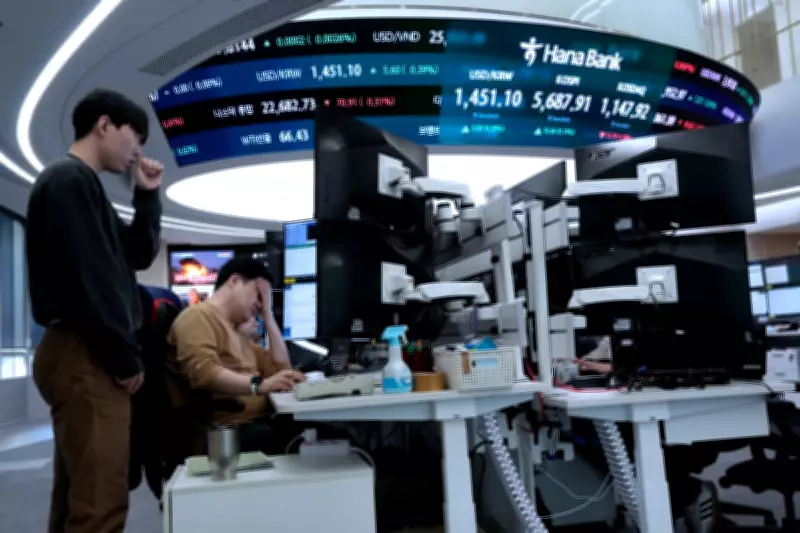
Asian Markets Mixed, US Futures Edge Higher as AI Fears Drag Wall Street Lower
Shares across Asia displayed a mixed performance on Friday, as mounting concerns over the risks associated with massive investments in artificial intelligence and escalating geopolitical tensions between the United States and Iran weighed heavily on major benchmarks. Meanwhile, US futures saw a slight uptick, and oil prices resumed their upward trajectory, reflecting heightened market uncertainty.
Geopolitical and AI Risks Impact Global Markets
Crude oil prices have been steadily climbing, driven by signals from both the United States and Iran that they are prepared for potential military conflict if negotiations over Tehran's nuclear program break down. This geopolitical friction adds to the market's unease, compounding fears that artificial intelligence could disrupt traditional industries and erode business models.
In Tokyo, the Nikkei 225 index fell by 1.2% to close at 56,797.22. This decline was primarily fueled by significant drops in shares of major banks and financial institutions, which are grappling with worries about the potential impact of weakening private credit companies. These companies have extended loans to firms that are particularly vulnerable to AI-driven competition, raising concerns about credit stability and future profitability.

Market heavyweights such as Mitsubishi UFJ Financial Group, which has a partnership with private-credit firm Blue Owl Capital, saw their shares tumble. MUFJ's stock dropped 2.6% in Tokyo trading, following Blue Owl's 5.9% loss on Thursday. Other notable declines included Toyota Motor Corp., which fell 3.9%, and Sony, which was down 3.3%.
Regional Market Movements and Defensive Gains
Hong Kong's Hang Seng index lost 0.6% to settle at 26,544.62 as trading resumed after the Lunar New Year holidays. Markets in mainland China and Taiwan remained closed and are scheduled to reopen next week, contributing to reduced liquidity and volatility in the region.
In contrast, South Korea's Kospi index jumped 2.2% to reach 5,803.40, buoyed by strong performances from major defense contractors. Hanwha Aerospace, for instance, saw its shares soar by 8.6%, benefiting from increased military spending in numerous countries amid global security concerns.
Elsewhere in the Asia-Pacific region, Australia's S&P/ASX 200 edged 0.1% lower to 9,075.70, while India's Sensex added 0.2%. The SET index in Bangkok declined by 0.7%, reflecting broader regional uncertainties.
Wall Street's Recent Struggles and Corporate Highlights
On Thursday, Wall Street experienced declines, with the S&P 500 slipping 0.3% to 6,861.89, the Dow Jones Industrial Average dropping 0.5% to 49,395.16, and the Nasdaq composite losing 0.3% to 22,682.73. These losses were driven in part by fears that AI technology could disrupt various industries, leading to significant sell-offs in certain stocks.
Booking Holdings, the parent company of Booking.com, Priceline, and OpenTable, dropped 6.1% despite reporting a quarterly profit that slightly exceeded analysts' expectations. The company is under pressure due to concerns that AI-powered competitors could reshape the travel industry and lure away customers. Booking's stock has already lost approximately a quarter of its value this year.
Carvana sank 7.9% even after posting a stronger-than-expected profit for the latest quarter. Walmart also contributed to market volatility, initially jumping 2.7% before flipping to a loss of 1.4%. The retail giant delivered robust quarterly results but provided a profit forecast for the upcoming year that fell short of estimates, disappointing investors.
Oil Sector Gains and Economic Indicators
Some of the more notable gains in the S&P 500 came from oil company stocks, which climbed alongside rising crude prices. A barrel of benchmark US crude rose 1.9% to $66.43, while Brent crude added 1.9% to $71.66 per barrel. Early Friday, US benchmark crude was up 29 cents at $66.69 per barrel, and Brent gained 30 cents to $71.96 per barrel.

Occidental Petroleum jumped 9.4% after reporting a quarterly profit that surpassed analysts' expectations. However, higher oil prices could influence the Federal Reserve's monetary policy decisions, potentially leading the central bank to delay interest rate cuts. Fed officials have indicated they want to see further declines in inflation before supporting additional rate reductions this year.
On the economic front, a report showing a decrease in the number of US workers applying for unemployment benefits suggested that the pace of layoffs may be slowing. Other data indicated accelerating growth in manufacturing in the mid-Atlantic region, but the US trade deficit widened in December more than economists had anticipated, highlighting ongoing economic challenges.
Currency and Precious Metals Movements
In early Friday trading, the dollar strengthened to 155.24 Japanese yen, up from 154.99 yen. The euro slipped to $1.1752 from $1.1775. Meanwhile, the price of gold rose 0.5%, and silver increased by 0.8%, as investors sought safe-haven assets amid the market turmoil.
Overall, global markets remain on edge, balancing optimism from corporate earnings against the dual threats of AI disruption and geopolitical instability. As investors monitor developments in US-Iran relations and the broader economic landscape, volatility is likely to persist in the coming sessions.





