
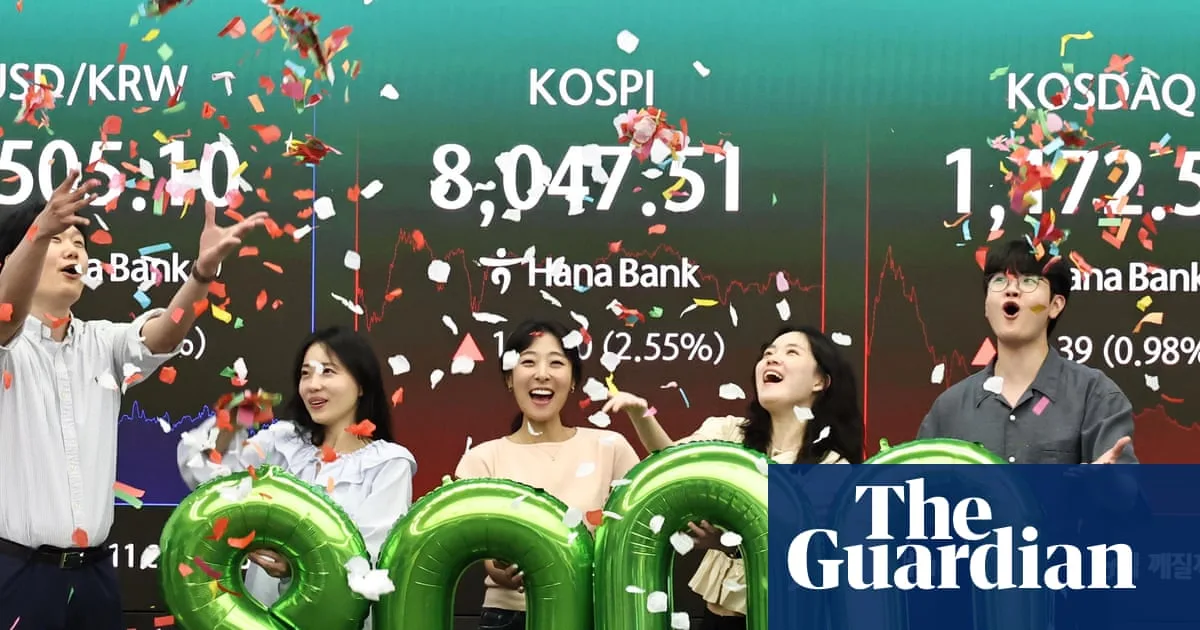
South Korea's Kospi index has reached an all-time high, capping a 220 per cent rise in 12 months and propelling the country past India to become the world's sixth largest share market. The benchmark closed at 8,880 this week, with Goldman Sachs raising its 12-month target to 9,000 in what it called a 'once-in-a-generation surge' in semiconductor earnings.
The rally has been driven by explosive demand for chips used in artificial intelligence, lifting SK Hynix into Asia's trillion-dollar company club alongside Samsung Electronics and Taiwan's TSMC. SK Hynix's share price has risen 1,000 per cent over the past year, while Samsung has soared 500 per cent. South Korea is now the first country outside the United States to boast more than one company worth at least $1tn.
The gains have rippled across the region, with Tokyo's Nikkei 225 also notching an all-time high on Monday. SoftBank Group, heavily focused on AI, toppled Toyota as Japan's most valuable listed company. Nvidia, the world's first $5tn company and a key customer of TSMC, has become central to the AI ecosystem, with its chief executive Jensen Huang calling Taiwan the 'epicentre' of the AI revolution and announcing plans to invest $150bn a year there.
However, some analysts urge caution. Russ Mould, investment director at AJ Bell, notes that the share price charts of Samsung, SK Hynix and US chipmaker Micron bear similarities to companies in 2000, just before the tech bubble burst. The chip sector has a reputation for volatility, although Mould believes AI demand may have put an end to boom-bust cycles.
Peter Kim, global investment strategist at KB Securities, says the demand appears underpinned by 'AI hyperscalers' such as Meta, Amazon, Alphabet and Microsoft, which have 'so much cash' and commitment to AI. But he warns that Samsung and SK Hynix have contributed up to 70 per cent of the Kospi's growth in 2026, leaving the market highly exposed to the global AI spending cycle or supply chain issues.
Ipek Ozkardeskaya, a senior analyst at Swissquote, noted that the Kospi's VIX volatility index hit an 'exceptionally high level' of 75 this week, historically a warning sign. Despite the stellar performance, the concentration of gains in a handful of chipmakers remains a point of concern for investors.




