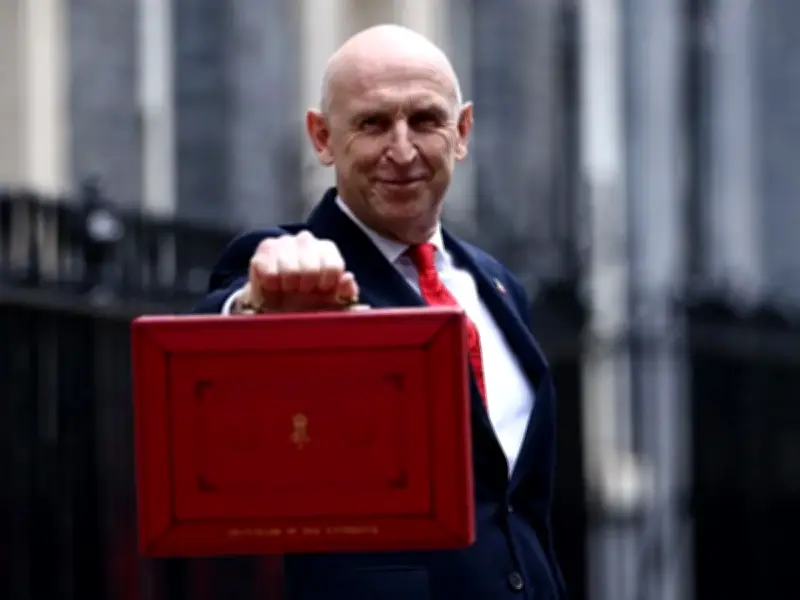
The red despatch boxes carried by British sovereigns, prime ministers and ministers have a history stretching back centuries, and the company behind them has been crafting them since 1760. Chancellor John Healey left 11 Downing Street proudly brandishing his red box ahead of the Budget, and Andy Burnham received one when he became Prime Minister.
The lockable red cases have been used for generations to carry top secret documents and confidential papers, containing information that has taken the country to war, ensured peace and shaped society.
Maker's light-hearted take
Mohammed Suleman, the man behind Barrow, Hepburn & Gale which produces the boxes, insists he doesn't lie awake at night worrying about what they might contain. He laughs: "I worry more about what's not being carried in them! There are rules in place about their use and strict protocols. They shouldn't be ignored."
The firm was founded in 1760 when John Hepburn, a tanner from Yorkshire, moved to London and set up a tannery in Bermondsey, then a major centre for leather tanning. The business grew and expanded, merging with other manufacturers including one which already held the right to make despatch boxes for the British government.
A history of royal and military service
Over the years, the company became one of Britain's largest leather manufacturers, with workers' expertise passed down through generations and even providing equipment for both World Wars. Field Marshall Montgomery visited the London factory ahead of the Allied invasion of Normandy to meet the craftswomen making leather and canvas equipment crucial to the operation.
The heart of the company remained the production of despatch boxes, with their red stained leather and gold print unchanged since Gladstone used one for his budget in 1853. Mr Suleman, who previously worked in a business advisory capacity for UK companies, acquired the firm 26 years ago after investing private family money. At the time, there was both Russian and Chinese interest in the company.
Traditional craft preserved
He recalls: "It was a small box advert in the pink pages of the Financial Times. It read, 'interesting prestige business for sale' and mentioned signing a confidentiality agreement. I didn't understand why they were being so cagey, but when I picked through it all I realised that this was a significant business. Not only was it doing stuff that was centre stage but it was one of the country's oldest established suppliers to the military. There was a lot more going on beneath that simple advert."
The boxes are still made in a traditional way, in workshops situated across the country, with skills passed on from worker to worker. Mr Suleman explains: "We try to use as many workshops around the country as we can. Many are family owned businesses on which we rely. We try to do our bit because without some of the crucial support that we provide these skills would be lost. We've been here for a long time as a business but sadly I think short-termism is a disease which has affected this country for a number of years. That's not how we operate here. Politicians need to walk around the shop floor and get their hands dirty."
He won't disclose how many boxes are made in a year, saying demand is determined by how active a government is, or how much one costs to make. No two boxes are the same, with those privately commissioned, like the one Angelina Jolie has, varying in price. He explains: "They can be very personalised so costs do vary. We made one for a collector of vintage watches, another to house a collection of pens."