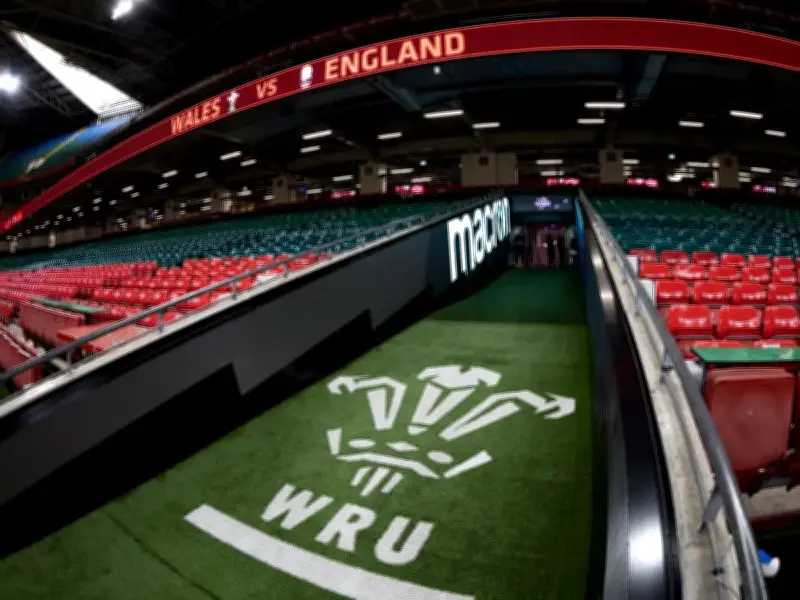
The Welsh Rugby Union (WRU) is expected to have generated revenues of around £110m in its last financial year, having initially been confident of a figure £7m higher. The governing body was initially projecting a figure of around £117m, but took a significant hit from lower-than-expected ticket, hospitality and food and beverage sales during last year’s Six Nations and, more markedly, during its autumn international series.
Revenue shortfall and current year outlook
For the current 2026-27 financial year, the union’s chief financial and operating officer, Gavin Marshall, who joined the governing body last November from English Premiership rugby side Bristol Bears, where he was chief executive, is confident of a similar turnover, despite Wales only hosting five men’s internationals at the Principality Stadium compared to seven in its 2025-26 financial year.
The initial £117m projected revenue figure was outlined by the union’s former chief commercial officer, Leighton Davies, with the support of the wider executive team and board in September 2025. It is not uncommon for firms to have to revise forecasts during a financial year.
Mr Marshall said: “In terms of the numbers, those assumptions haven’t materialised. When you budget, and you miss your budget, you need to understand why and learn from it.” He stressed it wasn’t a criticism of his predecessor. He added: “It is just an observation and you learn and reflect. There are a number of variables in this business that move materially, like the number of events, attendance, ticket yield, team performance, but ultimately we have to take responsibility for budgeting accurately and we need to focus on that going forward.”
Financial position and stadium investment
Mr Marshall, who hails from Pembrokeshire, said he could not give an actual turnover figure for the union’s last financial year to the end of June, as the accounts, which will be published next month, were still being audited by Grant Thornton. However, he said that, based on historic outcomes and taking inflation into account, a figure of £110m could be seen as a responsible assessment.
He added: “The accounts have not been audited yet, so I cannot be specific, but in general terms we have had a challenging year. There is substantial cost around generating that revenue, like staging international rugby, putting on events, the cost of delivering hospitality and food and beverage for those events and the cost of the hotel. The cost of sales is around £50m, so we have a gross profit of £60m, a figure that is more relevant than turnover.
“After that we have our overhead costs, the cost of running the stadium and corporate costs of running a business, and the professional and community rugby programme. Those costs are around £30m. That leaves us with an Ebitda of around £30m, and that is a figure we are not too far away from this time.
“But when you get to £30m, we have the cost of community rugby clubs, Super Rygbi Cymru, the servicing of the debt, and we have to find capital expenditure for the stadium. What is left we spend on professional rugby, and that includes the optimum investment we have identified for our pathways, where we have under-invested.”
As part of a new five-year hospitality and food and beverage partnership with US firm Aramark, he remains confident that a five-year target of growing related revenue from £18m per year towards the £25m to £30m level is achievable. Aramark has committed an undisclosed capital contribution to support the widening of the hospitality offer at the stadium, including some 14,000 new padded seats on level four, which will replace plastic seats that have been in the ground since it opened back in 1999.
Regional rugby and league structure
The WRU is committed to reducing the number of regions from four to three, with it looking for the Ospreys and the Scarlets to bid for one licence for west Wales. Cardiff, which is WRU-owned, and the Dragons will be invited to take up the other two licences. He argued that maintaining funding for four regions was not sustainable. However, opponents to the strategy, including the so-called Coalition of the Willing, counter that there is very little difference financially between funding four - although requiring significant benefactor backing - and three regions, with the latter providing increased investment of around £28m over five years to invest in the pathway development of the game.
Mr Marshall said: “Nobody wants to reduce investment in professional rugby for the sake of it. We want successful professional teams in Wales. What we are saying is that we cannot afford the level of investment we are currently making in professional rugby. That argument will be strengthened when we publish our accounts next month.”
He added: “It is an affordability issue and we want our professional teams to be competitive and have the right level of investment, and the current level of investment we cannot afford. We need to have spending on professional rugby at a level where the game can be sustainable.
“Abi [chief executive Abi Tierney] has talked about investment of £20m in professional rugby, but at the moment it is significantly more than that in terms of our investment and it is more like £26m. We cannot afford that level of investment and, where we are at as a business, that is why we need to change.”
The Coalition of the Willing, which includes the founder of price comparison firm Hayley Parsons and former chief operating officer of Hodge Bank and Principality Building Society, Rob Regan, has called on the union to provide in full the business case for three regions and the risk assessment undertaken on the implications of a loss of a region.
Mr Marshall said he was aware of the public appetite for an Anglo-Welsh league or a British and Irish one. The respective stakeholders in the English Premiership, the governing bodies, CVC and the URC, have been holding exploratory discussions over a possible new league structure. However, it would need enough of a commercial uplift, starting with a lucrative TV deal, to be appealing to all parties, but most importantly the English Premiership clubs.
Mr Marshall would not be drawn on the nature of any talks or whether he had any involvement. He added: “We are a member of the URC (United Rugby Championship, which the Welsh regions play in) and I want to respect that competition, but I acknowledge the public sentiment on Anglo-Welsh competitions and fully understand why it attracts such interest.
“It is worth noting that we have put in an application to PRW (Premiership Women’s Rugby) for two Welsh women’s teams to play in the English league.”
Events, ticket sales and commercial growth
He said the union had no plans to reduce its headcount. In 2024-25, when the union posted revenues of £106.1m and pre-tax losses of £7.2m, it had a total workforce of 344. He said: “Our headcount is pretty stable and that will be seen in the accounts, but we cannot cut our way to success. We need to grow our commercial revenues and we are happy with the cost base, which is appropriate for our business, although it is really important to control costs appropriately and we scrutinise every new hire, but we have no plans to run a redundancy programme.”
Its current financial year is the first with the WRU feeling the full impact of giving up equity, along with the other unions, to CVC in the Six Nations. That deal, struck in 2021, gave the private equity firm a 14% interest and rights to a share of commercial income generated by the Six Nations. Last year the WRU received its last phased payment (£8.5m) for its £40m share in what was a £360m deal. The full impact of the dilution will see the union being around £3m down.
Mr Marshall said for the current 2026-27 financial year, despite fewer Welsh home rugby internationals, revenues should come in around the same as the last financial year. He explained: “On the rugby side there will be five games rather than seven, but historically England and Ireland are very strong. We are ahead of where we were previously in terms of those sales. It is really important to have a strong autumn.
"It is still early days in terms of ticket sales for those games. We are really positive about the new tournament structure of the Nations Championship, and having three games to sell in quick succession is probably easier than four, which was a bit of a stretch last year.
“So, we are probably expecting a relatively flat year revenue-wise. We have got fewer games, but we would expect to drive a better yield and we have got some premium games in there with New Zealand, England and Ireland. In terms of events, the calendar for 2027 is looking very strong, with a lot of announcements over the next month or so for events between now and the end of the year.”
The union has increased its number of ticket price categories from three to six for rugby internationals. Mr Marshall said: “Our most expensive tickets are a jump, but we are already sold out. We need to drive increasing yields and I think we can do that with our six categories rather than three. We want to keep it affordable and accessible. We are only selling family tickets in the lower tier to create that family zone.”
On a full ground for the New Zealand game in November, Mr Marshall said: “We are not complacent, but confident.” With regards the other two autumn games against Australia and Japan, he added: “We got a great crowd last year against Japan, with a great family crowd and a great game of rugby. We are looking to replicate a similar crowd to what we had last year, with just over 60,000.
“We have kept the tickets affordable for Japan. The Australia game at 8pm on a Saturday is a challenging time as it potentially rules out families, with a lot of competition on a Saturday night. So we recognise that Australia is the most challenging due to the time, but we haven’t played them for a couple of years and we have got the Stickmen with the half-time show, which has proved really popular previously.”
On the concert market, he said: “We are really happy and have a couple of concerts booked, with discussions ongoing in a really strong pipeline. We are really confident that 2027 will be a great summer for concerts. We have Andrea Bocelli announced and we are expecting that to sell out, with ticket sales really strong for May. We were delighted to get him and it fits in with our strategy of trying to get a broader mix of events here.
“We have been very strong with pop and rock concerts, but having a different genre and financial model for that event, we are really happy with, and we plan to make it a biennial event.
"We have been very successful with concerts, but what we are looking at is attracting elite football to the stadium, like the Community Shield, and we are delighted to secure the Women’s Champions League final in 2029, so we have really identified football as an area of growth.
On getting to £30m over a five-year period from around £18m from hospitality and food and beverage sales at the stadium, while an ambitious target, he is confident it is achievable. He said: “Yes, we are (confident). So far we have focused on technology-led improvements, with speed of service and e-bars across the stadium, which were a big success at the Community Shield. But that is just part of it. With the deal with Aramark, we have a capital fund to spend to improve facilities.
“We are looking to develop level four as a real premium experience, including replacing around 14,000 seats on level four with new padded ones. The seats are just part of it, with investment in the concourse and the whole area to create a premium experience around level four. We are also looking to increase our hospitality capacity and have different types of hospitality that we can offer. We are confident that these things will help us drive food and beverage revenue, but also ticket yield.”
As part of its strategy to create an all-year-round venue, the union has opened a new riverside bar (with a licensed bar) on the River Taff walkway side of the Principality Stadium.
Hotel, debt and other assets
Mr Marshall said the Parkgate Hotel, next to the Principality Stadium, continues to perform strongly. The union owns a 75% stake in the hotel, with the remainder held by Cardiff-based property development firm Rightacres. In its last audited financial year to the end of June 2025, the hotel, next to the Principality Stadium, posted revenues of nearly £13m, with a profit of £498,000. The hotel was financed with a £45m funding deal with L&G, repayable over 45 years.
With cash of more than £1m, Mr Marshall wouldn’t be drawn ahead of the accounts being published as to whether the union has now received its first dividend from the hotel. He added: “It is trading profitably and we are really pleased with its performance. It was always seen as a long-term investment rather than a short-term cash exercise. The objective is to create long-term value by the investment.
In 2024-25 the union had a net debt position of £124m. Mr Marshall said; “The focus is on ensuring that our debt is affordable and we maintain liquidity and do not constrain our ability to invest in rugby. Our debt levels are pretty stable in terms of the facility with Goldman Sachs and HSBC, but also the facility with Parkgate (around a £45m lease finance with L&G) and our debentures.”
He said that the union had not explored, although previous regimes did, a possible securitisation against future income from stadium events or a sale-and-leaseback deal. While it would provide significant upfront capital, it would have to be repaid with a profit margin for an institution or institutions prepared to do a deal. Mr Marshall said: “There is a real cost around debt, so it is not something we are considering at the moment. What we are focusing on is getting value out of our assets, and what we are focused on is growing the events business from the stadium and driving more revenue and profit.
“We recognise that we need to broaden the mix of events. There is effectively a rental payment, but also the upside of food and beverage income, which is a similar financial arrangement to concerts.”
In January the union struck a new £60m funding deal, with a revolving facility element that can flex up and down when required, and £5m specifically for capital expenditure projects, with HSBC and Goldman Sachs. In what is a three-year deal around half was deployed by the WRU to refinance loans with the Welsh Government and NatWest. The facility has added to the overall debt position, but is carrying a lower interest rate than the previous debt deals.
Mr Marshall: “We are on better terms and will still have headroom in that facility, but the more we eat into it, the higher the interest payment.” On striking a long-term deal with its funders he said: “It would be wrong to disclose confidential discussions around different options, but Goldman Sachs and HSBC are great partners and we hope they will continue to be beyond this period.”
Last year the union terminated its partnership with Wire & Sky as operator of its stadium roof walk and zipwire attraction Scale. The attraction, using CVC monies, cost around £5m. Its performance was extremely disappointing and was failing to cover operational costs. However, Mr Marshall said he is confident that new operators, Welsh firm Zip World, will turn things around. He said: “It is still early days with the new operator and we have not had the first full year yet, but we are seeing increased revenue and it is worth saying that in terms of customer feedback that is very strong.
"We know that people who are using it are enjoying it and are happy with the product. It is growing, but yes the original model didn’t perform as we hoped and we have to be open about that and acknowledge that, but we