
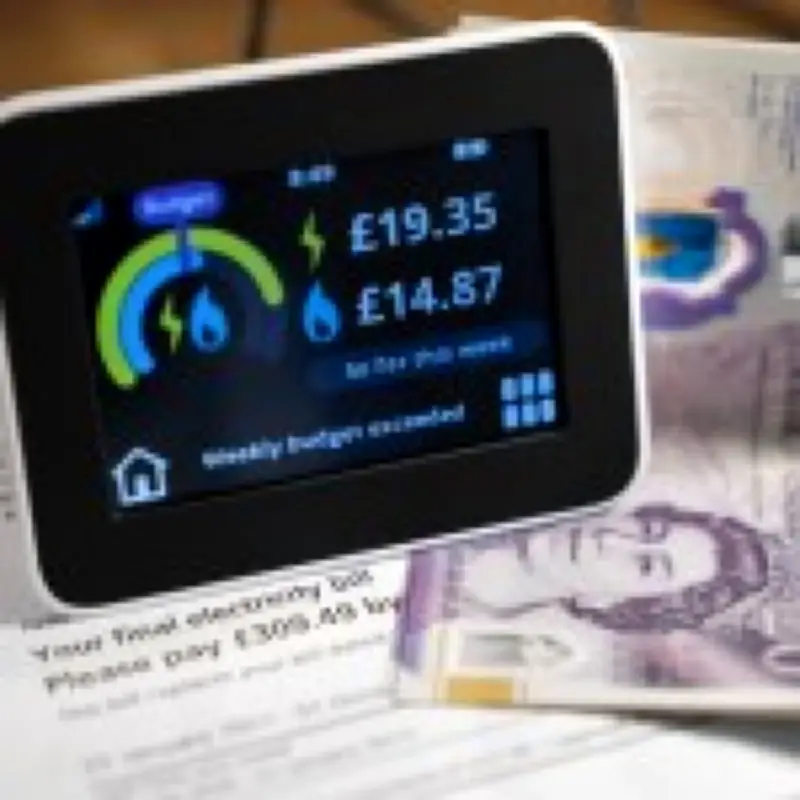
Millions of households are being urged to submit energy meter readings today as the Ofgem price cap rises by 13%, adding approximately £18 per month to typical dual-fuel bills. The increase, effective July 1, 2026, is driven by higher wholesale costs exacerbated by the ongoing conflict in the Middle East, with analysts warning that elevated rates could persist until at least winter.
Bill payers without smart meters are advised to provide a reading immediately to ensure their previous consumption is charged at the lower rate, avoiding being billed at the new higher price for energy used before the cap change. Some 33 million homes are covered by the price cap, though those on fixed-rate tariffs—about 40% of British households—are not affected.
Chancellor Hints at Support Amid Political Uncertainty
Chancellor Rachel Reeves has indicated that means-tested support could be introduced in the autumn to help vulnerable households. However, her position is uncertain as a potential cabinet reshuffle under incoming Prime Minister Andy Burnham looms. Experts caution that future energy rates depend heavily on negotiations between the US and Iran over the Strait of Hormuz, a critical chokepoint that normally handles 20% of the world’s natural gas. Craig Lowrey, principal consultant at Cornwall Insight, warned that even in the best-case scenario, the impact of the war would be felt for months to come.
Consumer Debt and Scam Warnings
British energy suppliers were owed a total of £4.79 billion by consumers by the end of March 2026. National Energy Action highlighted that the recent heatwave underscores the need for improved energy efficiency in properties and debt relief for those struggling to pay. Suppliers offer schemes to assist customers in difficulty. Consumers are also being warned to stay vigilant against scams, including fraudsters posing as government or energy company officials.
Martin Lewis on Cheap Fixes and Standing Charges
Money Saving Expert founder Martin Lewis urged consumers to take advantage of several new fixed-rate tariffs launching today. He wrote: “Everyone on standard-rate tariffs will see their price rise tomorrow as Ofgem’s 13% higher July Price Cap starts. Ironically, at the same time, there’s a few new cheap fixes launching – letting you lock-in far cheaper – as wholesale costs have been a smidge lower this last week.” He cited Fuse Energy, offering an average of 17.2% less than the price cap for new customers on a 13-month fixed tariff. Outfox follows at 16.5% less for both existing and new customers on a 15-month fixed tariff. Among major suppliers, Eon was cheapest at 15.4% less than the July price cap for a 12-month fixed tariff.
However, Lewis noted that the most common consumer complaint concerns standing charges—fixed daily fees that are applied regardless of usage. Speaking to the Commons Public Accounts Committee, he said: “I always use the analogy if I go to buy a book from a bookshop, they don’t say ‘Sorry you have to be a member of a club in order to buy a book because we have fixed costs’. Why do we have to have fixed costs factored into a daily charge and variable costs factored into a unit rate?” He expressed disappointment that Ofgem had not introduced a “dual price cap” to create lower and standard rates based on usage.
Impact on Typical Households
Ofgem has also revised down its definition of “typical” consumption due to changing household habits and improved energy efficiency, as reported by the BBC. For a household using the typical amount of gas and electricity, the increase amounts to £18 per month. The price cap does not affect those on fixed rates, which cover approximately 40% of British households.




