
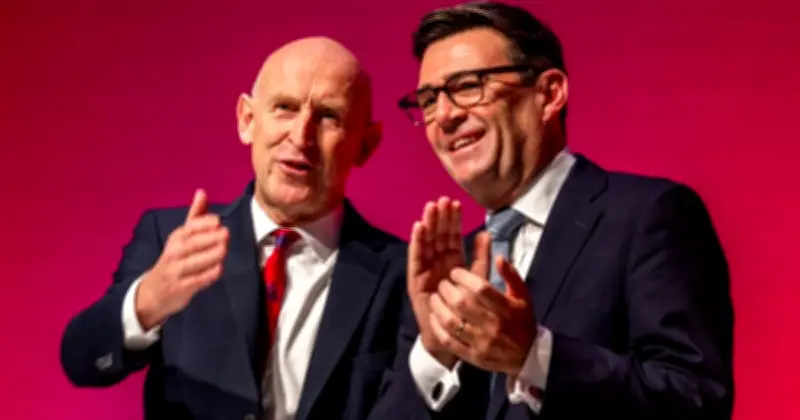
Andy Burnham and John Healey have been tipped to make three tax changes in this year's Autumn Budget. The Chancellor will outline the Government's financial plans on Wednesday, October 28. Not a lot has been trailed to date, although experts have suggested certain taxes may be in Mr Healey's sights, including Britain's outdated property tax system and Capital Gains Tax.
Smaller tweaks expected
Emma Rawson, director of public policy at the Association of Taxation Technicians (ATT), told the Daily Express that Mr Healey may have to make many smaller adjustments in the Budget. She said: "With changes to the 'Big Three' taxes - Income Tax, National Insurance and VAT – all but ruled out, the Chancellor may have to resort to a wider range of smaller tweaks in the hope they add up to larger receipts."
Labour promised not to raise Income Tax, National Insurance and VAT in its 2024 General Election manifesto. It leaves Mr Healey facing the same dilemma as his predecessor, Rachel Reeves, who was under enormous pressure to raise more revenue to fund public services without hampering Britain's economic growth.
The current incumbent at No.11 must find the money to meet a pledge to raise defence spending to 3% of GDP as well as fulfil Prime Minister Andy Burnham's promises to build more council houses and fund a new national care service.
Possible measures
Ms Rawson said Budget tweaks could include an additional tax on bank profits, changes to motoring taxes ahead of the expiry of the extended fuel duty freeze and a drive towards more timely payment of tax debts. She added: "One area in which we are expecting to see further announcements is small company taxation, in particular close companies."
In general, a close company is one that is controlled by five or fewer people, who may include directors, shareholders, or others. According to the ATT, the small company Corporation Tax gap currently stands at 44.6% of the theoretical Corporation Tax payable by small companies, and is an area of concern for both the Treasury and HM Revenue & Customs (HMRC).
Ms Rawson said changes which are less likely in the Budget apply to Capital Gains Tax and Inheritance Tax, the latter of which, she said, has already seen recent reforms and raises a comparatively modest amount for the public purse.
Fiscal discipline
ATT's public policy chief added: "We would urge that, rather than piecemeal changes to different taxes, more radical reform of the tax system is needed to tackle complexity. Unfortunately, however, such reforms require time and political will, unlikely when successive chancellors feel under pressure to increase tax revenues."
Mr Healey has already said fiscal discipline comes first and has committed to a "buffer against uncertainty". Ms Reeves's last Budget left about £22billion of fiscal headroom, but it is not clear how much wriggle room the current Chancellor has left after recent rises in the cost of Government borrowing amid tensions in the Middle East.
Grant Thornton's head of tax policy, Abigail Agopian, writing in September, said this year's Budget is harder to predict, with little leaking of potential tax policy measures. She suggested that if this discipline holds, then the Budget may become one of the least predictable fiscal events in years. Ms Agopian said areas to watch include sector-specific levies on bank profits and on the oil and gas sector.
She said property taxes also remain "an area to watch" at this Budget and beyond. Mr Burnham has long shown support for an annual tax on land values, but he has ruled out making major changes in the next Budget.
In its pre-Budget analysis, the Institute for Fiscal Studies thinktank said the most pressing problem for the Chancellor is that inflation will erode the budgets of Government departments. This will create a need for either large cuts to some public services or potential top-ups to spending plans, costing tens of billions of pounds. Analysis by the IFS found that while the war in the Middle East will mean inflation is higher than expected in the coming years, rising prices will also boost tax revenues. This means the fall in the financial buffer available to the Chancellor will be smaller than widely anticipated.




