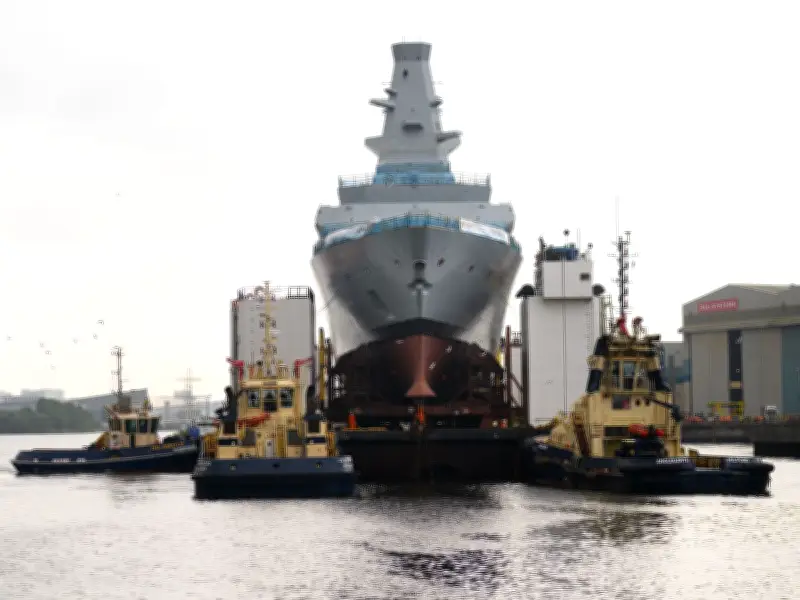
The UK Government has been warned that an increase in defence spending must secure shipbuilding jobs in Scotland and not lead to orders being sent overseas. In one of his final major policy announcements as Prime Minister, Keir Starmer said spending on the Armed Forces would reach £80bn a year by 2029, up from £54bn when he took office in 2024.
New fleet of destroyers not to be built
Industry experts said there were now "question marks" over the future of Scottish shipbuilding after it was confirmed that the six Type 45 destroyers currently in service will no longer be replaced by the planned Type 83 versions. Instead, the Navy will get several cheaper ships called common combat vessels that will act as hubs controlling a fleet of uncrewed vessels or drones.
Political pressure is already growing to ensure the new vessels are built in Scotland, where the Clyde yards and Rosyth are already established centres of naval shipbuilding excellence. The Glasgow yards at Govan and Scotstoun are currently working at capacity building the Type 26 frigate programme, but there is now uncertainty over where future orders will come in the 2030s.
GMB Scotland secretary calls for fair procurement
Louise Gilmour, GMB Scotland secretary, said: "The spending announced today will help secure the UK but must also secure skilled UK jobs and modern, world-class apprenticeships. Every pound spent making our country safer should be a pound spent making our country and our communities economically stronger. For too long, our governments have been content to send work, jobs and skills abroad, while allowing our own industrial capabilities to wither. It cannot go on. Procurement must be far faster and much fairer."
Gilmour said defence companies, from the naval shipyards in Glasgow and Fife, to small, specialist engineering firms need a pipeline of work to secure jobs and recruit apprentices to begin closing Scotland’s widening skills gap. She added: "Scotland has highly skilled workers, from coders to shipbuilders, but not nearly enough. This investment offers the opportunity to change that. Our country does not need to sustain its skilled workforce but grow it and that demands more world-class apprenticeships training our young people in the skills of tomorrow."
Scottish Labour MSP calls for continuous shipbuilding commitment
Paul Sweeney, Scottish Labour MSP and a former shipyard worker, said: "We need a commitment from the Government to continuous shipbuilding at Govan, Scotstoun and Rosyth - and how that will be achieved to sustain the country's industrial base. The common combat vessel proposal does make sense. Having spoken to industry contacts and in Government, the idea these will be smaller than a Type 45 destroyers is not necessarily the case. Steel is cheap, and I think we'll see a ship built on that kind of scale to act as a serious command ship."
UK Defence Journal editor highlights uncertainty
George Allison, editor of the UK Defence Journal, said: "The trouble is that this is less work overall than the industry expected. But the assumption had been that the Clyde would build the upcoming six or so Type 83 destroyers and Rosyth would pick up a number of Type 32 or further Type 31s, so two separate streams of work, avoiding the feast and famine cycles of the past. Norway ordering five Type 26s helps the Clyde and pushes its workload further out, but it does not change the underlying problem, which is that once the Type 26 run finishes there is currently nothing lined up to follow it on the Clyde in the latter part of next decade, now the destroyer work has gone. It leaves a real question mark over the Clyde in the 2030s, and across Scotland as a whole it amounts to less shipbuilding than was on the cards even a week ago. There's nothing in the pipeline after Type 26 at Govan, so what happens next? Six frigates isn't enough to keep two major naval shipyards running into coming decades."