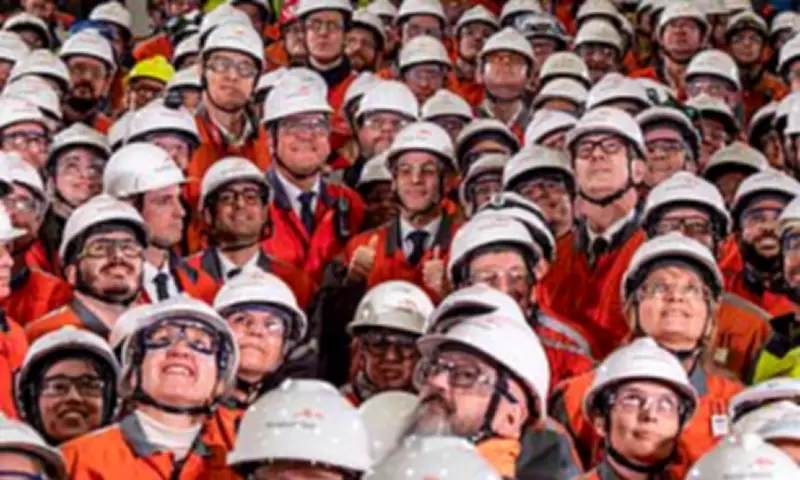
French President Emmanuel Macron seamlessly integrated himself among factory workers during a tour of new production lines at a major steel plant in Dunkirk, France. Dressed in standard safety gear including a hard hat, protective goggles, and a high-visibility vest, the president was nearly indistinguishable from the employees surrounding him at the ArcelorMittal facility.
Major Investment in Decarbonisation
During the presidential visit, company executives revealed that €1.3 billion (approximately £1.13 billion) would be invested to replace one of the site's coal furnaces with an electric model scheduled to become operational in 2029. Photographs from the event captured Macron smiling broadly and giving enthusiastic thumbs-up gestures as the significant funding announcement was made.
Addressing Union Concerns
Trade unions had previously expressed fears that ArcelorMittal might abandon the decarbonisation plan, which was originally announced two years ago. The comprehensive strategy involves replacing two coal-fired furnaces at the Dunkirk site with modern electric arc models to substantially reduce carbon emissions.

"If we want to build cars and infrastructure in our Europe, we need to produce European steel and less carbon-intensive steel," Macron declared while engaging with some of the facility's 3,200 employees. The president emphasised the strategic importance of maintaining robust steel production capabilities within European borders.
Funding Structure and Industry Challenges
Half of the substantial funding for this industrial transformation will originate from Energy Efficiency Certificates (CEE), a distinctive French investment programme financed through contributions from energy suppliers. This financial mechanism represents a innovative approach to supporting industrial decarbonisation efforts.
"With this strategic investment, ArcelorMittal confirms its commitment to France and Europe," stated Reiner Blaschek, the company's head of flat steel products in Europe, during Macron's high-profile visit to the industrial complex.
Competitive Pressures and Regulatory Support
The steel manufacturer has been actively lobbying European officials to implement protective measures for the continent's steel sector, which faces intense international competition. Asian rivals, in particular, operate without the stringent emission regulations that European producers must adhere to, creating significant competitive disadvantages.
While announcing a rise in projected 2025 operating profit to $2.9 billion this week, company representatives specifically welcomed recent reforms to the European Union's 'carbon tax' mechanism. These regulatory adjustments are designed to offset the carbon dioxide emissions of foreign firms, thereby creating a more level competitive playing field.
Environmental Significance and Political Context
According to French government assessments, ArcelorMittal's Dunkirk facility ranks among the fifty largest industrial sources of greenhouse gas emissions in the country. This classification underscores the environmental significance of the planned decarbonisation initiative.
With employees expressing legitimate concerns about potential job reductions if ArcelorMittal scales back its European operations, leftist lawmakers have proposed nationalising the company's French assets. A bill addressing this controversial proposal is scheduled for debate in the French Senate on February 25th, highlighting the political dimensions surrounding industrial policy.
Industry Leadership Expresses Gratitude
"I must thank President Macron and the French government who - very early on - understood the challenges the European steel industry was facing," declared ArcelorMittal CEO Aditya Mittal in an official statement following the presidential visit.
Mittal further elaborated that "their support, and in particular their efforts to drive changes to the mechanisms defending the steel market, will benefit the entire steel industry in Europe, starting here in Dunkirk." This acknowledgement highlights the collaborative relationship between industrial leadership and governmental authorities in addressing sector-wide challenges.