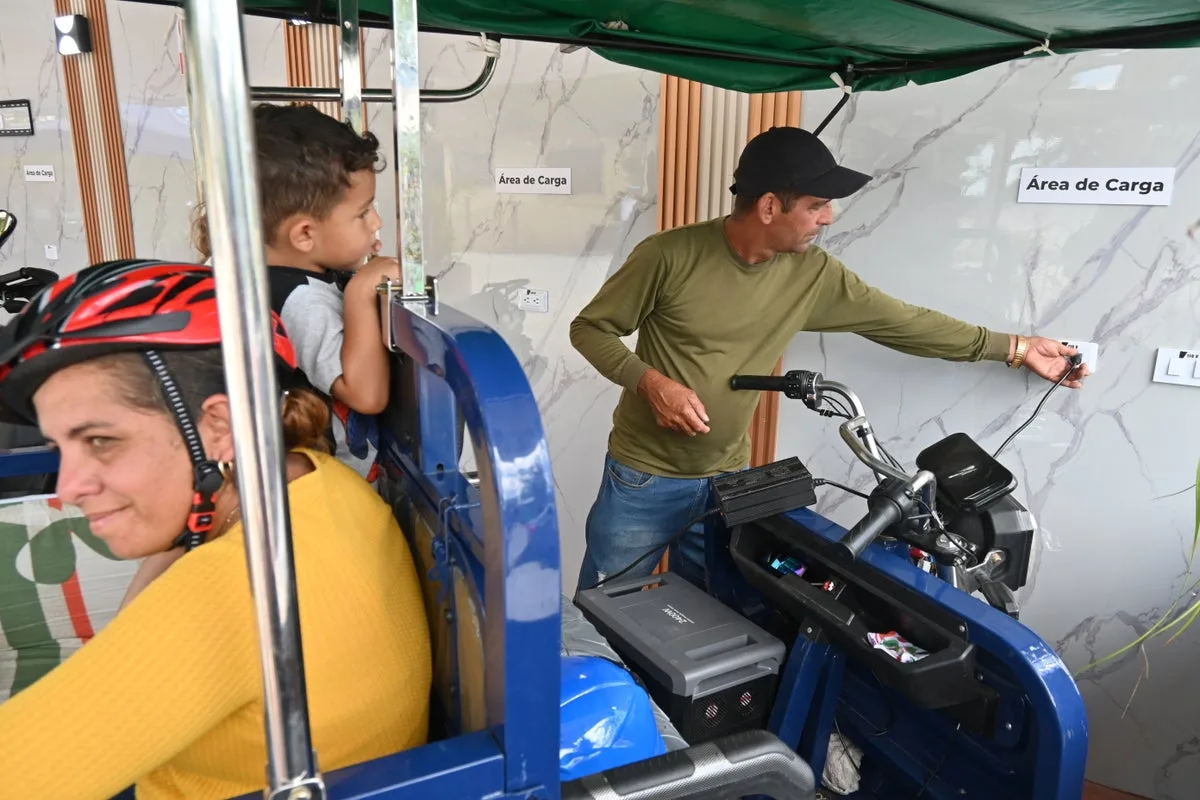
A pioneering solar-powered charging station in central Cuba is providing a lifeline to residents struggling with chronic blackouts and severe fuel shortages. Known locally as a "solinera," the free facility in Santa Clara has become a hub for people to recharge everything from electric vehicles to household appliances.
From Hitchhiking to Solar Power
Yudelaimys Barrero Muñoz used to spend up to three hours on a highway under the blazing sun trying to hitch a ride from Cienfuegos to Santa Clara to buy supplies for her family. The 43-mile journey was impossible on her husband's bicycle or their rechargeable three-wheeled vehicle, which lacked the battery capacity for a round trip. In early April, a local business owner opened what is believed to be Cuba's first solar-powered charging station—and it was free. Barrero Muñoz now drives regularly to Santa Clara with her husband and two young children, able to charge their vehicle and transport heavy goods like rice, sugar, and soap. "If it hadn't been for this, I wouldn't have been able to keep selling," she said.
Addressing Cuba's Energy Crisis
The Cuban government has accelerated solar panel installations in hospitals and other public sites, and established solar farms in response to chronic blackouts and a severe gas shortage caused by the U.S. energy blockade. Renewable energy now accounts for about 10% of the island's electricity, up from 3.6% in 2024, but distribution remains limited and few Cubans can afford private systems. Globally, just over 30% of electricity comes from renewables like solar, wind, and hydropower, according to energy think tank Ember.
Community Impact in Santa Clara
Santa Clara, a historic city of nearly 250,000 people, is known for its role in Cuba's 1959 Revolution and as the home of philanthropist Marta de los Ángeles González Abreu. Residents like Danailys Arboláez Pérez, a mother of two who sells food from her home, use the station to cook rice and beans, fry fish, and recharge fans to cool her children's rooms. "Almost everyone in this neighborhood goes there," she said. She no longer has to jump out of bed when power suddenly returns at 2 a.m. to cook or wash.
How the Station Works
Alexander Gutiérrez Altuve, who works at the business that financed the station, said the owner collaborated with the government to install solar panels providing 30 kilowatts of energy and a 60-kilowatt battery—enough to power an average U.S. home for a day. The station has 20 sockets for equipment, 16 spots for vehicles, and 12 for cooking. "This is something that hadn't really been done before," Gutiérrez Altuve said. Staff member Lisandra Couto Pérez noted that some people are initially shy to use it, surprised that it is free.
Transforming Daily Life
Lorenzo Ravelo, Barrero Muñoz's husband, used to borrow money to rent a car for medical emergencies. Now, with their three-wheeled vehicle charged at the solinera, the family can even take trips to the beach. "It's a great solution," he said, tearing up. The station has become a vital resource, helping residents cope with Cuba's daily challenges.