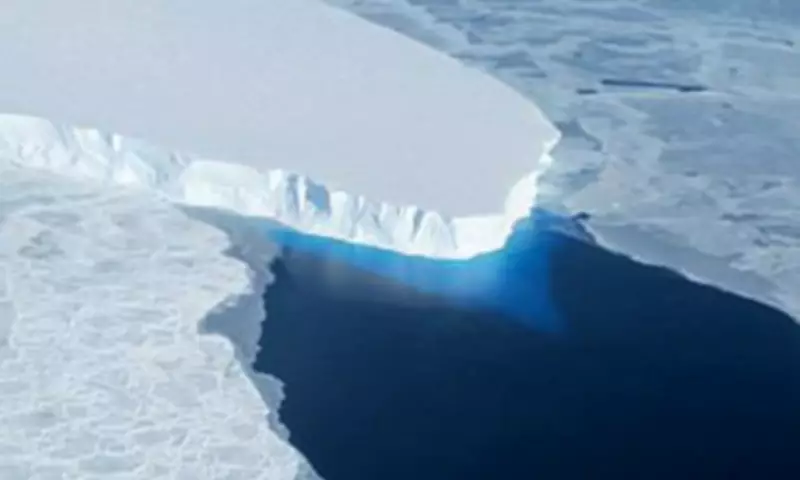
Scientists have issued a stark warning that Antarctica's Thwaites Glacier, often called the Doomsday Glacier, is approaching a critical tipping point. The eastern ice shelf, a crucial buttress holding back the glacier's flow into the sea, could disintegrate within months, according to researchers.
Thwaites Glacier: A Colossus Under Threat
Thwaites Glacier is one of the largest in the world, covering an area comparable to Great Britain. If it were to collapse entirely, it could raise global sea levels by 65 centimetres (26 inches), devastating coastal communities worldwide. The glacier's eastern ice shelf, known as the Thwaites Eastern Ice Shelf (TEIS), is a massive wall of ice attached to its eastern flank. This shelf, over 350 metres thick and spanning 1,500 square kilometres, acts as a natural dam, slowing the glacier's slide into the ocean.
However, warming ocean waters are thinning this frozen barrier at an alarming rate. Dr Robert Larter, a marine geophysicist at the British Antarctic Survey, warns that the shelf's breakup is "very likely to happen sometime this year." He told Live Science: "The last bit of ice shelf in front of the glacier is poised to disintegrate. We don't know quite how this ice shelf is going to break up, but it's definitely going to go."

Why Is the Ice Shelf Collapsing?
The primary driver of this transformation is the thinning of the ice shelf from below as warm water flows beneath it. A recent drilling expedition revealed that the waters under Thwaites are warming, weakening the shelf's structure. Satellite images show new fault lines opening at an increasing rate, particularly along the grounding line where the floating ice meets the bedrock. This indicates that the ice is tearing itself apart as it is forced against this pinning point.
"It's tearing away from the glacier at the moment, and its internal structure is getting more and more fragile," Dr Larter explained. "You can see the fractures and rifts growing in sequences of satellite images." Between January 2020 and January 2026, the TEIS's flow rate tripled to over 2,000 metres per year, and it has accelerated further in the first five months of this year.
Implications for Global Sea Levels
The Thwaites Glacier already contributes about 4% of global sea level rise. If the eastern ice shelf collapses, it could accelerate the glacier's slide into the sea, potentially leading to its complete collapse over decades to centuries. Dr Larter stated: "Even if we get to net zero emissions by 2050, this glacier is going to go. It is going to add 65 centimetres to sea level rise, which is a large commitment and will be something that's difficult to deal with in many places around the world."
However, not all scientists agree on the immediate impact. Dr Daniel Goldberg, an ice sheet expert at the University of Edinburgh, acknowledges that the TEIS is on the verge of collapse but believes the consequences for the entire glacier may be overstated. "We saw very little difference in the evolution of Thwaites between keeping the ice shelf intact and removing it entirely," he said, based on ice sheet models. He cautioned that Thwaites is one of the most difficult glaciers to model accurately, making predictions uncertain.
What Is the Doomsday Glacier?
Thwaites Glacier, nicknamed the Doomsday Glacier, is roughly the size of Great Britain or Florida. With ice up to 2,000 metres thick in places, its complete collapse would raise sea levels by 65 cm, flooding coastal areas and displacing millions. The glacier has been retreating since the 1970s, with its grounding line retreating nearly 14 kilometres between 1992 and 2011. Annual ice discharge from the region has increased by 77% since 1973.
The British Antarctic Survey has reportedly prepared an "obituary" press release for the TEIS, underscoring the urgency of the situation. While the timeline for the glacier's full collapse remains debated, the imminent loss of its eastern ice shelf marks a significant step in Antarctica's contribution to sea level rise.