In 2024, Constance Soule, a disabled Alzheimer's patient with a housing voucher, received a notice of termination giving her 10 days to move out of her Larkspur, California, apartment. She had paid her rent at a complex managed by Greystar, the country's largest apartment manager, but faced eviction solely over utility charges, court documents show.
"It just kept adding up," said Margot Jones, Soule's older sister. "I said, 'She's paid her rent. You're charging her all these extra fees.'"
Soule's story is familiar to Lucie Hollingsworth, policy director of Legal Aid of Marin County, California, which helped Soule and Jones navigate the eviction notice. Hollingsworth estimated that a majority of the evictions her agency currently sees for nonpayment involve tenants who are unable to pay their utilities.
How Ratio Utility Billing Systems Work
Ratio utility billing system fees, known as Rubs, are charged on top of rent. Unlike standard utility bills where tenants owe money to the utility company, Rubs are owed to the landlord and often paid through a third-party billing company. Many leases that include Rubs are written so tenants can be evicted for not paying utilities even if they have paid their rent.
For more affluent tenants, Rubs can raise housing costs by hundreds of dollars. For working-class and low-income tenants like Soule, falling behind on these charges can lead to eviction notices.
While there is no national data on evictions tracked by cause, tenant attorneys and advocates in Philadelphia, Los Angeles, Oakland and Columbus, Ohio, said utility-related eviction cases appear to be increasingly common.
Tenants and Advocates Fight Back
Eight cities in California have banned the use of Rubs within their borders, and multiple states have passed laws regulating the practice. California's attorney general reached a settlement of nearly $500,000 last year with a national property management firm to resolve allegations that it had used Rubs to make shadow rent increases that violated the state's limits on how steeply landlords can raise rents.
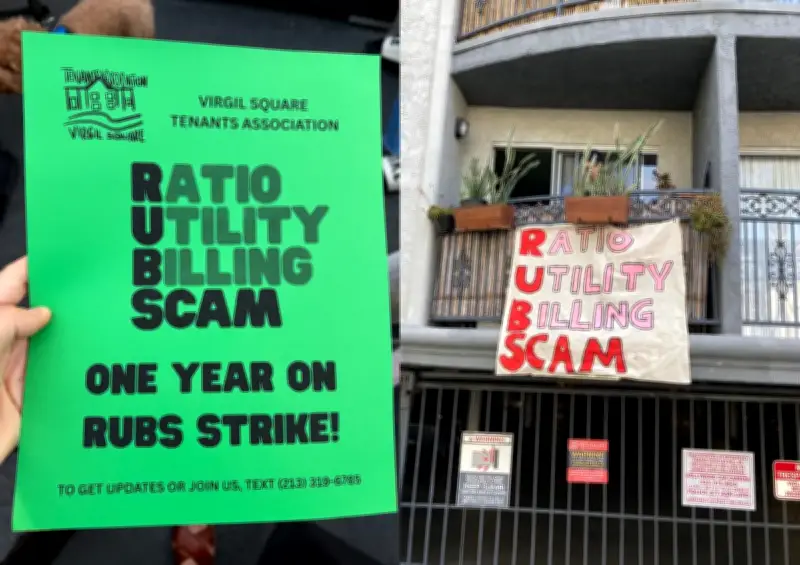
Tenants in Los Angeles and Seattle have launched Rubs strikes, refusing to pay utilities until landlords agree to reduce charges that can approach $300 a month per apartment. Members of LA's Virgil Square Tenants Association hung hand-made signs from their buildings that said: "Ratio Utility Billing Scam".
In Colorado, a study released last month by the Urban Institute and Denver's Community Economic Defense Project found that utility fees were the most common charge on top of rent for more than 1,100 tenants facing eviction. In one example, the study said, a tenant had to pay as much as $2,620 a month to stay current on rent and fees and avoid eviction, but the only monthly charges listed in their lease were $1,725 for rent plus $35 for pet rent.
Apartment industry representatives defend Rubs as a valid tool that allows landlords to deal with the financial and administrative challenges of operating buildings that do not have meters to capture individual units' water and electricity usage. They also argue that Rubs helps encourage tenants to conserve water.
Greystar declined to comment on Soule's eviction case or answer other questions for this story. The company previously said that "consumer education, communication and compliance with respect to upfront, ongoing, and situational expenses incurred in addition to base rent has always been a priority at Greystar."
Legal Challenges and Regulatory Efforts
In December, Greystar agreed to limit unpriced, add-on fees under a $24m settlement with the Federal Trade Commission, which had alleged the company violated fair competition laws by charging junk fees. However, the settlement allows Greystar to continue to charge unpriced, add-on utility fees in listings and advertisements.
At least 13 lawsuits have challenged Rubs since the start of 2025 across five states, including the California attorney general case that led to a settlement last fall with a national property manager, Mission Rock Residential. The office of that state's attorney general, Rob Bonta, alleged that Mission Rock's California arm had charged tenants in Marin County utility fees that pushed their housing costs above what was allowed under the state's tenant protection law.
"Some California landlords have tried to get away with illegal rent increases by shifting utilities and other fees to tenants and pretending those new charges are not 'rent'" under state law, Bonta said in a statement announcing the October 2025 settlement.
Efforts to limit or ban add-on utility fees are gaining momentum. Alameda and West Hollywood are among eight California cities that now prohibit landlords from using Rubs billing in most arrangements. In July, New York City officials announced plans to develop regulations on utility fees as part of a citywide effort to address rental ripoffs. Seattle officials, who passed legislation banning many apartment fees in August, said they may do the same. Los Angeles's city council is also considering strengthening Rubs protections for tenants.