

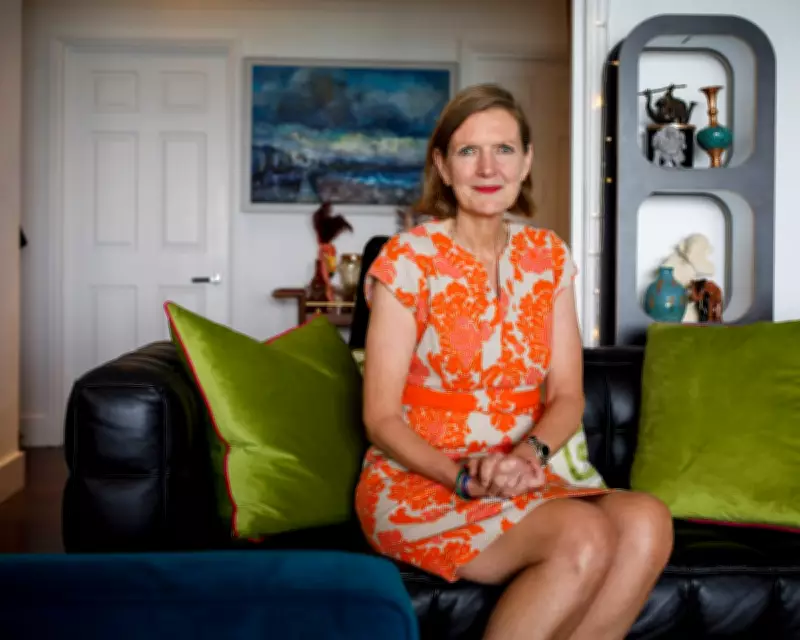
Lisa Jackson never thought she would survive the death of her husband, Graham. They met at university when she was 18, and for 35 years they formed an inseparable team. Both worked full-time, with Lisa organising their many marathon and backpacking trips abroad while pursuing her ambitions as an author and hypnotherapist. Graham supported her by handling most domestic chores and DIY tasks. When he was seconded to Bahrain for eight months in 2003, he left her a typed, two-page instruction manual explaining how to operate the dishwasher, washing machine and television.
A Diagnosis That Changed Everything
In 2017, Graham was diagnosed with asbestos-related lung cancer and given between 18 months and five years to live. The shock was profound, but after the initial terror subsided, the couple made a conscious choice to live in hope rather than fear. They vowed to make the most of whatever time remained, continuing to work, travel, run half marathons and see friends as much as possible.
They called their approach the Positivity Project. One of their first actions was to buy a raspberry pink notebook in which to record everything that offered hope: messages from loved ones, practical steps to support Graham’s immune system, and a list of positive factors about his prognosis. Graham had epithelioid mesothelioma, which was less aggressive and more treatable than other forms of asbestos-related cancer. It had not spread, and his immune system was extraordinarily healthy. The only negative factor was that men with mesothelioma tend not to live as long as women.

The Positivity Book also served as a gratitude journal. Each day they challenged themselves to name three things they were grateful to be, three things they were grateful to have, and three things they had done well that day. Graham once touchingly wrote, “Lisa – in bold, underlined, italic – my family and my friends.” This practice helped inoculate them against despair.
The Domino Deaths
Four years later, after surgery, chemotherapy, radiotherapy and immunotherapy, the cancer spread to Graham’s brain. He died on 1 September 2021 at home, with Lisa by his side, aged just 58. In the days that followed, Lisa recalled congratulating herself on still being alive after one week, then two, then a month, utterly astounded that she could endure such a loss. “If I could have cried Graham back to life, I would have – but I couldn’t, so I had no option but to get busy living,” she said.
Within three months of Graham’s death, Lisa sold their home of 27 years and moved from Croydon to the coastal town of Worthing. Soon after, she relocated to South Africa for eight months to care for her father, Anthony, who had developed dementia and prostate cancer. While there, three months before her father died, her much-loved younger sister, Loren, went missing in Portugal. Her body was found a week later, adrift in the Atlantic Ocean.
These three domino deaths left Lisa reeling. No longer a wife, sister or daughter, she felt stripped of her identity and plagued by thoughts of “What’s the point?” She had fought to keep Graham alive and her father well looked after, but with no one left to fight for, life seemed pointless. Being alive started to feel like a burden.
Writing a New Book
A close friend, Sarah, understood exactly what Lisa was feeling. “You’re not just starting a new chapter of your life,” she said. “You’re writing a whole new book.” Sarah was right. For years, Graham’s cancer, her sister’s bipolar disorder and her father’s dementia and prostate cancer had dominated Lisa’s narrative. It was time to reclaim authorship.
Lisa had attended a grief and bereavement workshop while Graham was ill. There she learned that many bereaved people find their world becomes smaller: invitations to social events often cease, and friendships can cool when you are no longer part of a couple. The model of grief that resonated most with her was “growing around grief”. Rather than shrinking over time, grief still takes up space in your life, but your life can expand around it if you make new friends, develop new interests, have new experiences, learn new skills and come to terms with your loss.

Underneath the layers of grief, Lisa knew she was a naturally happy person. To reclaim her old self, she had to seek out old and new activities that made her heart soar.
Experiments in Healing
Lisa tried a wide range of approaches in an attempt to put her broken self back together: reflexology, self-help psychology, kinesiology, astrology, knick-knack buying, intermittent crying, cold-water swimming, gong bath healing, hot stone massage, and junk food self-sabotage. Nothing worked, although cold water swimming gave her new friendships and flooded her bloodstream with dopamine and endorphins. Exiting the water felt like triumphantly crossing a marathon finish line, without having to run 26.2 miles first.
One evening, an anonymous quote on Pinterest caught her eye: “You need goals that give you goosebumps … a mission that makes it impossible to sleep, and irresistible to wake up. So, use excitement as your compass. It shows you exactly where to go.”
Lisa had first encountered the idea of a compass of excitement – essentially intuition – at a self-development workshop run by Jamie Catto, a founding member of the band Faithless. Seeing it referenced again gave her an idea: she would use it to guide her choices. Whenever faced with a decision, she would tap into her compass and tune in to how her body felt, rather than what her head said she “should” do. If it felt like “hell, yes!”, she would lean in. If her heart sank like “hell, no!”, she would withdraw.
What Lisa did not realise at the time was that her compass would play a significant role in what psychologists call “post-traumatic growth”: positive psychological changes that some people experience after a traumatic event. This phenomenon, identified in the 1990s, involves survivors of trauma forming stronger relationships, becoming more resilient, embracing new opportunities and gaining a deeper appreciation of life.
Living Authentically
Guided by her inner compass, Lisa stopped being a people pleaser and began living completely authentically for the first time in her life. She bid farewell to anyone who did not support, comfort, love or appreciate her, based on how her compass reacted when she spent time with them. When she encountered new people who had the potential to become friends, her compass guided her: if her gut detected negativity or a lack of respect or kindness, she knew she had to protect her peace. For the first time, when she saw a red flag, she did not wait for the bunting but simply and quietly exited stage left.
Lisa knew Graham wanted her to meet a new partner, so she used her compass to steer her romantic choices as well. A handsome man with piercing blue eyes with whom she struck up a conversation on Brighton’s Undercliff Walk seemed promising, but something felt off. Even though he was single and good company, and a friend was egging her on, her compass said no, so she did not suggest meeting up again.
Resilience and Adaptation
What truly astounded Lisa after her three bereavements was her resilience and ability to adapt. Graham had not typed her a manual during his illness as he had done when leaving for Bahrain; to do so would have undermined their commitment to hope. After his death, she had to figure everything out for herself: how to keep the flat clean and tidy, get an MOT, inflate the car tyres, and drill into walls (she nearly blinded herself when the drill bit buckled).
Now, four years on, Lisa is fluent in housework and takes care of most chores herself. Graham had always been in charge of hiring tradespeople, but when the badly cracked tiled floor of her new flat needed to be replaced soon after she moved in, her trusty compass once again stood her in good stead. Two tilers ghosted her, one asked for photos and then refused to answer her calls, and only one showed up. Radu was Romanian, enjoyed chatting about the Transylvanian Bear Run (a marathon Lisa and Graham had run in his homeland dressed as Dracula), and sent her a quote the very next day. She felt guilty accepting his quote as she had nothing to compare it with, but her compass said, “You can trust him – he’ll do a good job.” She hired Radu, and three projects later, he is still her “go-to guy”.
The most daunting decision Lisa had to make concerned investing her inheritance. One highly recommended financial adviser all but salivated over the fees he would be able to charge after 20 years: the equivalent of bequeathing him half her flat. Her compass bellowed no, so she endured the awkwardness of firing him and instead found someone more experienced who charged a fraction of what he did.
Returning to What She Loves
After many missteps and misadventures – including a yoga retreat led by a megalomaniac guru and attempts to join four different gospel choirs – Lisa’s compass led her back to three things she had always loved doing with Graham: camping, backpacking and running. While the former two were not nearly as much fun without him, she found that running, which she had mostly done on her own as Graham was so much faster, still gave her the head space, stress relief and deep sense of achievement it always had.
In 2025, Lisa ran the Brighton Marathon in Graham’s honour – her first in seven years – carrying a small pouch of his ashes. She has since signed up for two more marathons and is aiming to complete 100 half marathons in the next 10 years, as well as a half Ironman triathlon in the next five.
Each of these goals sets the needle of her compass quivering. Grief remains – a big solid circle at the centre of her life – but around it stretches something wider and brighter, and it is still growing.
Lisa Jackson is the author of Your Pace or Mine? and Still Running After All These Tears: A Runner’s Journey Through Grief (Summersdale, £12.99).
In the UK and Ireland, Samaritans can be contacted on freephone 116 123, or email jo@samaritans.org or jo@samaritans.ie. In the US, you can call or text the 988 Suicide & Crisis Lifeline at 988 or chat at 988lifeline.org. In Australia, the crisis support service Lifeline is 13 11 14. Other international helplines can be found at befrienders.org.





