

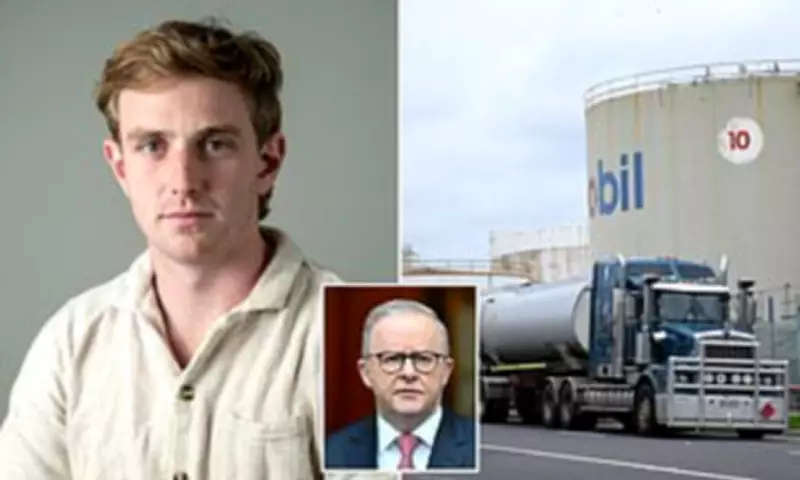
Trucking Coordinator Slams Albanese's Fuel Excise Cut as 'Half-Measure'
A senior operations coordinator at a major national trucking marketplace has delivered a scathing critique of Prime Minister Anthony Albanese's response to Australia's escalating fuel crisis, warning that inadequate measures risk leaving supermarket shelves empty across the nation.
'Half-Measure for a Full-Blown Crisis'
Alex Randall, operations coordinator at Loadshift – a freelance trucking platform connecting 80,000 shippers with 40,000 carriers nationwide – said his company had been advocating for complete suspension of the fuel excise "for five weeks" before the government's announcement.
"It's good they've finally moved, but halving it when drivers are paying $3.60 a litre and getting stranded at empty servos is a half-measure for a full-blown crisis," Randall told Daily Mail Australia.

The Prime Minister revealed on Monday that his government would implement a four-point National Security Fuel Plan, with the centerpiece being a temporary halving of the fuel excise on petrol and diesel for three months. This reduction translates to 26.3 cents per litre savings at the pump.
Supply Chain Catastrophe Warning
Randall emphasized that Australia's entire supply chain depends on freight movement, arguing that both the excise and GST on diesel should be "fully suspended until this is over."
"Twenty-six cents doesn't cover the gap when your fuel bill has doubled," he stated bluntly. "The nation depends on freight for supply chains, and we're facing a situation where trucks simply won't be moving unless more substantial cost-cutting measures are introduced."
He highlighted the precarious position of Australia's trucking industry, noting that "98 per cent of the trucking industry is small businesses running on margins under 3 per cent. They need more than a trim. They need genuine relief or they go under - and when they go under, freight stops moving and shelves go empty."
Real-World Consequences Already Evident
The crisis isn't theoretical for Loadshift. One of their drivers recently experienced 2.5 days of delays during a Perth-to-Melbourne journey after becoming stranded twice at empty service stations near Bordertown and Ceduna.
This incident underscores the practical challenges facing the industry beyond just financial pressures, with fuel availability becoming increasingly unreliable in remote areas.
Government's Four-Point Plan
Albanese's emergency response, developed after meeting with state and territory leaders at a National Cabinet session, consists of four stages:
- Plan and prepare
- Keeping Australia moving
- Taking targeted action
- Protecting critical services for all Australians
Australia currently sits at the second stage: "Keeping Australia moving." As part of this phase, the government has also suspended the heavy vehicle road user charge – a 32.4 cent levy per litre of fuel for heavy vehicles.
"Removing the heavy vehicle user charge is the right call – we welcome that," Randall acknowledged. "But it's not enough to keep the majority of trucks operational given current market conditions."
Financial Impact and Government Justification
Treasurer Jim Chalmers estimated the excise reduction would save approximately $19 when filling a standard 65-litre tank. The combined measures are projected to cost the budget $2.55 billion, with an additional $53 million in foregone revenue from delaying the road user charge increase.
"So this relief is temporary, it's timely and it's responsible," Chalmers stated. "It's all about taking some of the edge off these high petrol prices which are putting such extraordinary pressure on household budgets right around the country."
Energy Minister Chris Bowen expressed confidence in Australia's fuel supply resilience and confirmed the government would collaborate with regional allies in Asia to share oil reserves if necessary.

Structural Issues with Fuel Taxation
Fuel excise represents a flat federal tax applied to every litre of petrol and diesel sold in Australia, indexed twice annually regardless of global oil price fluctuations. While retail fuel prices vary daily based on international markets, transport costs, and retail margins, excise remains a fixed component – making it a potentially powerful tool for short-term economic relief during crises.
Randall's criticism highlights the growing tension between temporary political solutions and the structural challenges facing Australia's transport sector amid global energy market volatility triggered by ongoing conflicts in the Middle East.





