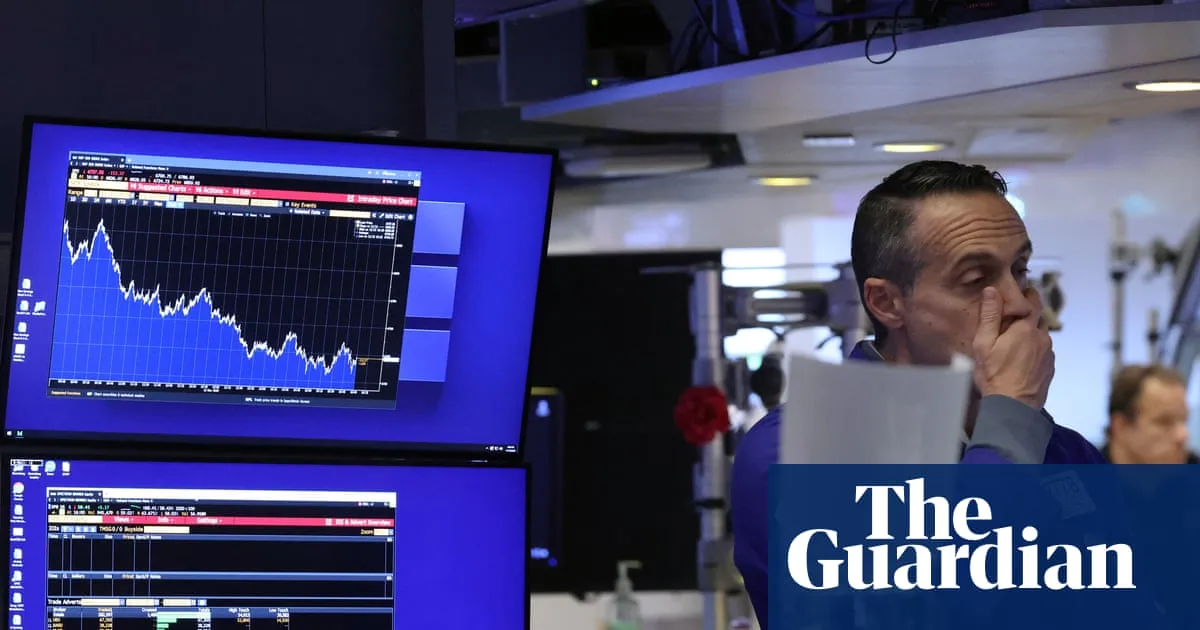
Global markets experienced another volatile day on Friday, following Wall Street's worst session in a month and weak economic data from China that showed an unprecedented slump in investment. The FTSE 100 fell 1.1% in London, closing down about 100 points at 9,698, as banking stocks tumbled. Barclays, Lloyds and NatWest each dropped between 2.7% and 3.6%.
In the US, the S&P 500 opened lower but closed flat, while the Dow Jones industrial average declined 0.7%. The tech-focused Nasdaq Composite fell as much as 1.8% before recovering to close up 0.1%. European markets also opened lower, with the pan-European Stoxx 600 falling 0.9%, France's Cac 40 down 0.54%, and Germany's Dax dropping nearly 0.9%.
Asian markets were hit hard, with Japan's tech-heavy Nikkei falling 1.8%, South Korea's Kospi plunging 2.6%, and Australia's ASX 200 down 1.5%. Nvidia led the tech decline, falling 3.6% after Japan's SoftBank sold its entire stake in the company. SoftBank and SK Hynix fell more than 6%, Samsung Electronics dropped 4%, and Taiwan Semiconductor Manufacturing Company fell 1.8%.

Data from China showed that fixed-asset investment shrank 1.7% in the first 10 months, a record decline, according to the National Bureau of Statistics. China's CSI 300 fell 0.7%, Hong Kong's Hang Seng dropped 0.9%, and Taiwan's Taiex slumped 1.4%. The pound fell nearly 0.5% against the dollar to $1.31, while UK 30-year gilts rose 12 basis points as investors weighed the impact of Chancellor Rachel Reeves' U-turn on income tax in the upcoming budget.
Analysts cited concerns over AI valuations and reduced expectations for a US rate cut in December as key factors behind the sell-off. Jim Reid of Deutsche Bank noted a volatile week, with relief over the end of the US government shutdown vying with worries over AI valuations and cautious Fed commentary. Kyle Rodda of Capital.com added that Asian markets showed sluggishness, with weak Chinese investment data raising hopes of further stimulus.