

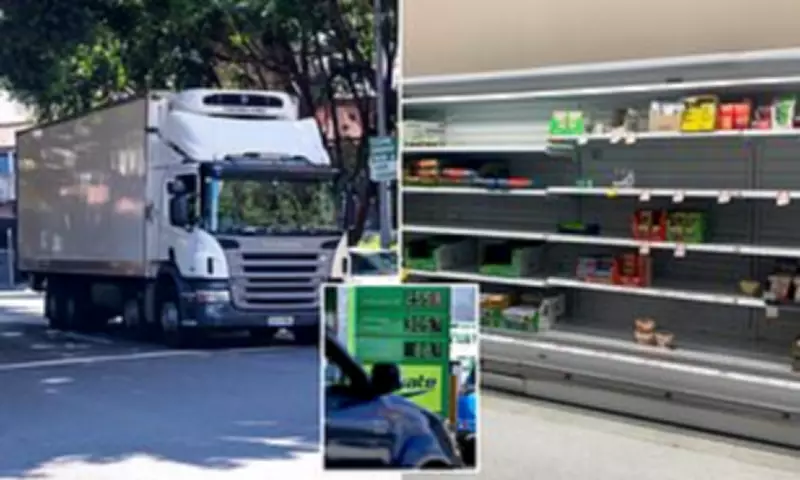
Supermarket 'Armageddon' Warning as Fuel Crisis Threatens Australian Supply Chains
Australians have been issued a stark warning to prepare for what truck drivers are calling supermarket 'Armageddon', with prices set to skyrocket and shelves potentially stripped bare as early as mid-April. The nation's escalating fuel crisis, driven by ongoing Middle East tensions, is threatening to severely disrupt supply chains and delivery networks across the country.
Transport Operators Sound Alarm on Soaring Costs
Transport operators have revealed the situation is deteriorating rapidly, with some reporting fuel bills have increased by as much as 70 percent. Queensland truck driver David explained to 4BC breakfast hosts how these rising expenses would create a domino effect ultimately hurting everyday Australians.
'It usually takes me $950 to fill up. My fill-up last week each day was $1,550 - a jump of $500-$600,' he said. 'The profit margins in trucks are not that great. They've got to pay me overtime, double time, triple time, living away allowances and tolls - it's all adding up.'

'It's all going to come to one place and that's the consumer,' David continued. 'We deliver eggs, milk, bread, meat, and vegetables. They all have to go up. Prepare yourself for Armageddon, because if this keeps going, it has to go into the shops. There's no other place it can go.'
Businesses Park Trucks as Costs Become Unsustainable
National Road Transport Association chief Warren Clark said the situation has become so concerning that some businesses owning their trucks outright are choosing to pull vehicles off the road entirely. These operators are opting to wait out the crisis rather than continue operating at a significant loss.
Clark warned consumers could start seeing the effects as early as mid to late April, with noticeable price hikes on everyday essentials or empty shelves becoming a reality. 'The cost of fuel has to be worn by the end customer or people can't actually operate in business,' he explained.
'Some of our members are telling us they simply cannot keep going. We are seeing long-term operators parking their trucks and walking away from businesses they've spent years building.'
Clark identified April 21 as a critical date when many operators will face reality. 'We are expecting to see more businesses make tough decisions on April 21, when the fuel card bills for March start landing. That will be the moment many operators realise they simply can't absorb these costs any longer.'
Farmers Brace for Impact on Food Production
The crisis extends beyond transportation, with farmers also preparing for significant challenges. The effective closure of the Hormuz Strait has interrupted crucial shipments of fertilizer from the Middle East, adding another layer of complexity to Australia's food production systems.
National Farmers' Federation president Hamish McIntyre said dairy products would be among the first to see prices skyrocket, followed by fresh produce. 'We estimate in a matter of weeks we'll start to see the costs flow through to the consumers on supermarket shelves,' he warned. 'It starts with dairy, then our fruit and veg, and in any of our intensive animal industries too.'
Government and Corporate Responses
Meanwhile, corporate giants using subcontracted delivery drivers will front the Fair Work Commission on Wednesday as part of a union bid to force them to cover surging fuel costs. The Transport Workers Union and the Australian Road Transport Industrial Organisation have made a joint application for gig workers, owner-drivers and transport businesses to be able to pass surging fuel bills back to their major corporate clients.
These clients include Coles, Woolworths, Aldi, McDonald's, Amazon and Dan Murphy's owner Endeavour. Several companies have already taken action:

- Woolworths has lifted the levy drivers can charge food and grocery manufacturers for transporting their goods to distribution centres
- Woolworths has changed its fuel levy reviews from monthly to fortnightly
- Coles will also review its fuel levy for truck drivers every fortnight
- Rideshare giant DiDi has introduced a 5¢ per kilometre increase which will go directly to drivers
- Uber is overhauling its fee structure to pay drivers more, amounting to an earnings increase of 6 percent on average nationwide
On Monday, Workplace Relations Minister Amanda Rishworth announced the Fair Work Act will be changed to fast‑track applications by unions and transport operators seeking 'emergency' supply‑chain orders from the FWC. The amendments will scrap the current six‑month waiting period, enabling the tribunal to issue orders compelling transport clients to offer fair contract terms far more quickly.
Warren Clark emphasized the broader consequences of government inaction, warning that 'when trucking businesses collapse, supply chains suffer, and Australian households pay the price.' The coming weeks will reveal whether these warnings of supermarket 'Armageddon' become reality or if intervention measures can mitigate the worst effects of Australia's escalating fuel crisis.





