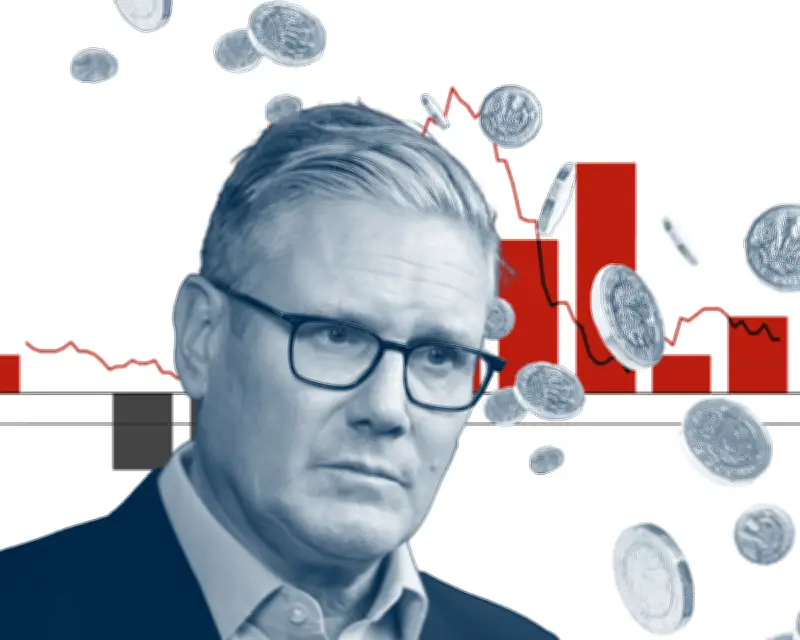
Keir Starmer used his leaving speech to highlight Labour's achievements, but his economic legacy appears mixed, characterized by sluggish UK growth and higher employment costs. The prime minister claimed his government had turned around an ailing economy after 14 years of austerity, reversing previous Tory investment cuts and achieving the highest economic growth in the G7. However, the reality is more nuanced.
GDP Growth Under Starmer
When Labour was elected in July 2024, Starmer declared economic growth the government's number one mission. In early 2024, the economy was growing due to Jeremy Hunt's pre-election tax cuts, but this ended when Rachel Reeves signaled tax rises to maintain Tory budget rules. Growth fell from 0.6% in the second quarter of 2024 to 0.2% in the third quarter under Labour. In early 2025, stockpiling ahead of Trump's tariffs boosted GDP, but it collapsed in the second half as spending cut fears hit confidence. A more digestible second budget in autumn 2025, without major tax rises, spurred investment and consumption, leading to 0.6% GDP growth in the first quarter of 2026, making the UK the fastest-growing G7 economy. However, Trump's strikes on Iran prompted the IMF to forecast UK growth slowing to 1% in 2026 from 1.4% in 2025.
Inflation and Employer Costs
In July 2024, annual inflation was 2.2%, close to the 2% target. It crept up to peak at 3.8% in summer 2025, driven by higher water bills, vehicle excise duty, and Reeves's increase in employers' national insurance contributions. The Bank of England noted that a third of companies raised prices to offset the tax. Trump's liberation day tariffs in April 2025 pushed up raw material costs, but effects faded by late 2025. However, Trump's first strikes against Iran in late February 2026 triggered an oil price rise, reversing the downward trend.
Unemployment Rises
Unemployment rose from 4.3% in July 2024 to 4.9% in the three months to April 2026. Companies blamed higher employment costs from national insurance increases and enhanced workers' rights, as well as uncertainty from Trump's tariffs and global instability. Economists also cited AI adoption as a factor discouraging hiring, especially of younger staff.
National Debt Eases Slightly
Public sector net debt fell from 99.4% of GDP in 2024 to 95.1% in May 2026. Reeves aimed to reduce the annual spending deficit from over 5% to below 2% to reassure financial markets, but recent extra spending on defence, the NHS, and welfare has blown this off course, pressuring the next government.
Interest Rate Cuts
The Bank of England cut interest rates six times under Labour, from 5.25% in summer 2024 to 3.75% in December 2025, where they remained. This made mortgages cheaper and eased financial pressure on households and businesses. However, expectations of further cuts in 2026 were dashed by Middle East conflict driving up oil prices and inflation.
Food Parcel Deliveries Fall
Labour made welfare benefits more generous despite reform efforts. Starmer ditched the two-child cap after a backbench revolt and reversed plans to restrict Pip eligibility, increasing the welfare bill and lowering poverty levels, especially for children in low-income families. Annual data from the Trussell Trust showed emergency food parcel deliveries fell in 2024 and 2025, as inflation eased from 2022-2023 highs.