

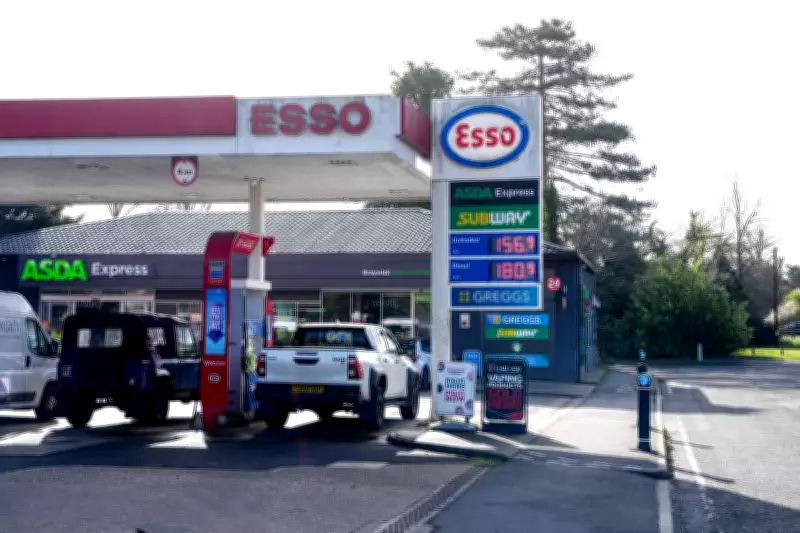
Chancellor Rachel Reeves is facing mounting pressure to follow European allies and implement urgent measures to protect consumers as fuel prices continue to spiral upwards. Campaigners have accused the government of treating British drivers as a "cash cow for the Treasury" during a period of severe financial strain.
Diesel Prices Reach Critical High
On Monday, diesel prices surged to their highest level since December 2022, reaching 181.2p per litre. This represents a dramatic 27 per cent increase since the onset of the Middle East conflict. Meanwhile, average petrol prices have climbed to 152.0p per litre, marking a 14 per cent rise from 132.8p over the same timeframe.
The price disparity between diesel and petrol has now reached its widest gap since at least 2003 in the United Kingdom. This alarming trend has prompted Steve Gooding, director of the RAC Foundation, to issue a stark warning that the "white van man is bleeding cash just to stay on the road."

European Nations Take Action
In contrast to the UK's current stance, several European nations have already implemented significant interventions to shield their citizens from soaring costs. Greece recently announced a three-month cap on profit margins for fuel and select supermarket products. Hungary has taken direct action by capping petrol at 595 forints (approximately €1.52) per litre and diesel at 615 forints (€1.57).
Furthermore, Germany is set to introduce stringent regulations from April, limiting petrol stations to just one price increase per day at a fixed time of 12pm. Companies found violating these new rules could face substantial fines of up to €100,000. Germany is also reportedly considering a windfall tax on oil companies as an additional measure.
Mounting Calls for Government Intervention
The surge in pump prices is directly linked to soaring oil prices, which have been driven higher by Iran's stranglehold on tankers passing through the critical Strait of Hormuz. This geopolitical tension has piled immense pressure on the government to abandon a planned increase in fuel duty scheduled for September.
In her November 2025 budget, Chancellor Reeves announced an extension of the fuel duty reduction—originally introduced by the Conservative government in March 2022 following the outbreak of the Ukraine war—until the end of August 2026. The plan was for rates to gradually return to previous levels over the subsequent five years.
Campaigners and MPs Voice Concerns
William Yarwood, media campaign manager at the TaxPayers' Alliance, delivered a scathing critique, stating, "British drivers are being used as a cash cow for the Treasury at a time when they can least afford it. While our European neighbours are stepping in to shield their citizens from soaring pump prices, the British government is preparing to hike fuel duty for the first time in 15 years." He urged the chancellor to extend the fuel duty freeze and commit to removing VAT from fuel duty entirely.
Howard Cox, founder of the FairFuelUK campaign, echoed these sentiments, highlighting that "dozens of countries worldwide, like France, India, and Italy, are recognising the financial sense in supporting drivers as pump prices soar uncontrollably." He accused the government of remaining "determined to uphold the 5p increase in the Autumn Budget" and called for immediate action, including a cut in fuel duty, the removal of VAT on fuel, and the establishment of a PumpWatch regulatory body with legislative power.
Left-wing Labour MP Clive Lewis, a vocal government critic, warned that the planned fuel duty increases were "designed for a different moment, not a crisis where pump prices are surging because of a war." He argued that proceeding with the escalator would "project an air of indifference towards drivers, farmers and small businesses who had no hand in creating this situation," with the burden falling hardest on those with the fewest choices.
Economic Impact and Business Strain
The crisis is having a profound impact on the economy, particularly on small businesses and key sectors. Latest DVLA figures reveal there were 16.2 million diesel vehicles licensed in the UK as of the end of September last year, including the vast majority of light goods vehicles such as vans.

Steve Gooding emphasised that "diesel is the lifeblood of millions of small businesses," warning that soaring prices would extract money from everyone's pockets, whether through direct fuel costs or increased bills for services and deliveries.
AA president Edmund King added, "The extra hike in diesel prices disproportionally hits businesses, deliveries, the service industry and the self-employed. The government must be concerned about sky-high diesel prices as it is these costs that fuel inflation." He suggested that with higher pump prices generating increased VAT revenue, there is "some 'free' money in the system that could be used to help drivers out."
Government Engages with Industry Leaders
In response to the escalating situation, Prime Minister Sir Keir Starmer convened a meeting on Monday with senior executives from energy, shipping, and banking firms. The discussions, which included representatives from Shell, BP, Maersk, Lloyd's of London, HSBC, and Goldman Sachs, focused on Iran's ongoing blockade of the Strait of Hormuz.
Downing Street stated the aim was to hear directly from businesses and explore collaborative responses between the government and the private sector. The meeting also featured an update on the regional situation from Major General Richard Cantrill, the UK's maritime operations commander.
This summit is expected to be followed by a Cobra meeting on Tuesday, where senior ministers will discuss the ongoing economic repercussions of the conflict. The government's engagement comes amid heightened geopolitical tensions, including controversial statements from former US President Donald Trump regarding potential actions against Iranian oil infrastructure.





