

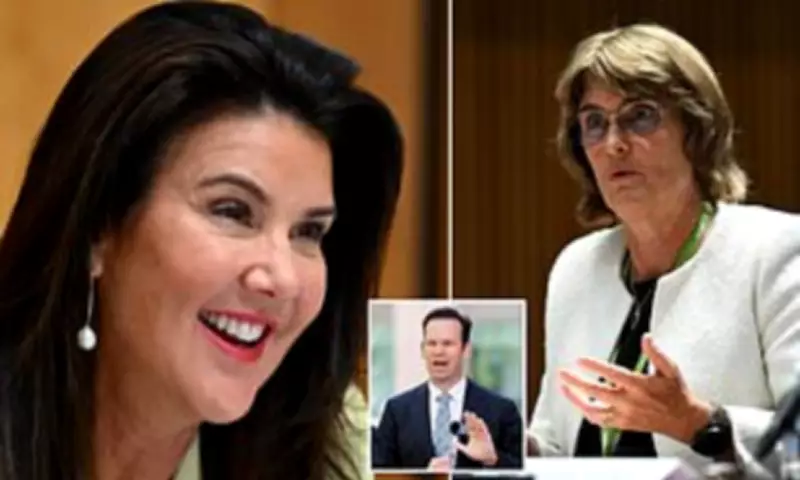
RBA Governor Michele Bullock Confronts Senators in Heated Exchange Over Economic Assessment
Reserve Bank of Australia Governor Michele Bullock has forcefully responded to accusations that she is 'gaslighting' Australians about the state of the economy. The confrontation occurred during a tense Senate Estimates hearing in Canberra, where Bullock defended her positive assessment of economic conditions against skeptical parliamentarians.
'Gaslighting' Allegation Sparks Fiery Exchange
Nationals senator Matt Canavan launched a direct attack on the central bank chief, accusing her of misleading Australians about economic realities. "I think people are only going to get angry in this country if they're gaslit into thinking the economy is okay, when their lived experience is absolutely terrible right now," Canavan declared during the hearing.
Bullock immediately rejected the characterization, responding with visible frustration: "I am not gaslighting anyone. I have said that there are certain aspects of the economy which are doing well and one of them is the labour market, which is positive for people."

Labour Market Defended as Economic Bright Spot
The RBA governor sought to highlight positive economic indicators despite widespread concerns about cost-of-living pressures. "I do want to inject one positive here, and that's the labour market," Bullock told the committee. "I think everyone's been focusing on the negatives, but we're in this position because the economy is actually doing okay."
She elaborated on the labour market's resilience, noting: "It can't grow really strongly because productivity is not growing, but the labour market is holding up. It's still a little bit tight, and this is good news, and in fact it's much better news than some other countries overseas have seen with their labour markets."
Inflation Debate Intensifies Over Government Spending
The hearing also featured repeated attempts by opposition senators to attribute rising inflation and interest rates to government expenditure. Bullock consistently rejected these claims, expressing frustration with what she perceived as repetitive questioning.
"I really feel that I am answering the same question over and over again," Bullock told Liberal senator Jane Hume, who pressed her on whether private or public sector demand was responsible for inflation's unexpected increase from 3.4 to 3.8 percent.
The RBA governor clarified the bank's rationale for raising the cash rate from 3.6 to 3.85 percent, explaining: "Demand from both the private sector and the public sector was higher than the economy could accommodate." This imbalance, she noted, caused December's inflation spike.
Private Demand Identified as Primary Inflation Driver
Bullock specifically addressed opposition claims about government spending's role in economic overheating. "If you look at the difference between our forecasts in November, where we had inflation coming back into the band, and you look at our forecasts now, where inflation isn't, the key difference there is not fiscal policy," she stated.
"It's pretty much the same as it was in November. The key difference is private demand," Bullock emphasized, directly contradicting opposition narratives that have circulated for weeks.
Economists Support Bullock's Position on Government Spending
Private sector economists have echoed Bullock's assessment regarding government spending's limited role in current inflationary pressures. AMP's chief economist Dr. Shane Oliver noted in a client communication that while government spending growth slowed in the September quarter, private spending surged significantly.
"This ignores the fact that public spending is part of demand in the economy and its level is also very important," Oliver wrote. He highlighted that despite recent adjustments, "public demand in the economy is still around a record 28 percent of GDP, whereas in the 40 years prior to the pandemic it averaged around 22.6 percent."

International Context for Australian Government Spending
Recent OECD data provides additional context for Australia's fiscal position. In 2022, Australian government spending represented 38.4 percent of gross domestic product, ranking as the ninth-lowest among 33 OECD nations. This placed Australia significantly below France's 58.4 percent while remaining above Ireland's 20.6 percent, the lowest among measured countries.
Bullock concluded her testimony by acknowledging economic challenges while maintaining her balanced assessment. "Now I understand that some people are doing it tough. I do understand. I get letters and I read them," she said. "But that is not to say that you can't recognise that there are some parts of the economy that are doing well and the labour market, I think, has been a really positive thing for this country."





