

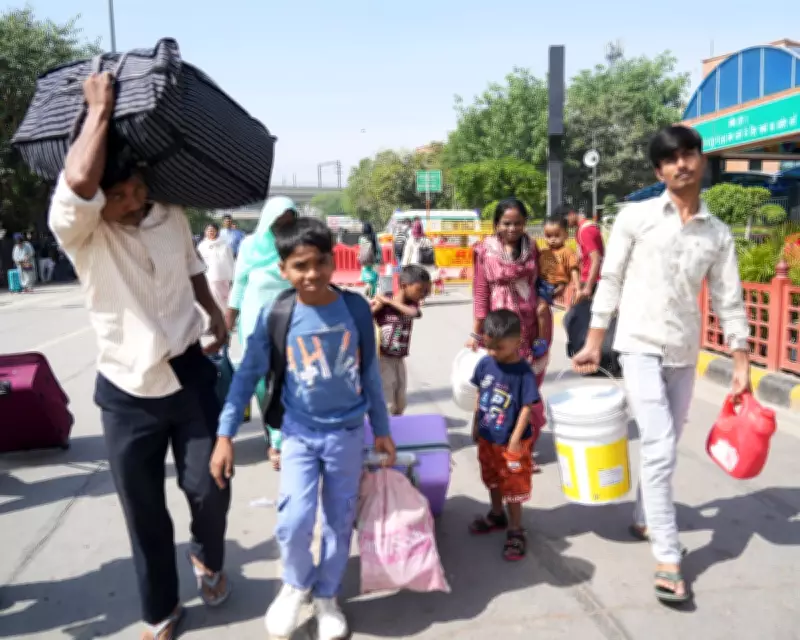
At the bustling Anand Vihar railway station in Delhi, a poignant scene unfolds as families laden with bags and weary expressions prepare to depart. Among them is 35-year-old Raju Prasad, who, along with his wife, brother, and four children, is leaving for Gorakhpur in Uttar Pradesh after nine months in the capital. The family, who worked as ragpickers earning about 500 rupees (£4) daily during gruelling 10-hour shifts, now faces a stark reality: their dreams of a secure future and education for their children have been shattered by escalating costs and fuel scarcity.
Desperate Choices in a Deepening Crisis
Prasad's voice trembles as he explains their predicament. "If we stay here even a few more days, our children might die of hunger. They don't understand what this crisis is – we just see them crying for food," he says. Their last gas cylinder ran out fifteen days ago, and despite efforts to collect firewood, resources have dwindled. With savings nearly exhausted, returning to their village, where they can cook on a temporary mud stove, has become their only viable option.
A City in Reverse Migration
Delhi, a magnet for millions from states like Uttar Pradesh, Bihar, and Jharkhand, is witnessing a sudden and dramatic reverse migration. The disruption of global fuel supplies, intensified by the US and Israel's war with Iran, has sent prices soaring, destabilising daily life for the urban poor. The city's dense network of dhabas, street vendors, and small eateries – lifelines for students, daily wage labourers, and low-income migrants – is collapsing under the strain. Without affordable gas and with food prices spiralling, many vendors are shutting down, leaving those dependent on cheap meals in dire straits.

As the Prasad family merges into the station crowds, 25-year-old Sarfaraz from Bihar sits nearby, his belongings and a small table fan beside him. He has been waiting since dawn for a family member to transfer 300 rupees to his account so he can purchase a train ticket home. "I came here to support my family, but now I am asking them to send me money so I can return," he laments. Sarfaraz, a father of four who moved to Delhi to work on the construction site of Jewar Noida International Airport, finds himself trapped in a similar plight. His gas supply vanished twenty days ago, and black market cylinder prices have skyrocketed from 900 to 4,500 rupees, far beyond his reach. "I've not had proper food for the past two days. All my savings are gone," he confesses.
Broken Promises and Systemic Failures
While the Indian government asserts that liquefied petroleum gas (LPG) cylinders are being delivered within days for online bookings, reality paints a grimmer picture. Outside gas agencies, long and uncertain queues form, even for those with domestic gas consumer cards – a privilege denied to migrant workers and students. This systemic gap leaves the most vulnerable exposed to the crisis's full brunt.
Restaurants and Students Bear the Brunt
Across cities like Delhi, Mumbai, Pune, and Lucknow, small eateries and restaurants are reducing menus, hiking prices, laying off staff, or closing entirely. Anil, who has run a restaurant in Nehru Place, Delhi, for three decades, expresses disbelief. "It is the first time in my life that the gas cylinder price on the black market has reached 4,500 rupees," he says. Forced to revert to traditional open-fire cooking on a chulha, he notes the slower process and looming threats to his ten employees' livelihoods as customer numbers decline.
Praveen Shankar Kapoor, the BJP's Delhi spokesperson, acknowledges efforts to stabilise supply but admits particular challenges for smaller cylinder users. "Yes, the 5kg LPG category is facing more acute challenges at the moment, especially among migrant and low-income groups who depend on it for daily cooking," he states, expressing hope for normalisation soon.

The crisis extends to Delhi's student population, many of whom hail from low-income families outside the city. Farheen Naaz, a media student at Jamia Millia Islamia University from West Bengal, shares her struggle: "I have not had gas for the last 10 days, and most of the time now I skip breakfast." With university canteens closing and available food becoming prohibitively expensive, she and about fifty fellow residents face deteriorating health and the prospect of abandoning their studies to return home.
Economic Ripples and Alternative Solutions
As demand shifts, prices for alternative cooking appliances have surged. Ahmad, a wholesale seller at ZamZam Crockery, reports that induction cooktops once sold for 1,300 rupees now fetch 5,000 rupees, with nearly 60% of other electrical food-making items also seeing price hikes. This further limits options for those seeking relief from the gas shortage.
Back at Anand Vihar, Sarfaraz anxiously checks his phone for the awaited transfer, hoping to join the exodus home where village cooking fires still offer a semblance of sustenance. The mass departure underscores a deepening humanitarian and economic crisis, as India's urban workforce retreats in the face of unaffordable basics, leaving the capital's future uncertain and countless lives in limbo.





