

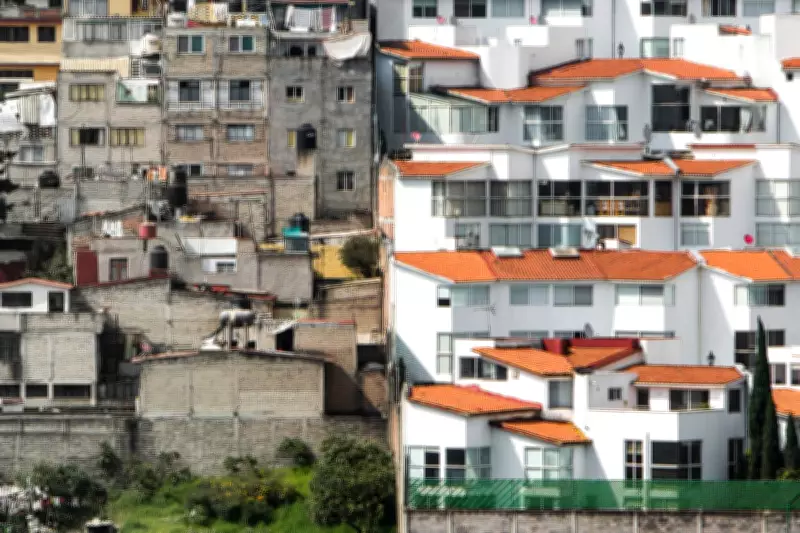
Mexico's Stark Wealth Inequality: 1% Holds 40% of National Wealth
A recent report by Oxfam Mexico has highlighted the extreme economic disparities plaguing the nation, revealing that the richest 1% of Mexicans own a staggering 40% of the country's total wealth. This concentration of resources underscores a deep-seated issue that has persisted for decades, with the fortunes of Mexico's 22 billionaires doubling over the last five years to reach an unprecedented collective wealth of $219 billion.
The Microcosm of Santa Lucía Reacomodo
In Mexico City's Santa Fe neighborhood, the contrast between affluence and poverty is vividly displayed in the working-class area of Santa Lucía Reacomodo. María del Socorro Corona, a 79-year-old resident, built her turquoise two-bedroom house with her late husband on what was once a cactus-covered hillside. Today, she sells clothes and knick-knacks at a weekly market to make ends meet, stating, "I have to make money, or I won't eat."
Corona notes that the area began transforming about 20 years ago when a bridge was constructed connecting Mexico City to the high-end Santa Fe business district. While foreigners sought to buy land, residents held firm, leading to a stark divide: luxury apartment buildings with glass balconies and manicured hedges loom over cinder-block houses where electrical wires tangle and stray cats roam.

Historical Inequality and Recent Trends
Viri Ríos, a public policy expert and director of Mexico Decoded, describes the situation as "unbelievably unequal – it's almost inconceivable." She points out that inequality has been entrenched for centuries, with Mexicans growing accustomed to this reality. The Oxfam report confirms that ultra-rich Mexicans have never been so numerous or wealthy, with Carlos Slim, Latin America's richest man, seeing his wealth increase more than eightfold between 1996 and 2025.
Despite this, there is a silver lining. During the term of former president Andrés Manuel López Obrador, substantial increases in the minimum wage helped reduce poverty by 13.4 million people, a decrease of almost 26%. Extreme poverty also dropped from nearly 9 million to 7 million, with Mexican inequality at its lowest point since 2006, according to the World Inequality Database.
The Persistent Divide and Social Isolation
Ríos emphasizes that while the gap is narrowing, it remains a chasm. Wealthy Mexicans often isolate themselves in exclusive gated communities, avoiding public services like health and education. In Santa Lucía Reacomodo, neighborhoods like Bugamvillas are accessible only to residents, with strict security measures, while the working-class area faces issues like theft and drug use.
Sebastián Cejalugo, a 36-year-old garbage collector and lifelong resident, recalls playing on the streets until late as a child but now notes the neighborhood is filled with "lots of thieves and lots of drugs." Francisco González, 59, laments the changes, from the smell of forest to that of cats, dogs, and marijuana, and the constant noise from traffic and luxury sports cars.
Community Perspectives and Economic Benefits
Residents acknowledge some benefits from nearby wealthy developments, such as job opportunities. Cejalugo once worked as a carpenter in Bugamvillas, admiring the luxurious homes. However, he prefers Santa Lucía for its community spirit, with parties and celebrations that are absent in gated areas.
The physical divide is symbolized by a 10-foot wall separating Santa Lucía from Bugamvillas, which has existed as long as the neighborhood. As Cejalugo's aunt Pilar notes, "That's the wall that divided us," to which her nephew adds, "The rich from the poor."
This report underscores the ongoing challenge of inequality in Mexico, where historic poverty reductions are tempered by persistent wealth concentration, highlighting the need for continued policy efforts to bridge the divide.






