

Labour's Wealth Pledge Under Threat as Economy Stalls Before Middle East Crisis
Keir Starmer's promise that Britons would be richer under a Labour government was already facing significant challenges even before the recent Middle East conflict escalated, according to newly released official data. The latest national accounts confirm that the UK economy effectively ground to a halt in the final quarter of 2025, setting a troubling backdrop for the Prime Minister's economic ambitions.
Household Incomes Decline Amid Economic Stagnation
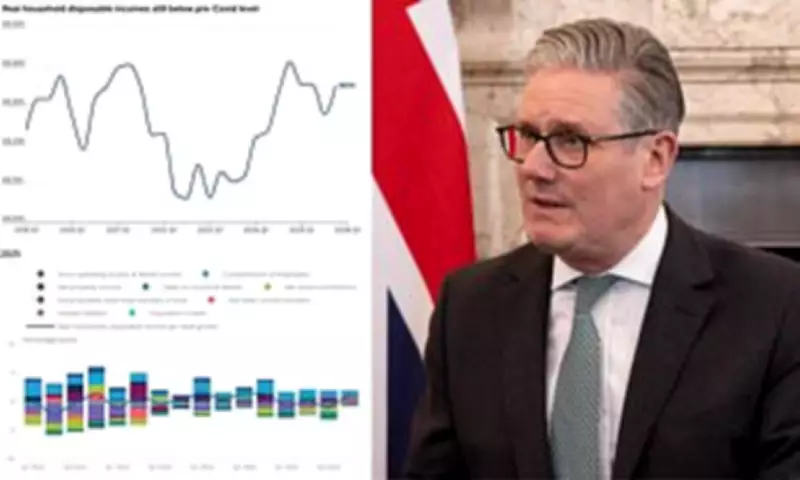
Households endured a difficult 2025, with real disposable incomes falling throughout much of the year. While the final quarter saw a modest 1.2 percent recovery in this key metric, the Office for National Statistics (ONS) revised the drop in the third quarter upward from 0.8 percent to 1.2 percent, indicating deeper economic strain than initially reported.
Real Household Disposable Income (RHDI) per head, which measures what remains after taxes, benefits, and inflation adjustments, stood at £6,353 at the end of 2025. This represents a decline from £6,413 at the end of 2024, with the quarter coinciding with Chancellor Rachel Reeves delivering her first major tax-raising Budget.

Although household incomes remain marginally higher than when Labour assumed power, they continue to languish below pre-pandemic levels, highlighting the persistent economic challenges facing the nation.
Starmer's Economic Goal Faces Mounting Pressure
These figures present particular difficulties for Sir Keir Starmer, who declared upon entering Downing Street that he aimed to achieve growth in RHDI per head over the course of the Parliament. This goal was considered relatively unambitious by economic observers, as the only period in the last fifty years when such growth failed to occur was between 2019 and 2024—a timeframe severely impacted by the COVID-19 pandemic and the Ukraine war.
Further complicating the economic picture, real GDP per head decreased by 0.1 percent in the final quarter of 2025, though it showed a 0.6 percent increase compared with the same quarter a year earlier. This modest annual improvement appears to reflect the increased tax burden implemented by the government.
Economic Vulnerability and Recession Fears
The economy's dismal performance has raised serious concerns about the potential for Middle East turmoil to trigger a recession. Economic experts have warned that the current situation could prove worse than the energy shocks experienced during the 1970s, creating additional headwinds for recovery efforts.
While the ONS found that GDP rose 1.4 percent across 2025, up from previous growth estimates of 1.3 percent, more recent data shows the economy flatlined in January with zero output growth. This stagnation has heightened fears about the UK's economic resilience.
International Comparisons and Forecast Downgrades
Forecasts from the Organisation for Economic Cooperation and Development (OECD) delivered last week gave Britain the largest downgrade among all major economies. The OECD now predicts that UK GDP will be 0.5 percentage points lower in 2026 than prior forecasts, settling at just 0.7 percent growth.
This projection places the United Kingdom second lowest in the G7 in terms of economic growth for this year, trailing only Italy. The downgrade underscores the significant challenges facing policymakers as they attempt to stimulate economic activity.
Government Response and Expert Analysis
A Treasury spokesperson maintained that the government possesses "the right economic plan" to navigate these difficulties. They stated: "The decisions we have taken have put us in a better position to protect the country's finances and family finances from global instability. We were the fastest growing European economy in the G7 last year and now we're going even further by using regional growth, artificial intelligence and a closer relationship with the EU to get our economy growing."

Liz McKeown, ONS Director of Economic Statistics, provided context to the latest figures: "Our latest data shows GDP was unrevised in the last quarter of the year, with the economy growing a little. Services showed no growth, while production grew strongly, partially offset by a weak quarter from construction. Annual growth for the whole of 2025 was, however, revised up slightly. Meanwhile, the household savings ratio increased and remains high by historic standards."
Martin Beck, chief economist at WPI Strategy, offered a sobering assessment: "With so little momentum heading into 2026, the economy is particularly vulnerable to the latest energy price shock, and it would not take much for GDP to tip into outright contraction."
Beck elaborated on the potential consequences: "Much will depend on how long the conflict in the Middle East, and the associated rise in energy prices, persists. If it drags on, inflation is likely to pick up again, cost-of-living squeeze pressures will revive, and any support from lower interest rates will be pushed further back. That would weigh on both growth and jobs. In that scenario, it's easy to see the economy stagnating or even slipping into recession, rather than achieving the 1% to 1.5 per cent growth that had previously been widely expected."





