

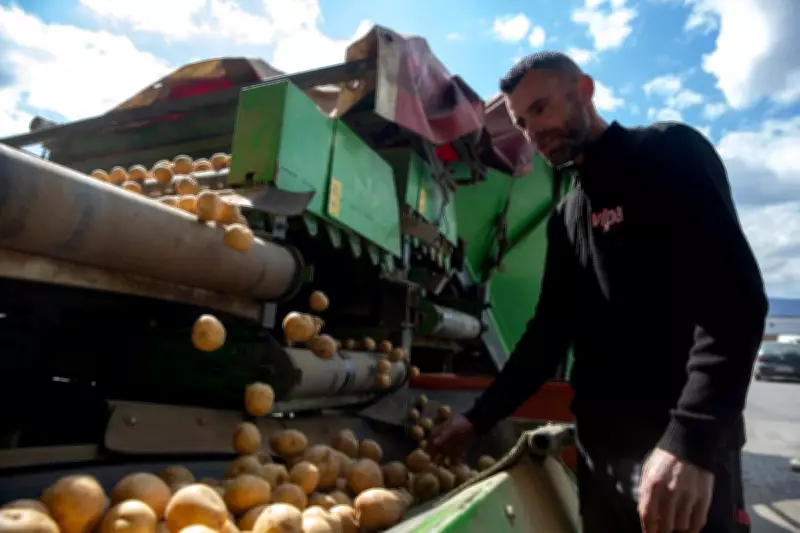
In one of Europe's most economically disadvantaged nations, a prominent business is grappling with the severe repercussions of escalating fuel prices, a direct consequence of the ongoing war in Iran. Kushtrim Ajvazi, the manager of Pestova, a company renowned for producing the popular Vipa brand potato chips and snacks, finds his thriving enterprise overshadowed by unforeseen financial strains.
Production and Distribution Network Under Pressure
Pestova cultivates nearly 100 acres of potato fields in eastern Kosovo, which supply the essential raw materials for its snack production. However, both the company's agricultural operations and its extensive distribution network have been severely impacted. The wholesale price of fuel has surged dramatically from €1.10 ($1.27) to as high as €1.70 ($1.96) per litre, according to Mr Ajvazi.
Kosovo lacks domestic fuel production, meaning prices for diesel and petrol are determined by importers, whose profit margins are legally capped at 12 per cent. With spring marking the critical potato planting season, Mr Ajvazi has urgently appealed to the government to intervene and alleviate this mounting financial burden.

Immediate and Long-Term Consequences
Mr Ajvazi described the company's fuel costs as "extremely high". While fertiliser prices have also increased, Pestova had sufficient reserves to mitigate that particular impact for the time being. Nevertheless, the situation remains precarious. "We are analysing and calculating every additional cost, and if we see that this process of rising costs continues, we will be forced to adjust our prices," Ajvazi stated.
The crisis extends beyond production challenges. Approximately 40 per cent of Pestova's output is exported under prearranged, fixed-price contracts, which can only be modified with a 90-day advance notice. This rigidity makes strategic planning exceedingly difficult in an unstable market. "We call on the government to ease this phase for us," Ajvazi emphasised. "We are a company that exports to more than 23 different countries, including those in Europe."
Government Inaction Amid Regional Measures
While neighbouring Balkan nations such as Romania, Hungary, and Serbia have implemented measures to support farmers—including special diesel prices or reduced state taxes—Kosovo's government has yet to act. Officials did not respond to inquiries regarding potential interventions.
Economic experts have issued stark warnings. Economist Safet Gerxhaliu noted, "There is not one sector that is not affected by the price increase." He urged the government to respond urgently to prevent further damage to the already fragile economy.
Broader Impact on Citizens and Political Context
The fuel price hike has also burdened ordinary Kosovars. Bardh Mehmeti, an IT professional from the capital, Pristina, reported that filling his tank now costs €100 ($115), up from €80 ($92) before the crisis. Mehmeti is now "seriously considering" switching to an electric vehicle to mitigate expenses.
Kosovo's economic struggles are compounded by longstanding political issues. Since declaring independence from Serbia in 2008, the nation has faced recognition disputes, with Serbia refusing to acknowledge the split, stalling both countries' European Union accession bids. Additionally, a prolonged political crisis left Kosovo without a fully functional government for much of the previous year.
The current administration under Prime Minister Albin Kurti is again in a stalemate due to a failure to elect a new president. The main opposition Democratic Party has criticised this governmental inaction, advocating for temporary tax cuts to relieve pressure on both citizens and businesses like Pestova.






