

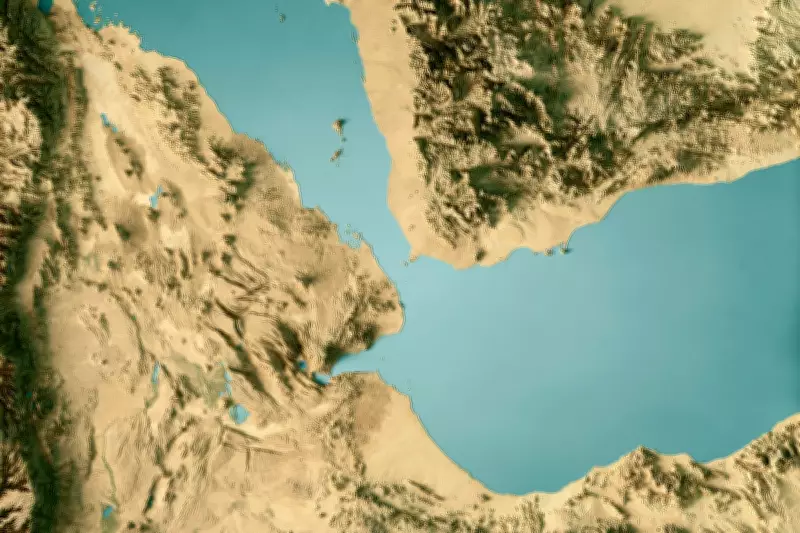
The strategic Bab al-Mandab strait, a critical maritime chokepoint in the Middle East, is under renewed threat from Houthi rebels, raising fears of a seismic impact on the global economy. This development comes as the Iran-backed group's involvement in regional conflicts escalates, potentially blocking another vital waterway for oil tankers and exacerbating existing economic chaos.
Vital Shipping Route Under Threat
Known as the "Gate of Tears," the Bab al-Mandab strait spans approximately 50 kilometres in length and 16 kilometres in width, situated between Yemen and Djibouti. It serves as a crucial link in the maritime trade route connecting the Mediterranean Sea to the Indian Ocean via the Red Sea and the Suez Canal. While it does not handle the same volume of oil as the Strait of Hormuz, which accounts for about one-fifth of global oil and gas transit, its closure would deliver a severe blow to economies reliant on Middle Eastern imports.
Economic Significance and Recent Disruptions
According to the US Energy Information Administration, daily oil transit through Bab al-Mandab peaked at 9.3 million barrels between 2020 and 2023. However, this figure plummeted to 4.1 million barrels in 2024 following systematic Houthi attacks on commercial ships associated with Israel. The International Monetary Fund reported a 50 per cent decline in Suez Canal trade during the first two months of 2024 compared to the previous year, with Panama Canal trade falling by 32 per cent.

As traffic diminished, insurance costs surged, prompting major shipping firms to reroute vessels around the Cape of Good Hope in South Africa. This detour adds an extra 10 to 14 days to journeys, further straining global supply chains.
Global Ramifications of Potential Closure
The closure or disruption of Bab al-Mandab, coupled with the ongoing issues at the Strait of Hormuz, could have catastrophic consequences for global trade. Energy supplies from the region might be cut off, intensifying the current crisis. The Strait of Hormuz remains under strict control by the Islamic Revolutionary Guard Corps, leading to worldwide rationing and soaring prices. Brent Crude oil prices have surged from $78 per barrel before the Iran war to $107 per barrel recently, highlighting the market's volatility.
Countries such as the Philippines have declared energy emergencies, with fuel reserves dwindling to just 45 days. India has implemented cooking gas rationing, Sri Lanka introduced a four-day working week, and Bangladesh deployed troops to prevent fuel hoarding, illustrating the widespread economic strain.
Saudi Arabia's Strategic Reliance
Saudi Arabia has strategically utilised the Bab al-Mandab strait to export crude oil through its vital Yanbu port on the west coast. This port receives oil via the country's east-to-west pipeline, which freight analyst Matthew Wright from Kpler described as "being pushed to the maximum." He emphasised that Yanbu is currently the most active port in the Middle East Gulf, with as many as 4.6 million barrels per day loaded onto vessels in recent weeks—more than three times the 2025 average.
Wright warned that losing even 2.5 to 3 million barrels per day from Yanbu, amid the 15 million barrels daily shortfall from Hormuz, would pose a "major problem" for global oil markets.
Broader Implications for Global Trade
The Bab al-Mandab strait provides access to key ports including Saudi Arabia's Yanbu, Djibouti's Doraleh, Eritrea's Assab, and Somalia's Kismayu. Its disruption not only threatens oil exports but also undermines the broader maritime infrastructure essential for international commerce. With the Houthi rebels claiming responsibility for recent missile attacks on Israel and targeting ships, the risk of further escalation looms large.
In summary, the Houthi threat to the Bab al-Mandab strait represents a significant vulnerability in global economic stability. As tensions in the Middle East persist, the potential closure of this strategic waterway could trigger widespread energy shortages, higher costs, and prolonged supply chain disruptions, compounding the challenges already faced by nations worldwide.






