

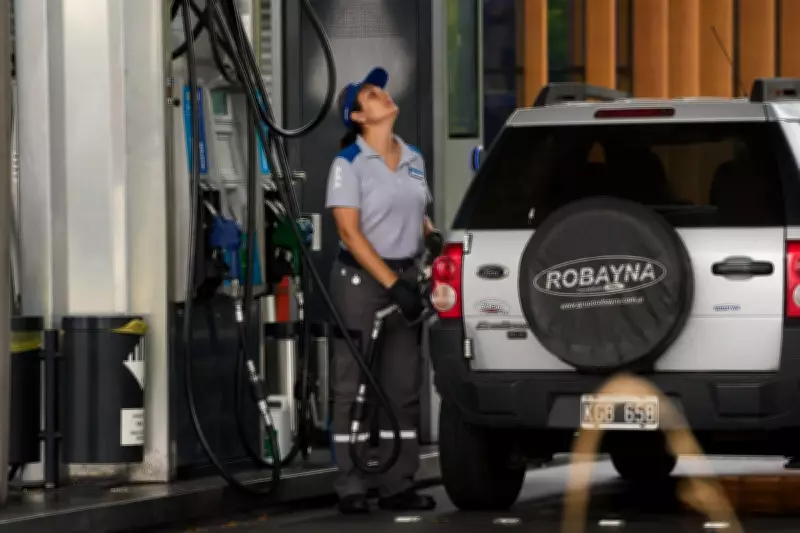
Global Fuel Price Surge Forces Households to Abandon Small Luxuries
People across the world are increasingly cutting back on everyday spending as persistently high gas prices continue to stretch household budgets to their limits. The financial strain is forcing families to give up small comforts and recreational activities in order to keep up with essential bills and obligations.
Personal Stories of Financial Strain
Luis Catalano, a taxi driver waiting to refuel at a gas station in Buenos Aires, Argentina, expressed cautious uncertainty about his financial future. "For now, we're still managing to hold on," Catalano admitted. "But I don't know for how long."
At the same YPF station, German Toledo, a 38-year-old road safety worker, detailed how surging fuel costs have compounded other rising expenses against a backdrop of stagnant wages. His salary has remained unchanged for five consecutive years, creating what he describes as an unsustainable financial situation. "You can't make it to the end of the month," Toledo lamented, noting that a single job is no longer sufficient to cover basic living expenses.

Geopolitical Context and Market Dynamics
The ongoing conflict in Iran entered its 24th day on Monday, with the vital Strait of Hormuz oil pathway remaining virtually paralyzed despite emerging glimmers of hope for a potential breakthrough. This geopolitical tension continues to disrupt global energy markets and supply chains.
U.S. President Donald Trump injected a measure of optimism into the situation by claiming that negotiations were ongoing with Iranian leaders who were reportedly eager to reach a deal to end the hostilities. These statements triggered a significant drop in global oil prices, with Brent crude falling 9.7% to $101.26 per barrel from nearly $120 the previous week.
However, Iranian officials promptly denied that any talks had taken place, with their parliament speaker characterizing Trump's claims as a deliberate ploy to manipulate international markets. Regardless of the diplomatic posturing, experts note that such developments typically have no immediate impact on consumer fuel prices due to the complex nature of petroleum supply chains.
The Lag Between Markets and Pumps
Oil follows extensive, winding journeys that can require weeks to travel from extraction sites to retail gas stations. The crude must first pass through refineries where it is processed into usable fuel, then transported via pipelines and tankers to distribution terminals before finally reaching local service stations. Consequently, pump prices generally lag behind global market fluctuations, sometimes taking several weeks to reflect changes in crude oil valuations.
Global Impact on Working Families
As with most economic disruptions, those with the fewest financial resources are experiencing the most severe consequences, forcing them to scrutinize already minimal budgets for additional areas to reduce spending.
In Cologne, Germany, Kevin Plucken, a 35-year-old janitor, can only afford to purchase 20 euros worth of gasoline at a time. To manage what he describes as "burdensome" costs, he has fundamentally altered his weekend routines with his two children, seeking activities close to home rather than driving to distant destinations. "It's just too expensive," Plucken explained.
This sentiment resonates across continents, with many viewing the fuel price spike as merely the latest challenge for ordinary people who have grown accustomed to relentless cost increases.
Felicia Iwasa of Lagos, Nigeria summarized the widespread frustration: "Everything is going up. The economy is not easy for us."
Specific Challenges in the Philippines
In Manila, drivers of the iconic "jeepneys"—colorfully decorated public transport vehicles that evolved from American military jeeps left after World War II—face particular hardships. Diesel prices, which these working-class vehicles rely upon, have risen even more sharply than gasoline rates.
Johnny Pagnado, a 55-year-old jeepney driver, has eliminated various discretionary expenses, including his nightly bedtime bottle of beer. Yet he remains deeply concerned about longer-term financial pressures, particularly how he will afford college education for his four children.

Another driver, Sandy Roño, 34, has canceled a planned beach trip to celebrate his upcoming birthday. Roño couldn't afford his rent payment last month and failed to make the installment on his jeepney. If prices remain at current levels, he anticipates being forced to seek alternative employment. "I'll stop driving and look for another job," Roño stated resignedly.
The collective experiences from Buenos Aires to Manila illustrate how global economic pressures manifest in deeply personal sacrifices, as families worldwide recalibrate their lives around escalating fuel costs and diminishing purchasing power.





