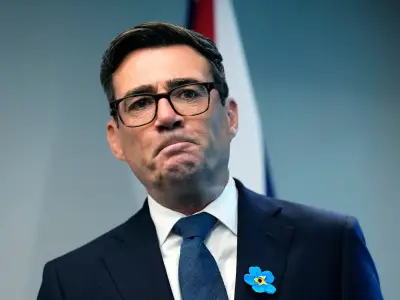
Tony Blair's son Euan Blair has warned Britain is "very close" to a point where higher taxes could "cripple growth", criticising Andy Burnham's tax plans as "not very sensible".
Speaking to Sky News broadcaster Cathy Newman, Mr Blair, who has an estimated net worth of £350 million, said there was "genuine fear" among businesses and entrepreneurs that the UK was approaching a point where the economy could no longer absorb further tax increases without damaging growth.
Tech sector's role in the economy
Mr Blair, who founded the education technology company Multiverse, argued that technology companies could play an important role in expanding the UK economy and creating jobs. "Tech companies are key to actually having a growing economy," he said.
He added: "We create more unicorn companies than anywhere outside of China and America." Mr Blair said Britain had "an incredibly educated workforce" and "amazing entrepreneurs", arguing that the Government should be doing everything possible to support businesses looking to expand.
Concerns over further taxes
Asked about the prospect of further taxes on entrepreneurs, he said: "I actually don't think anyone disagrees with that in government."
"There may be some arguments around the mechanism, and I think heaping more taxes on entrepreneurs right now is probably not very sensible," he added. Mr Blair said the Government needed to ensure that businesses could continue employing people and expanding.
"Certainly, what we don't want to do is make it harder for companies to employ people and to grow," he said. "That is essential. It's how everybody is going to win."
Government policy under scrutiny
His comments come after the Labour Government increased employer National Insurance contributions, while possible changes to Capital Gains Tax have also been discussed. Asked whether businesses such as his were being hurt by the Government's policies, Mr Blair said that nothing had yet happened on Capital Gains Tax.
However, he argued that the increase in employer National Insurance contributions had not produced the intended effect. "I think actually there are plenty in government who would accept it was a mistake to increase national insurance contributions, and I think it's had the opposite effect that it was intended to have," he said.
Asked whether the UK was approaching the point where the level of taxation could begin to seriously damage economic growth, Mr Blair said: "There is definitely a point at which the economy cannot face more tax and digest it in a way that doesn't cripple growth."
Asked whether Britain was close to reaching that point, he replied: "I think we're very close to that point." "I speak to enough entrepreneurs and businesses and people running big businesses to know that there is some genuine fear there," he added.
Entrepreneurs leaving Britain
Mr Blair also pointed to entrepreneurs leaving Britain as a warning sign. "We've seen entrepreneurs leave the country. That is a problem," he said.
He argued that Britain needed to reassure entrepreneurs that it remained a place where companies could not only be founded but also expanded into major international businesses. "We have to make it clear to the entrepreneurial community that Britain is not only an amazing place to build a business, and we build lots of businesses here, but to grow one and scale one," he said.
The comments come as Mr Burnham's Government prepares for its first Budget, with the Prime Minister having previously refused to rule out tax rises. At his first Prime Minister's Questions, Mr Burnham said he would not "write the Budget" in the Commons and that the final decisions would be a matter for the Chancellor.
The Government has faced growing pressure over its spending commitments, borrowing costs and the limited room available to raise additional funds. Chancellor John Healey has said the October Budget will be built around fiscal discipline.
Mr Blair's warning comes as the Government also seeks to reassure business leaders about its growth agenda. Mr Burnham has been due to meet private-sector chiefs to discuss the role of business in driving economic growth.
For Mr Blair, the priority is ensuring Britain remains an attractive place for ambitious entrepreneurs. "We need to be building giant companies here in Britain and indeed in Europe," he said. "And we're gonna have to do everything we can to encourage entrepreneurs to be ambitious and think big and celebrate those successes."