

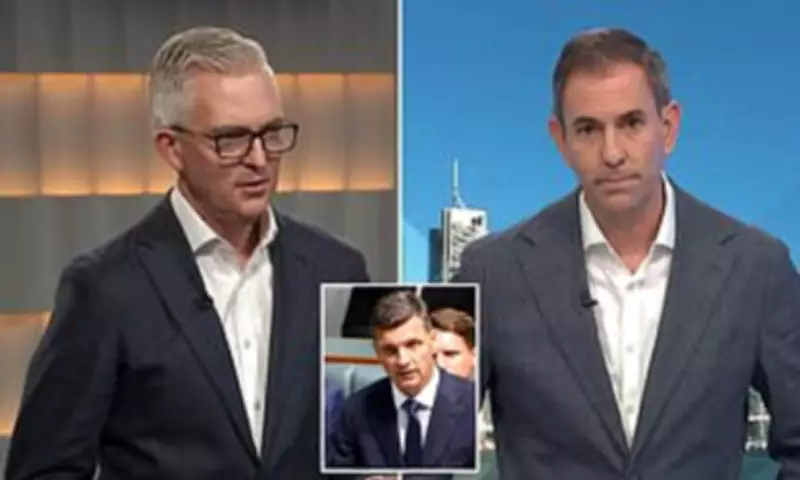
Treasurer Jim Chalmers has all but confirmed he will not move to end tax bracket creep for workers, describing the government's approach as 'responsible and affordable' during a tense exchange on ABC's Insiders program.
Appearing on Sunday with host David Speers, Chalmers said he disagreed with Opposition leader Angus Taylor's proposal to index tax thresholds in line with inflation. Taylor's plan, outlined in his Federal Budget reply speech, would put $250 back into the average taxpayer's pocket in the first year and $1,000 by the fourth year.
Bracket creep occurs when inflation pushes wages higher, moving workers into higher tax thresholds despite their purchasing power not having increased, resulting in more expensive tax bills without any formal change to tax rates.

Speers pressed the Treasurer on why the government would not 'lock it in' for Australians by making the change bipartisan. 'We're cutting income taxes five times using three different mechanisms,' Chalmers fired back, pointing to a series of already legislated tax changes. He argued the Coalition had opposed earlier tax cuts and would repeal them, and that Taylor's policies were fiscally reckless while Labor's Budget was 'one of the most responsible in memory'.
'One of the reasons for that is because Angus Taylor would be adding a quarter of a trillion dollars to national debt,' Chalmers said. 'That would cost tens of billions of dollars in debt interest, because of these uncosted, unfunded tax announcements.'
Speers questioned whether the government was relying on workers paying more despite no official tax rise as a key revenue stream. 'If it's a quarter of a trillion dollars over the decade, then that's a lot of bracket creep that you're going to be relying on in budgets, is that right?' he asked. Chalmers rejected that premise without going into the numbers, and declined to commit to eliminating the tax sleight of hand.
'What we have shown, David, and not just said, is that this government is enthusiastically returning bracket creep (to taxpayers) and on more than one occasion our opponents have tried to prevent us from doing that,' Chalmers said. Speers pressed again: 'So why not just lock it in and say we're going to permanently end bracket creep?' The Treasurer again refused to commit, arguing 'flexibility' was necessary with the government having the option to spend the extra haul if needed.
'When you provide these tax cuts, you have to do it in the most responsible and affordable way, and you have to take into consideration the economic conditions at the time,' he said. He warned that the Coalition's policy would inject too much stimulus into the economy, potentially putting upward pressure on inflation and causing interest rates to rise. 'What Angus Taylor is proposing to do is to pump more money into the economy when inflation is already at its highest.'
Speers suggested the government was hoarding revenue from bracket creep to manage inflation. 'No, David, I'm saying we return bracket creep and we've created more room to do so,' Chalmers said. When asked whether he intended to return the full amount, the Treasurer again avoided a direct answer. 'We'd be returning bracket creep as we have been, in the most responsible way we can,' he said. He noted recent tax cuts delivered 'about $2,800 a year for the average worker' and that the government would determine future changes based on economic conditions.
Chalmers also defended Labor's Budget changes to capital gains tax and negative gearing, claiming they addressed a 'massive distortion' in the housing market that had 'locked too many people, particularly young people, out'. Despite acknowledging political backlash and concerns about broken promises after Labor said it wouldn't change those two taxes at the last election, Chalmers insisted the government was focused on long-term outcomes rather than popularity. 'We didn't do this to get a bounce in the polls,' he said. 'We did it to get a boost in first home ownership.'

Taylor on Sunday said Labor's own figures showed heavy reliance on bracket creep. The government has said indexing tax thresholds would cost about $35 billion over four years, compared with the Coalition's estimate of $22.5 billion. Asked whether he stood by his figures, Taylor said the higher costing pointed to a deliberate strategy by Labor to increase revenue through inflation-driven tax rises. 'The government plans to raise income tax rates to the tune of $35 billion,' he told Sky News on Sunday. Taylor said the Coalition's modelling was based on current economic assumptions and argued its policy would return the additional revenue directly to households.





