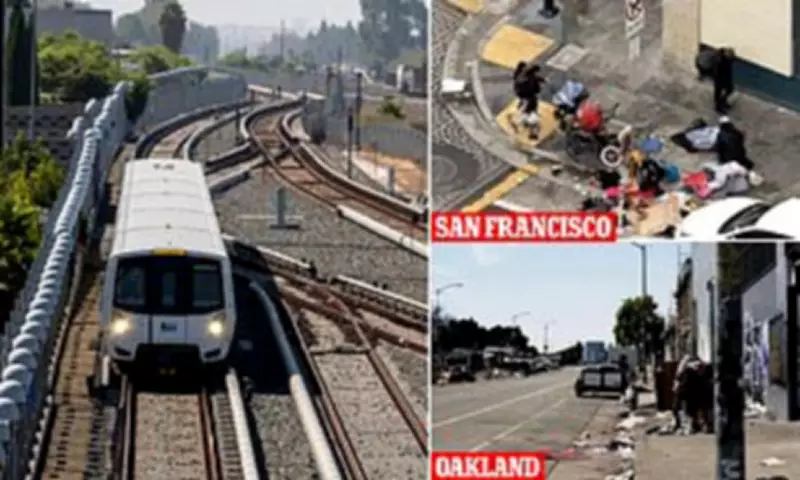
San Francisco's BART rail system is facing the possibility of sweeping station closures and potentially an even wider shutdown, as officials warn the cash-strapped transit agency is running out of money. The Bay Area network, which operates 50 stations across five counties, is confronting a projected budget deficit of roughly $376 million next fiscal year as ridership remains far below pre-pandemic levels and federal relief funding expires.
Emergency Service Plan
Under a proposed emergency service plan, BART could eliminate rail lines, shut down up to 15 stations, slash operating hours, hike fares and lay off more than 1,000 workers if voters fail to approve a new tax measure later this year. However, transit officials have acknowledged that even those painful cuts may not be enough to save the network and stop what some board members have described as a financial 'death spiral' that could ultimately threaten the future of the entire system.
'If at any point BART determines that it can't safely or legally operate with available resources, a full shutdown is still on the table,' the agency's alternative service proposal states.

Post-Pandemic Challenges
The looming meltdown comes as San Francisco continues battling deep post-pandemic problems that have battered the city's economic recovery, including empty office towers, struggling downtown retail corridors, rampant homelessness, open-air drug use and persistent concerns over crime and public safety. Ridership on BART has never fully recovered after the pandemic emptied office buildings and accelerated remote work, leaving the transit agency dependent on a shrinking pool of commuters.
Impact on Commuters
For hundreds of thousands of commuters, students and workers who built their lives around the train system, the warning has come as a huge shock. Emily Yarrington, a UC Law San Francisco student, said access to BART shaped nearly every major decision her family made in recent years. Five days a week, Yarrington walks from her apartment near the Dublin/Pleasanton station, boards a train and rides roughly an hour into San Francisco for classes. She said she specifically chose housing beside the station because it allowed her family to survive financially while she pursued law school on a single income.
'The fact that we knew that building was within a three-minute walk of BART was a huge selling point,' Yarrington said to the San Francisco Standard. Now she fears the transit system underpinning her daily life could begin unraveling around her. 'You're cutting yourself off from the world if you're not going to have a good transit system,' she said. 'I think it would be very heartbreaking for the community to lose this amenity.'
Transit-Oriented Developments at Risk
For years, state leaders aggressively pushed so-called transit-oriented developments with dense apartment complexes and housing projects clustered around rail stations as a solution to congestion, pollution and soaring housing costs. Developers marketed proximity to BART as a luxury feature. Cities approved sprawling residential projects designed around the assumption that trains would remain reliable and permanent. Now many of those same residents are discovering the transit lifeline they depended on may no longer exist.
Financial Details
The financial emergency facing BART is staggering. Without a new funding stream, the agency has warned it will be legally required to make massive cuts to balance its books. In a statement provided to the Daily Mail, BART said: 'BART faces a budget deficit of $376 million for the next fiscal year. The BART Board has initially approved an Alternative Service Plan if no new funds become available to BART.' The agency stressed that the earliest any cuts would begin would be January 2027 and noted that voters may still approve a transportation funding measure on the November 2026 ballot.

'We are required to balance our budget,' BART said. Headquartered in Oakland, BART serves five counties under the authority of an elected board. Under the 'alternative service plan,' riders could face the elimination of the Red and Green rail lines, trains stopping service at 9pm and dramatically reduced frequencies with trains arriving only every 30 minutes. Fares and parking costs would jump 30 percent. Hundreds of workers including maintenance crews, cleaners and police personnel could lose their jobs.
Beginning in July 2027, BART could shutter as many as 15 stations if the board signs off on the closures. Another round of fare hikes would follow, alongside hundreds more layoffs. There is the possibility that station closures and cuts could trigger a financial 'death spiral' that ultimately destroys the entire system. A death spiral refers to a cycle in which cuts to service lead to declines in ridership, which decreases fare revenue, which necessitates more cuts, which leads to even fewer riders and steeper declines in revenue.
Board Members Acknowledge Danger
BART board members themselves have openly acknowledged the danger. Director Victor Flores warned that service cuts could scare away riders, causing revenue to plunge even further. 'There is no guarantee that if we get to the point where we have to close stations, that we will achieve a balanced budget,' Flores said. BART board Vice President Edward Wright delivered an even bleaker assessment. 'From my perspective, whether stations close in January or July is beside the point,' Wright said. 'Without a new funding model, we cannot balance our budget in any way that is sustainable, and we cannot cut our way out of this crisis.'
Residents Rattled
The warnings have rattled residents who deliberately moved near BART stations to avoid dependence on cars in the notoriously traffic-clogged Bay Area. Melissa Lopez, a transportation engineer who lives near the South San Francisco station, said she may ultimately be forced to uproot her entire life if the rail system deteriorates. She currently commutes to Oakland by train and worries that driving would expose her vehicle to break-ins while dramatically increasing costs and stress.
'It's just really a shocker, because I feel like California needs better public transportation in general,' Lopez said. 'It just wouldn't be ideal.' The plan initially approved by the BART Board doesn’t name which stations would close. It will be up to the BART Board to decide at a later date which stations to close should it become necessary.
For some commuters, the issue goes beyond convenience. Tanner Firlotte, who works at San Francisco International Airport, said he intentionally moved closer to a BART station because he fears driving after surviving a catastrophic crash in Washington state in 2011 that left him in a coma for weeks. He now relies heavily on the train network and says losing stations or enduring massive fare increases would push many commuters back onto already overcrowded highways.
'It would really suck to move and then immediately have them close the station,' Firlotte said. 'I literally moved here a year ago just so I could get this BART ride.' 'If you can get eight people off the road, that's eight people off the bridge,' he added. 'Why would we not do that?'
Others say the financial math of commuting without BART is brutal. Nathan Arza, a software engineer who works in San Francisco, said commuting by car would cost him vastly more once bridge tolls, gas and downtown parking are factored in. 'It would be really difficult for my commute,' he said.
Traffic Impacts
BART projections show that if the rail system were to stop operating entirely, traffic on the Bay Bridge during peak morning hours could surge by 73 percent, while congestion through the Caldecott Tunnel could rise by 22 percent. The agency estimates drivers could spend an additional 19 hours per year stuck behind the wheel.