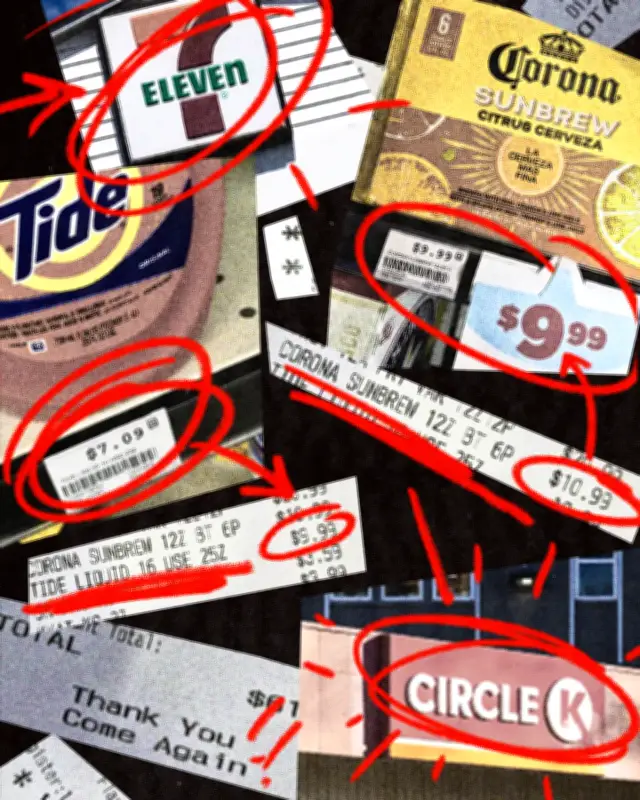
America's two biggest convenience-store chains, 7-Eleven and Circle K, routinely charge customers more than the shelf prices for snacks, beverages, toiletries, tobacco and medications, a Guardian investigation has found. Between 2023 and 2025, Circle K locations failed 35% of their government price-accuracy inspections in Florida, 62% in North Carolina and 82% in Columbus, Ohio. Over the same period, its larger rival, 7-Eleven, flunked 47% of inspections in both Colorado and Utah and 79% in Ontario county in upstate New York.
In some cases, inspections turn up multiple overcharges in a single sample. This February at a 7-Eleven in Casa Grande, Arizona, a state inspection found that 12 out of the 25 items rang up higher at checkout than what was listed on the shelf – a 48% error rate. These included a 10-cent bump on dill-flavored Pickle Bites and a 40-cent bump on a KitKat bar. A “mega pack” of Wrigley’s watermelon gum, priced at $3.99 on the shelf, came up as $4.99 at the cash register.
Consumer complaints
Marco Cruz, a 29-year-old from Casa Grande, pulled off a four-lane road into the parking lot of a Circle K convenience store in McAllen, Texas, 12 miles north of the US-Mexico border, on a mild November night in 2025. He grabbed a pack of beef and jalapeño cheese sticks from the shelf, where they were priced at $3.99. At the counter, though, they rang up at $4.19. Cruz asked the cashier to charge him the lower shelf price. The employee refused, he said, and threatened to call the police when Cruz grew more insistent. “All I’m asking you is honor the price,” Cruz told the attendant before leaving the store and, later, filing a complaint with the Texas attorney general.
Cruz said he had run into similar issues at convenience stores at least five times in just six months. Earlier that day, he tried to buy two bottles of water at the same Circle K after seeing an in-store promotion offering a free energy drink with any such purchase. At the register, he said, the manager told him the offer was no longer valid.
These kinds of overcharges – inside convenience stores and outside at their fuel pumps – put added stress on family budgets already burdened by years of high inflation. As tariffs, war in the Middle East and other economic turmoil have helped drive up prices for groceries, fuel and other products, consumers are not inclined to overlook even the smallest overcharge. “We expect to pay what we see on the shelf,” Cruz said, “even if that already doesn’t seem like a good deal.”
Company responses
Circle K and 7-Eleven declined interview requests and did not answer detailed lists of questions from the Guardian. Instead, both provided brief statements. “Delivering value and maintaining trust amongst our customers is a top priority and we take pricing accuracy very seriously,” a spokesperson for 7-Eleven said. A spokesperson for Circle K said that the company is “committed to complying with all applicable laws and regulations” and that the chain’s mission “is to make our customers’ lives a little easier every day, so their satisfaction is a top priority. We take customer concerns seriously and are always working to improve their experience in our stores.”
David Friedman, a legal scholar at Oregon’s Willamette University who has written extensively about deceptive pricing in the American marketplace, says major merchants have no excuse for charging customers more than the prices they promise on shelves and gasoline signs, especially given how advanced their inventory management tools have become. “It strains credibility for them to say, ‘Well, we’ve invested in all these sophisticated systems,’” but they’re “not really capable” of ensuring that all prices are correct, he said.
Complaints by Cruz and other convenience-store shoppers about overcharges come at a time of consumer anger about how big companies treat their customers. In a 2024 poll by Navigator Research, 72% of respondents agreed that big corporations are pocketing large sums by “overcharging American consumers”.
Industry-wide problem
Convenience stores are the worst offenders among all retailers in the US, according to a 2024 report by the National Council on Weights and Measures. They failed 34% of price-accuracy inspections by regulators in 26 states, followed by dollar stores (29%) and auto parts stores (27%), the report found. Despite evidence of overcharging at convenience stores, most government authorities are not paying attention. Many states give low priority to inspecting convenience stores – responding only to consumer complaints in some cases – and instead focus their inspections on grocery and big-box stores. Others, including Illinois, South Carolina and Wyoming, perform no retail price-accuracy inspections at all.
Texas is home to 16,500 convenience stores – more than any other state – but Lone Star state officials rarely inspect them. Though the Guardian accessed 51 price-disparity complaints against 7-Eleven and Circle K stores that consumers filed with Texas authorities between 2023 and 2025, the state’s agriculture department conducted just 32 inspections at the two chains during that period. Texas officials did not respond to the Guardian’s requests for comment. But even regulators in states that do inspect convenience stores say their resources are limited. “We have very few bodies to check a whole lot of stuff,” said Mike Brooks, program administrator for Arizona’s office of weights and measures. “So we do the best we can.”
Brooks oversees 14 inspectors who are responsible for monitoring every retail outlet across the state’s 114,000 sq miles. Between 2023 and 2025, Circle K failed 39% of its 739 Arizona inspections and 7-Eleven failed 41% of its 151 inspections there. Miland Kofford, the weights and measures project manager for Utah’s department of agriculture and food, said that in many cases overcharges are caused by suppliers, rather than in-store employees – a harried vendor for, say, Coca-Cola or Frito-Lay might stock the products on shelves and affix them with vendor-generated sale tags but then fail to update them on later visits. Stores are sometimes too understaffed to catch these vendor errors. In the end, Kofford said, “the store is still responsible, regardless of who put the price up”.
Customer experiences
Convenience stores and their signature products – including 7-Eleven’s Slurpees and Circle K’s Polar Pops – are inescapable fixtures of the American landscape. As much as 57% of the population shops at these quick-in, quick-out retailers at least once a week, according to a 2025 study by the National Association of Convenience Stores. 7-Eleven, based in Irving, Texas, operates more than 12,000 stores across the country. Circle K, the nation’s second-largest convenience-store chain, with roughly 7,300 outlets in 48 states, also has roots in Texas.
The Guardian examined 153 consumer complaints alleging overcharges at Circle Ks and 7-Elevens across 17 states. Nearly half focused on overcharges on purchases of candy, food, drinks and other items within the stores. The rest cited overcharges on gasoline – reporting that stores displayed lower prices on their big outdoor signs than what was being charged at the pumps. Many shoppers’ complaints accuse the two chains of deceptive business practices and “bait-and-switch” pricing tactics. “These places count on distracted, hurried, desperate customers who are already in line to pay whatever prices are presented at the register,” wrote Joe Lunsford, a 7-Eleven shopper in Virginia, in a complaint to his state’s attorney general. “The operators and clerks make it seem like you are out of place to challenge a price off by pennies, and I agree I felt a little ridiculous, but these small ‘pricing errors’ add up in their favor at the end of the day and harm consumers.”
Often, the two retailers’ customers are families and individuals struggling with their day-to-day finances. Though different chains appeal to different demographics, 7-Eleven and Circle K compete in the “low-income tier”, according to a 2026 report by the market research company Morning Consult. “Convenience stores are often used by a lot of shift workers, blue-collar workers, seniors and people that have limited transportation options,” a finance staffer for a Circle K vendor in Ohio told the Guardian, speaking on the condition that her name not be used. “The people who can least afford being overcharged are the ones paying the price.”
In California, home to an estimated 15% of all US 7-Eleven stores, regulators have found that price can be steep. Between 2023 and 2025, 7-Eleven stores in Los Angeles county flunked 335 out of 909 price-accuracy inspections – a failure rate of 37%. One inspector there noted a 67% overcharge rate at a 7-Eleven in Huntington Park on a Wednesday in 2024, and the next day recorded a 50% overcharge rate at a location in North Hollywood, 19 miles away. A Pomona store failed four times, including during a 2025 inspection in which five out of 13 items rang up higher than their shelf prices. An energy drink supposed to cost $1 with a rewards card came up as $3.49 at the register. A tropical fruit-flavored snack priced at $1 rang up at $2.89, and a $2.29 Hershey’s Mr Goodbar at $3.49.
In July, a Guardian reporter visited 10 7-Eleven stores in Los Angeles county that had previously failed price-accuracy inspections, including the North Hollywood and Pomona locations. The reporter bought batches of 10 items at each of the 10 locations. Half of these shopping tests resulted in overcharges. The Pomona store, for example, failed to honor a two-for-$5 discount on Quest protein chips. The North Hollywood location rang up overcharges on five items. At the Pomona 7-Eleven, an employee said a phone number was needed, even though that was not specified anywhere on the sticker price. At a 7-Eleven in Highland Park, a manager blamed a night shift worker for not updating shelf prices. Workers at all five stores that overcharged the reporter acknowledged that the sticker prices were out of date, and that employees could not always keep up with updating thousands of individual items’ prices. “It’s not about overcharging or something like that,” an employee at the North Hollywood 7-Eleven said, asking that he not be named out of fear of getting in trouble with management. He said that workers are already expected to run registers, clean stores, manage deliveries and stock shelves, and that it sometimes takes the store two weeks to update stickers after the company issues new prices.
Gas price discrepancies
Convenience stores sell roughly 80% of the gasoline purchased in the US, according to industry data. But government price-accuracy inspections of retail stores typically cover in-store items, not gasoline. As fuel prices have surged – hitting an all-time Labor Day record of $4.15 a gallon this month for regular gas – car and truck owners don’t take inaccurate price listings lightly. One evening in March, Rachel Hays, a 50-year-old veterinarian and single mom who hunts deer and wild boar on a ranch east of Austin, Texas, stopped at a 7-Eleven near her home after noticing its large sign advertising diesel at $4.199 a gallon. “I was so happy because I was like, ‘$4.19, that’s a great price,’” said Hays. She planned to fill her Ford truck’s 34-gallon tank but noticed the price on the pump read $4.499. “The lone employee in the store made no attempt to change the price on the sign,” Hays wrote in a complaint to state authorities. “This has happened multiple times at this particular gas station.” Driving by the following day, Hays saw that the prices still had not been aligned. “I pay a lot of attention,” she said in a June interview. “I mean, it costs me 150 bucks to fill up my truck.”
In several complaints, consumers accused the stores of using false gas prices as a way to lure shoppers inside. Indeed, more than half of customers who stop for gas go inside to make purchases, according to the industry’s trade association. The Circle K vendor in Ohio said that when she stops for gas at her local Circle K, she often lets her seven-year-old go inside to pick out a treat. But pricing disparities have become the norm. “They would have old sale tickets up that said two for $5 and then the promotion had ended,” she said. “I saw it on the candy. I saw it on energy drinks. Everything was just consistently mislabeled.”
In its statement, Circle K said “pricing discrepancies can sometimes occur between shelf labels and point-of-sale systems, resulting in either an undercharge or overcharge at the register”. When this occurs, the company said, it works “quickly to support our store teams to correct any unintentional pricing errors and ensure prices are accurately reflected across our products and offers”.
Repeat violations
Last year, a state inspector in North Carolina named Tripp Foltz responded to a complaint that the pump price at a Circle K in Hillsborough was significantly higher than the road-facing sign. The sign said $3.459 for cash or credit. The pump said $3.799. After Foltz explained the situation to the manager, she fixed the problem. But when he returned twice more over the next couple of weeks, he noted two more overcharges – 14 cents and then 24 cents a gallon. His agency imposed a $500 penalty. Weeks later, another consumer complaint prompted a return visit. Foltz recorded another 14-cent overcharge. Because of limited staffing, North Carolina only inspects in-store pricing at convenience stores when it receives complaints. Of the 28 failed Circle K inspections between 2023 and 2025, 16 were follow-ups from previous failures. One store in Kernersville failed five times in a row.
Repeat pricing violations are also common at other types of retail stores, the Guardian’s reporting has shown. Even wide-ranging investigations and millions of dollars in fines often do not stop big companies from charging customers more than their posted prices. In 2021, state and local prosecutors in California informed Carquest Auto Parts that their investigation had found that the chain’s stores across the state were routinely overcharging customers. Despite the warning, the problem got worse, authorities claimed in a lawsuit. At one point, the suit said, Carquest stores flunked 39 of 43 price inspections across 20 counties, overcharging on 23% of the items pulled by inspectors. The chain paid $750,000 in 2024 to settle the case. In another example, Walmart agreed to stop overcharging customers in a 2008 settlement with California officials, then paid $2.1m in 2012 to settle claims that it had violated that deal by continuing to ring up higher-than-posted prices at checkout. In August 2025, it agreed to pay state authorities another $5.6m to address claims it had once again overcharged customers at checkout as well as selling produce and other groceries with less weight than promised on the label. Carquest and Walmart did not reply to questions from the Guardian about these settlements.
Friedman, the law professor, said that making real progress against rip-offs at checkout counters will require a national commitment. “There are a lot of people who get speeding tickets and the next day they’re speeding again,” he said. “Unless you have the Federal Trade Commission or state attorneys general stepping in aggressively and repeatedly as a strategy and saying, ‘We are going to litigate against all of the retailers that do this, and we’re going to do it on a broad scale,’ the practices are going to continue.”
Consumer frustration
On a Monday evening in August 2024, Alexander Stout, a 43-year-old retired military reservist who lives with five dogs on a six-acre ranch in Somerset, Texas, pulled his Dodge truck into his local 7-Eleven. He had spotted a roadside sign touting regular fuel at $2.859 a gallon. In an email to his state’s department of licensing and regulation, Stout explained that he discovered the price on the pump read $2.999. He offered to share a video of the 14-cent disparity with the agency. “This gas station has done this before,” Stout wrote. Three months later, he got an email informing him the case had been closed for “insufficient evidence”. An agency attorney said he had tried to contact Stout and indicated that, having performed an on-site inspection and determined the marquee had not been “operational”, he “did not feel it was warranted to move forward to a penalty”.
“This closing letter is a joke,” wrote Stout, who says his phone did not register any calls, texts or emails from the state at the time. “Imagine my frustration to do something right and this is how investigations are handled. I’m pissed about this because you keep screwing people over. Fourteen cents doesn’t seem like a lot,” he added, but “for somebody who’s already hurting” that 14 cents could add up to “a meal their kids miss”. During a June visit to the Somerset 7-Eleven where Stout spotted the overcharge, a Guardian reporter brought two 14-ounce bottles of 7-Select cold-pressed juice advertised on the shelf at “2 for $6” to the counter only to have them ring up at $7.78. Presented with the discrepancy, the cashier counted out a $1.78 refund, suggesting that the sale had probably ended but “we just haven’t removed the sign yet”. In fact, the fine print on the sign indicated that the offer was valid for another three weeks.