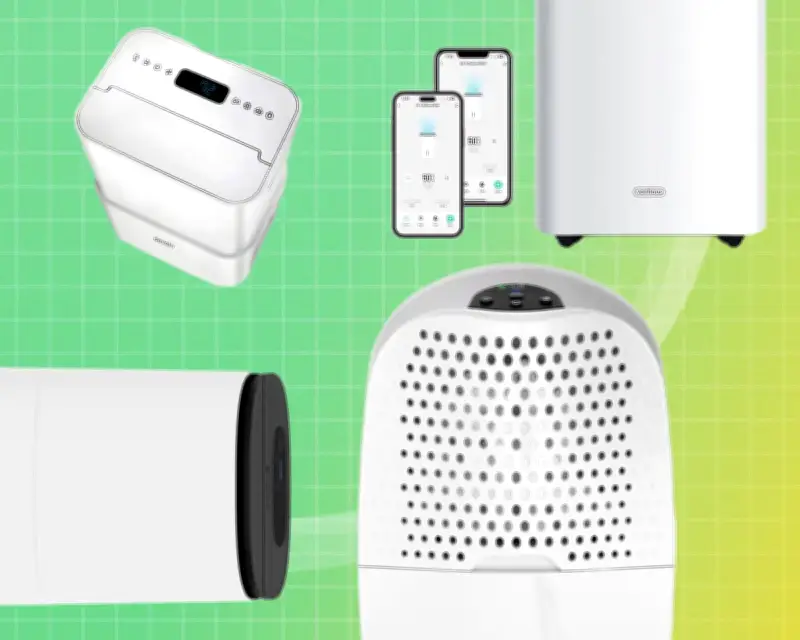
Fourteen dehumidifiers from leading brands were tested to find the best models for tackling damp, mould, and musty smells, as well as for drying laundry more cheaply than a tumble dryer. The overall winner was the Ebac 4650e, priced from £309.99, which impressed with its performance, smart controls, and four-year warranty.
Why use a dehumidifier?
At home, everyday activities such as breathing, cooking, and showering increase humidity. When the air becomes too humid, it can harm both health and the home: moisture allows mould and dust mites to flourish, which in turn can trigger asthma and allergies.
A dehumidifier reduces the amount of moisture in the air, making the indoor environment more comfortable. It is also an effective laundry-drying method, costing a fraction of a tumble dryer. For those unsure whether they need one, a cheap hygrometer – the one used in testing cost less than £10 – can check a home's relative humidity and help make an informed decision.
How the dehumidifiers were tested
Each dehumidifier was set up and used for several days. A power meter measured electricity use, and the Sound Meter app measured noise from 1m away in decibels (dB) on multiple occasions. The figures featured are those measured at home in consistent conditions, so they often differ from manufacturers' official figures, which are measured in lab conditions in inconsistent ways. The quality of the sound was also assessed, along with each unit's size.
A digital hygrometer held 1m away measured the room's humidity, and a thermometer checked the temperature. The amount of water extracted into the tank was measured using a jug. Because conditions vary from moment to moment and room to room, it was impossible to test each unit in precisely the same conditions, so results from these not-so-scientific tests are only mentioned when they stood out.
After testing, any dehumidifiers not collected by manufacturers were donated to Furnishing Futures, a charity that fully furnishes the empty social housing in which women and children are placed after surviving domestic abuse.
Best dehumidifier overall: Ebac 4650e
The Ebac 4650e, priced from £309.99, is the priciest dehumidifier on test, but it is worth the money. It is large but luggable, with a single deep handle on the rear that makes it easy to carry and an integrated cable tidy on the back for storage.
A flap at the front opens to reveal a black water tank that is easy to empty, with water coming out of just one hole. The small display is colourful, and there is a good range of modes, including laundry. A smart control feature remembers the home's humidity levels and kicks in only when levels start to rise: in a home without major damp problems, this saves a lot of electricity. It can be controlled via an app and comes with an activated carbon filter for removing unwanted smells.
Performance was good, bringing relative humidity down by 4% in a short time. The sound was inoffensive, and it is pretty energy efficient. It is made in north-east England, so its carbon footprint is lower than some other models, and it comes with a four-year warranty if bought directly from the brand. The only downside is there is no window to inspect the fill level.
Dimensions: 34 x 27 x 54cm (WDH); daily extraction rate: 18l; tank capacity: 3.5l; peak power use on test: 180W; average noise level on top setting: 10dB; target humidity range: 35-80%; laundry setting? Yes; running costs: 5p/hour.
Best budget dehumidifier: VonHaus smart dehumidifier with laundry mode
At the time of writing, a discount brings the VonHaus smart dehumidifier's price down to less than £150. Even at full price, it is a bargain. Alongside a laundry mode, a sleep mode brings volume levels down from an already quiet 15dB to 10dB by slowing the fan speed, and it turns off the screen so the lights won't disturb you.
Other modes include auto, which turns the machine off when it reaches the target relative humidity, and continuous, which means it won't turn off until the tank is full. An app lets you control it from your phone or with Google Home or Amazon Alexa. Simple coloured lights on the front give a visual indicator of what mode it is in.
On test, it started cutting humidity levels within minutes, and over a couple of hours, it brought relative humidity down by at least 5%, pulling 450ml of water out of the air. It is good for drying laundry and tackling damp – the only corner cut, when compared with pricier models, is Hepa air filtration. It only has a washable dust filter, not Hepa air purification, even though there looks to be enough room for a larger filter.
Dimensions: 31 x 24 x 49cm (WDH); daily extraction rate: 20l; tank capacity: 4.5l; peak power use on test: 290W; average noise level on top setting: 15dB; target humidity range: 30-80%; laundry setting? Yes; running costs: 8p/hour.
Best combined dehumidifier and air purifier: Devola Platinum hybrid DVHA20L
The Devola Platinum hybrid DVHA20L, priced from £161.99, promises cleaner as well as drier air. It comes with a Hepa filter (for filtering the air), an ioniser (for pulling dust out of the air), and an ultraviolet lamp (for killing germs). Several models on test come with Hepa filters, but what sets this model apart is that it measures air quality too: simply press a button to get a traffic light measure of PM2.5 particles (green, blue or red light, depending on air quality).
Dehumidifier modes include laundry and night (quieter at 20dB), and the flap on the top is motorised, so it opens automatically and can be set to “swing” to circulate air. The water tank is accessed from the side and its handle doubles as a visual level indicator, and the tank is easy to empty without making a mess.
The downsides are that it is not quieter, and Hepa filters will need replacing periodically (Devola suggests every six months, so budget about £15 a year).
Dimensions: 36 x 27 x 57cm (WDH); daily extraction rate: 20l; tank capacity: 2.9l; peak power use on test: 330W; average noise level on top setting: 30dB; target humidity range: 40-80%; laundry setting? Yes; running costs: 9p/hour.
Best dehumidifier for drying laundry: Duux Bora Smart
The Duux Bora Smart, priced from £279.99, is a good-looking dehumidifier with clean lines. The water drawer at the front has a useful visual indicator, so you can see at a glance how full it is. It features wifi and app control so that you can set schedules, and an activated carbon filter works to remove odours, gases and smoke.
The four-hour laundry mode reduced relative humidity by 5% in the first five minutes, swiftly drying clothes. The Duux is Quiet Mark certified for its ultra-quiet operation. The night mode turns off the lights, and in tests it reached an impressively low average of below 10dB, much quieter than the manufacturer's claims. It sounds like a fan with a little bit of fridge sound thrown in, but quieter.
It also uses the environmentally friendly R290 refrigerant, which has a low global warming potential (GWP). In fact, its GWP is only triple that of carbon dioxide, while some refrigerants have a GWP that's hundreds of times that of CO2 (and some refrigerants now banned from sale have GWPs of thousands). It doesn't offer Hepa air purification at this price.
Dimensions: 32 x 24 x 51cm (WDH); daily extraction rate: 20l; tank capacity: 4l; peak power use on test: 270W; average noise level on top setting: 20dB; target humidity range: 30-80%; laundry setting? Yes; running costs: 7p/hour.
Best quiet dehumidifier: MeacoDry Arete Two
The MeacoDry Arete Two, priced from £299, is not just a dehumidifier – it also purifies the air, thanks to the included dust and medical-grade H13 Hepa filters. It can be controlled via a smartphone app or voice control via Google Home or Amazon Alexa. Modes include continuous, smart (which aims for a middle-of-the-road 55% humidity) and laundry. The louvre on top opens manually and can be directed at your washing.
Its display is slightly unusual: rather than a number, it shows a sliding scale of humidity levels, giving a clear visual indication of the current humidity and your target. The interface is intuitive, and there aren't too many buttons. The five-year warranty is the longest seen for a dehumidifier.
The average noise was just 5dB, dropping to 4dB (considerably quieter than the manufacturer's claimed noise level) in night mode. If you leave it plugged in but not switched on, it will say “wet” on screen to alert you when it detects a relative humidity of 70% plus. You can also choose your type of air filtration when you buy refills (£39.99 for a pack of three). Replace the Hepa filter if you have allergies or pets; swap for an activated charcoal filter if you'd prefer to remove cooking smells, smoke and VOCs (chemicals that come off new furniture, paint, carpets and so on). The louvre isn't motorised, considering the price.
Dimensions: 37 x 27 x 62cm (WDH); daily extraction rate: 20l; tank capacity: 4.8l; peak power use on test: 230W; average noise level on top setting: 5dB; target humidity range: 40-70%; laundry setting? Yes; running costs: 6p/hour.
Best compact dehumidifier: Devola DVH12L
The Devola DVH12L, priced from £135.99, extracted the most water from the air when compared with the other smaller (12-litre capacity) models on test. It removed 200ml, reducing relative humidity by 5% in a short time. Performance is impressive for a small dehumidifier, especially considering it comes with a Hepa filter for air purification, which is bound to slow airflow for dehumidification.
It was pretty quiet and sounded like a fan, and you could definitely sleep through its 5dB on low fan mode. The rear tank doesn't have a visual indicator, so you can't tell how full it is without pulling it out. For only a little more, you can buy the larger Devola DVHA20L, which features a built-in PM2.5 air quality monitor.
Dimensions: 30 x 23 x 47cm (WDH); daily extraction rate: 12l; tank capacity: 2.7l; peak power use on test: 180W; average noise level on top setting: 10dB; target humidity range: 30-80%; laundry setting? Yes; running costs: 5p/hour.
The best of the rest
Swan low-energy dehumidifier (from £139) – Best for looks. The Swan's design is as elegant as its feathery namesake, and it's a contender for best bargain when reduced. It didn't make the final cut because the powerful upwards fan and motorised flap make it great for drying laundry, but there's no laundry mode, and the minimum target for relative humidity is 40% (many models go down to 30%, and laundry mode is invariably 35% with a timer). You can still dry laundry by choosing 40% and setting a timer, but it seems like an oversight. Dimensions: 33 x 22 x 57cm (WDH); daily extraction rate: 20l; tank capacity: 4l; peak power use on test: 330W; average noise level on top setting: 30dB; target humidity range: 40-80%; laundry setting? No; running costs: 9p/hour.
Meaco DD8L (from £169.98) – Best for a garage or shed. This is a desiccant dehumidifier, rather than a condenser dehumidifier like the others. As such, it uses more electricity but can be used in colder spaces, operating as low as 1C. It features an ioniser that helps cut airborne dust, and it's compact, light and easy to carry. On test, it performed well, cutting relative humidity by 10% but raising the temperature slightly. It didn't make the final cut because it uses twice as much electricity as condenser dehumidifiers, so it wouldn't be used in the home, and it doesn't display the humidity level. Dimensions: 36 x 20 x 55cm (WDH); daily extraction rate: 8l; tank capacity: 2l; peak power use on test: 690W; average noise level on top setting: 40dB; target humidity range: 40-60%; laundry setting? Yes; running costs: 18p/hour.
ProBreeze dehumidifier with max extraction and laundry mode (from £149.99) – Best for powerful drying. At the time of this page update, the ProBreeze website had a discount code that brought the price down by £40. In tests, it extracted moisture powerfully, bringing relative humidity down by more than 10% in a couple of hours. For £50 extra, you can get a version with smart app control. It didn't make the final cut because it uses quite a lot of electricity, even on low power mode, and although it was fairly quiet (15dB on low fan mode), there was an annoying low hum as well as the fan noise. Dimensions: 32 x 20 x 58cm (WDH); daily extraction rate: 20l; tank capacity: 5.5l; peak power use on test: 360W; average noise level on top setting: 20dB; target humidity range: 30-80%; laundry setting? Yes; running costs: 9p/hour.
Devola DV12L (from £106.99) – Best for clever design. The little notch at the top of the rear water tank means that, when dry, you can stow the power cable in there, making this an easy machine to store. A light-up ring on the front indicates relative humidity at a glance: green for good, red for too humid, blue for too dry. It didn't make the final cut because the newer Devola DVH12L also has a Hepa filter for air purification. Dimensions: 26 x 22 x 47cm (WDH); daily extraction rate: 12l; tank capacity: 2l; peak power use on test: 180W; average noise level on top setting: 25dB; target humidity range: 30-80%; laundry setting? Yes; running costs: 5p/hour.
Honeywell TP Fit (from £121.22) – Best for the smallest dehumidifier. This was the smallest on test, so it could be worth considering if you only want to use it occasionally and need to stow it away most of the time. The dust filter is washable, and while there's no true sleep mode (there's one that dims the lights, but it doesn't reduce noise), most of the lights turn off after a minute, and it's not too loud. The comfort mode targets a relative humidity based on the temperature, and its front water drawer gives a visual indication. It also uses the environmentally friendly R290 refrigerant. It didn't make the final cut because it didn't reduce humidity as much as some, collecting just 150ml overnight, and unusually, some water was spilled when carrying it after testing. Dimensions: 28 x 24 x 39cm (WDH); daily extraction rate: 12l; tank capacity: 2.5l; peak power use on test: 180W; average noise level on top setting: 20dB; target humidity range: 30-90%; laundry setting? Yes; running costs: 5p/hour.
Meaco 12 LE (from £154.97) – Best for compact air purification. It has excellent features, including top-notch air filtration and a three-year warranty from some retailers. Like its big sibling, the MeacoDry Arete Two, it purifies the air thanks to an included medical-grade H13 Hepa filter and dust filter. The Hepa filter is optional, and it will need replacing (about every three months) if you want to use it. Budget £40 a year for refills. It didn't make the final cut because you can't see whether the air purification is working, and for only a little more, you can buy the larger Devola DVHA20L, which features a built-in PM2.5 air quality monitor. The green and white looks were also found a bit clinical. Dimensions: 32 x 24 x 49cm (WDH); daily extraction rate: 12l; tank capacity: 2.5l; peak power use on test: 200W; average noise level on top setting: 20dB; target humidity range: 30-80%; laundry setting? Yes; running costs: 5p/hour.
Blyss Madden WDH-316DB (£120) – Best for easy carrying. This has a daily extraction rate of 16 litres, and it has a simple handle across the full width that's well balanced. If you find it difficult to carry heavy items up and down stairs, choose a smaller model like this. The display shows relative humidity and temperature inside a cartoon house, and there's a fan swing function that helps with drying laundry. It didn't make the final cut because there's no sleep function, although it's fairly quiet. Dimensions: 30 x 19 x 47cm (WDH); daily extraction rate: 16l; tank capacity: 2.4l; peak power use on test: 230W; average noise level on top setting: 20dB; target humidity range: 50-70%; laundry setting? Yes; running costs: 6p/hour.
Black+Decker BXEH60014GB (from £174) – Best for smart controls. The Black+Decker has a coloured light at the top that indicates humidity (red for high, green for good, blue for low) and large, white digits on its front that tell you the precise relative humidity. These quick-glance displays work well when paired with the app, so you can control it from afar. You can even add Google Home and Amazon Alexa voice controls, and use your phone as a remote control from anywhere in the home to check on progress – rare for a dehumidifier at this price. It didn't make the final cut because the machine was loud at times (although the sleep setting averaged 17dB). Dimensions: 34 x 24 x 57cm (WDH); daily extraction rate: 20l; tank capacity: 6.5l; peak power use on test: 395W; average noise level on top setting: 20dB; target humidity range: 30-80%; laundry setting? Yes; running costs: 10p/hour.
What you need to know
What is relative humidity? Relative humidity is the percentage of water vapour in the air compared with the maximum that the air can hold. Warm air can hold more water vapour than cold air, so if the amount of water in the air stays the same but the temperature drops, relative humidity increases. When relative humidity hits 100%, the air is fully saturated, and water condenses on surfaces, like how dew condenses on cool morning grass.
What humidity should I aim for? All the dehumidifiers tested here measure relative humidity (a percentage) and let you set a target. If the air is too humid, it feels muggy, and it's hard for sweat to cool you on a hot day. If the air is too dry, it can lead to problems such as dry eyes and throats. For your health and your home, the ideal relative humidity is 40-60% in summer and 30-50% in winter.
Do I need a dehumidifier? You may benefit from a dehumidifier if you have damp and mould problems. Humidity helps mould and dust mites flourish, and they in turn can trigger asthma and allergies. Another benefit is drying laundry fast: use a dehumidifier to pull moisture out of the air, then clothes in the room dry much faster and without causing damp problems such as condensation on windows or walls. Dehumidifiers are also good for specific uses, such as drying paint or plaster faster, or helping a room dry out after flooding. If in doubt, use a cheap hygrometer to check your home's relative humidity.
What are the different types of dehumidifier? Most of the dehumidifiers tested here are compressor dehumidifiers, so they work a bit like a fridge, compressing and then expanding a refrigerant to cool a metal coil. Water from the air then condenses on the coil and drains off into a water tank. These are usually the best style of dehumidifier for the home. Don't throw away the plastic tube if you find one in the box – some models come with a drain hose, so you can constantly dry rather than stopping when the tank is full. Other models let you add a hose if you need it.
One desiccant dehumidifier was tested. These excel in cold environments, such as garages, cellars and outbuildings, because they work by using moisture-absorbing materials that don't rely on temperature to remove humidity. However, they use more electricity to do so. They don't require refills (none of the units featured here needs refills for dehumidification – the only ongoing cost apart from electricity is that some have Hepa air filters that need replacing every three to six months). Peltier dehumidifiers are small and quiet, but they're not very effective, and they use more energy, so none are featured in this roundup.
What size dehumidifier do I need? The larger (20l a day) models tested here are good for larger homes and open-plan spaces. You can put them somewhere central to tackle humidity in the whole home. The smaller (12l a day) models are very popular and better for smaller homes or single tasks, such as drying laundry. However, if you have persistent damp problems, then it could be worth sizing up. You can add a hose to most dehumidifiers if you want to keep them in constant use without having to empty the tank.
How much does a dehumidifier cost to run? Each dehumidifier's power use was measured on the top setting, in watts (W). Electricity costs are in kilowatt hours (kWh). For example, if you're running a 200W dehumidifier for four hours, it would use 800Wh or 0.8kWh. The energy price cap for 1 October to 31 December 2026 is 26.32p a kWh. Multiply this by the last figure, and you'll discover it costs about 21p to run the dehumidifier for four hours. This compares favourably with a tumble dryer. One load in a traditional model uses about 4.5kWh (£1.18), although an energy-saving heat pump model uses half that. Either way, it's much cheaper to run a dehumidifier than either type of tumble dryer.
What's a laundry mode? Many dehumidifiers have a laundry mode that aims for a low relative humidity of 35%, with a timer that turns off automatically, typically after six hours. To dry laundry effectively, hang it in a room, turn on the dehumidifier and close the doors. That way, it's drying the air (and speeding the laundry drying) without having to dry moist air that comes in from the outside world.
How to clean your dehumidifier Empty the water tank after each use, or when it's full. Regular cleaning mainly involves dusting the unit and cleaning the air filters. Dust filters can usually be vacuumed and washed, while paper Hepa filters need replacing. How often depends on use: about three months for continuous use, six months for average use, or annually if you only run it occasionally. Smart models should track usage and alert you when the filter needs changing. If you use your dehumidifier mainly in the winter, then give it a thorough clean before storing it away. Start by running the unit on fan-only mode to dry the interior; if it doesn't have one, set it to its highest humidity setting. Clean the unit and filters, then wash and disinfect the tank with a 50/50 mix of white vinegar and water to help prevent mould. Finally, leave everything to air-dry for at least 24 hours, ensuring it's completely dry before reassembling and packing it away for the summer.
How often should you empty your dehumidifier? A dehumidifier will stop working when its water tank is full, usually signalled by a flashing light, beep or app alert. But it's good practice to empty the tank regularly rather than wait for this to happen. If you run a dehumidifier continuously, don't aim for the driest air possible. Ideally, indoor relative humidity should be 40-60% in summer and 30-50% in winter. How often you need to empty the tank depends on the humidity, how much you use it, and tank capacity. A larger tank means you'll have to empty it less often.
Can dehumidifiers also cool rooms down? No. If anything, a dehumidifier makes a room a little bit warmer while it's running. However, humid air makes sweat evaporate less effectively, so reducing humidity can help you feel cooler on a warm day. This isn't the case on a cold day, when high humidity can make you feel colder, because water vapour conducts heat away from the skin more efficiently than dry air. So getting the relative humidity right year-round improves comfort.