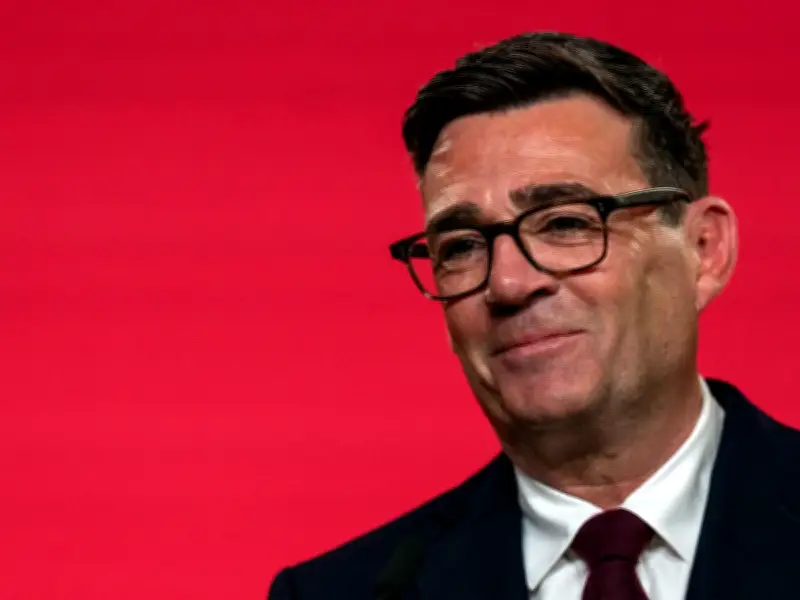
Andy Burnham, who is set to officially become Prime Minister on Monday, has hinted at a major change to the tax-free personal allowance, potentially affecting millions earning above £12,570. The former Greater Manchester mayor took over as Labour Party leader on Friday, July 17, following Sir Keir Starmer's resignation, and will deliver his first speech as Prime Minister on Monday afternoon.
Burnham's Pledge for a New Politics
In his first speech as party leader, Burnham declared that Labour had a 'last chance to change' and pledged to 'build a new politics' that is 'distinctively Labour' rather than 'wearing too many Tory clothes.' He argued that the country took 'a series of wrong turns in the 1980s' and 'needs a new path' to create an economy that works for all people and places.
Burnham emphasized his commitment to representing the entire UK: "I will be a leader for the north, the south, the east and the west, plus Scotland, Wales and for Northern Ireland." He acknowledged that the north of England had given him everything, but now he would do the same for everywhere, seeing similar challenges across the country.
Hint at Raising Personal Allowance
Burnham has hinted at raising the personal allowance, currently frozen at £12,570 for five years, as a way to offer relief for the cost of living. In an interview with The Times, he said the freeze was 'the thing I heard the most on the doorsteps' during the Makerfield by-election campaign. He added: "So when people, they're just characterising me as a tax raiser, well again it's never that simplistic is it? The breathing space point is a really serious one. How do we just make people feel better?"
The standard personal allowance is £12,570, meaning income below this threshold is tax-free. Burnham's comments suggest he may consider increasing this amount to ease financial pressures on households.
Sticking to Manifesto but Open to Tax Moves
Burnham said he plans to 'stick by' Labour's 2024 general election manifesto, which promised not to increase taxes on 'working people,' including National Insurance, income tax, and VAT. However, he suggested there is 'some room' for 'movement on tax.' In an interview with Andrew Marr on LBC, he stated: "I stick by the manifesto and the promises that it made. So, let me be absolutely clear about that, but there is some room within that manifesto for movement on tax."
He proposed higher business rates on warehouses and major developments on city outskirts to cut business rates for pubs, and lifting some high street businesses out of business rates altogether. He also declined to rule out a wealth tax, indicating the government 'might be having to ask for a little more' to balance Britain's books, but needed time to assess public finances first.
Cost of Living and Public Control
On the cost of living, Burnham said Britain was 'paying too much for the basics.' He outlined plans for more public control over water, energy, and transport to reduce bills and fares, giving people and businesses 'breathing space.' He stressed: "Britain needs more breathing space … We do need to be serious about putting more money back into people's pockets."